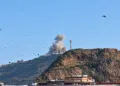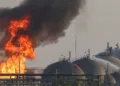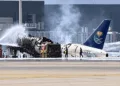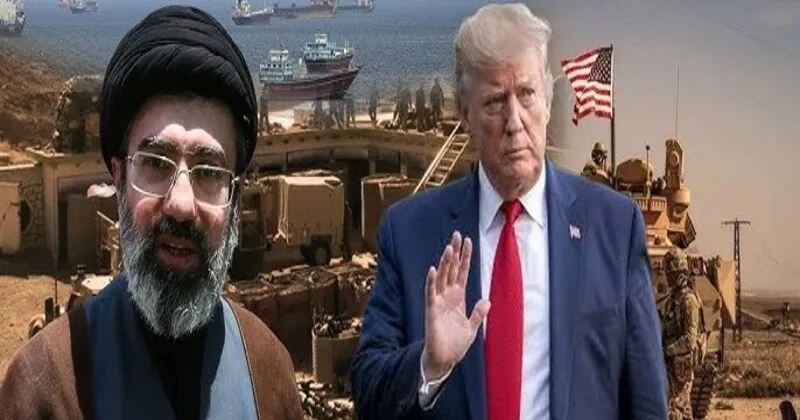
In twelve hours on February 28, 2026, American and Israeli forces struck Iran nearly nine hundred times, killing Supreme Leader Ali Khamenei within minutes of the opening salvo. Four months later, President Trump signed the Islamabad Memorandum — a 14-point framework ending 109 days of warfare estimated to have cost between $34 billion and $42 billion (CSIS, 2026). Yet Iran’s ballistic missile arsenal remained largely intact, its nuclear programme deferred rather than dismantled, its proxy network unaddressed, and Tehran set to recover some $24–25 billion in frozen assets (CNN, 2026). The gap between battlefield dominance and political outcome revives an old American anxiety: did Operation Epic Fury compress, into four months, the error Washington spent a decade learning in Vietnam — that firepower is no substitute for a workable political objective? The two wars are not comparable in scale, but beneath the difference in casualties and duration sits a recognisable pathology: coercion without a clear endstate, producing tactical victories that left the strategic position weaker than before the first bomb fell.
When military success masks strategic failure
Operation Epic Fury commenced with nearly 900 strikes in twelve hours, targeting Iran’s military leadership, missiles, air defences, and naval infrastructure. The Congressional Research Service placed first-week costs at more than $11.3 billion; CSIS estimated total war expenditure at $34–42 billion, with approximately 40 percent of US surface warfare ships deployed to the theatre — a concentration of force without modern precedent in the region (CRS, 2026; CSIS, 2026). The tactical results were considerable: Iran’s conventional navy was dramatically degraded. Yet the war’s objectives kept shifting — from nuclear disarmament to missile destruction to proxy neutralisation, and ultimately to a ceasefire addressing none of these aims comprehensively. CSIS analyst Mark Cancian identified the core problem in March 2026: the administration had described target sets rather than a coherent strategy, and “just destruction is not the strategy.” That observation applies with equal force to Vietnam, where military supremacy — 7.7 million tonnes of ordnance and 543,000 troops at peak — never translated into political settlement.
The Vietnam Parallel — And where it breaks down
The differences demand candour. Vietnam consumed two decades, 58,220 American lives and deployments peaking at 543,000 troops; the Iran campaign lasted 109 days with single-digit American fatalities and no ground occupation. Not every strategic setback becomes a Vietnam-scale quagmire, and the comparison collapses if pressed carelessly.
What makes the parallel analytically durable is structural. In Vietnam, American objectives drifted from containing communism to propping up Saigon to managing an exit — a drift Congress enabled for nine years under the 1964 Gulf of Tonkin Resolution. In Iran, the stated goal shifted within weeks from regime change to nuclear rollback to simply reopening the Strait of Hormuz, with Congress never voting to authorise the campaign; a Senate war-powers resolution was voted down on 25 June 2026.
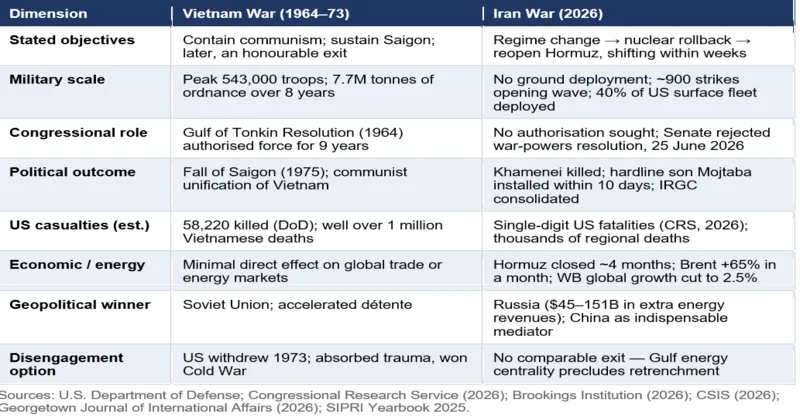
Both campaigns also misjudged adversary politics. Washington expected Hanoi’s will to break under bombing and expected Tehran’s hardliners to fracture once Khamenei was killed; instead, his son Mojtaba was installed as Supreme Leader barely ten days later, and the Revolutionary Guard Corps tightened its grip. The Georgetown Journal of International Affairs characterised the Iran intervention as carrying the risk of “strategic overextension” — the same diagnosis applied to Vietnam (Georgetown JOIA, 2026). Table 1 offers a structured comparison across eight dimensions.
Why Iran matters more than the battlefield
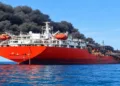
Vietnam wounded American confidence but barely touched global commerce. Iran sits astride the Strait of Hormuz — the route for roughly a fifth of the world’s seaborne oil and 35 per cent of its LNG (International Energy Agency, 2026). When Iran closed the Strait on March 4, the disruption became, in the IEA’s assessment, the largest in the oil market’s history; the International Maritime Organization counted some 20,000 seafarers and 2,000 vessels stranded inside the Gulf.
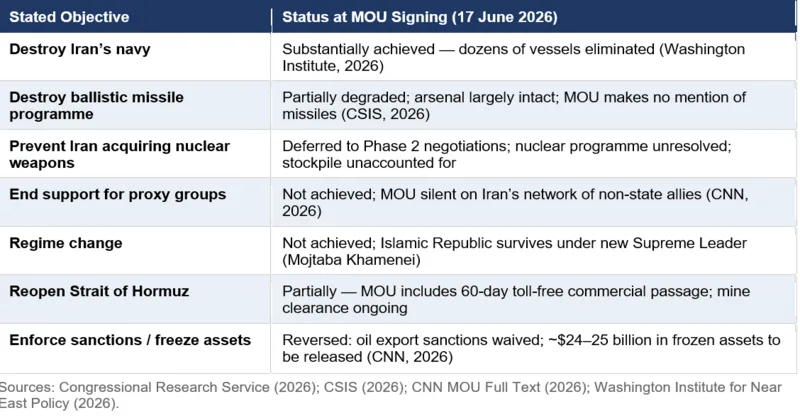
International Crisis Group Iran Project Director Ali Vaez captured the strategic irony precisely: in attempting to prevent Iran from developing a weapon of mass destruction, the United States handed Tehran a weapon of mass disruption. Chatham House concluded in March 2026 that the conflict risks triggering a new wave of nuclear proliferation, with public opinion shifting toward domestic nuclear capability in South Korea, Turkey, and Poland (Chatham House, 2026). The 38 North Programme identified eight specific lessons reinforcing North Korea’s nuclear force posture from the conflict alone — underscoring how far the strategic consequences now extend beyond the Persian Gulf. Table 2 maps the gap between Washington’s stated objectives and the actual outcomes at MOU signing.
Energy, economics and the new strategic contest
Brent crude rose from $71.32 on 27 February to above $100 within ten days, briefly touching $118 by late March — the steepest monthly oil shock on record according to the World Bank’s Commodity Markets Outlook. The Federal Reserve Bank of Dallas modelled that closing Hormuz in Q2 2026 cut global annualised real GDP growth by 2.9 percentage points. The IMF’s April Regional Economic Outlook cut its 2026 global growth forecast to 3.1 percent and raised its inflation forecast to 4.4 percent; the World Bank subsequently reduced growth to 2.5 percent — the weakest pace since the pandemic — warning of a slide to 1.3 percent under prolonged disruption (World Bank, 2026).
The costs were not distributed evenly. CSIS estimated Russia would accrue between $45 billion and $151 billion in additional 2026 budget revenues from elevated energy prices — revenues directly underwriting Moscow’s war in Ukraine (CSIS, 2026). China, whose oil purchases from Iran continued through the blockade, emerged as an indispensable mediator Washington could neither route around nor coerce, gaining strategic positioning that cost it nothing.
Lessons Washington cannot ignore
Three structural lessons recur across both wars. First, align military means with achievable political ends. Lyndon Johnson’s faith that bombing bridges would break Hanoi’s will echoes in the assumption that killing Khamenei would fracture Tehran; both proved wrong. Former US Special Envoy Rob Malley argues Washington is again counting kills and tonnage rather than asking whether the adversary remains standing — the same analytical error McNamara embodied in the Mekong Delta. Verifiable objectives anchored to IAEA-supervised nuclear constraints and phased sanctions relief must replace maximalist demands no sovereign state will accept as national capitulation.
Second, alliance management cannot run on transactional improvisation. Turkey denied US air base access and is advancing toward a $700 million GE engine deal and renewed F-35 review; Italy’s parallel refusal drew a presidential rebuke of Prime Minister Giorgia Meloni. That asymmetry is noticed from Rome to Jerusalem and erodes the principled solidarity on which durable alliances depend (Congressional Research Service, 2025).
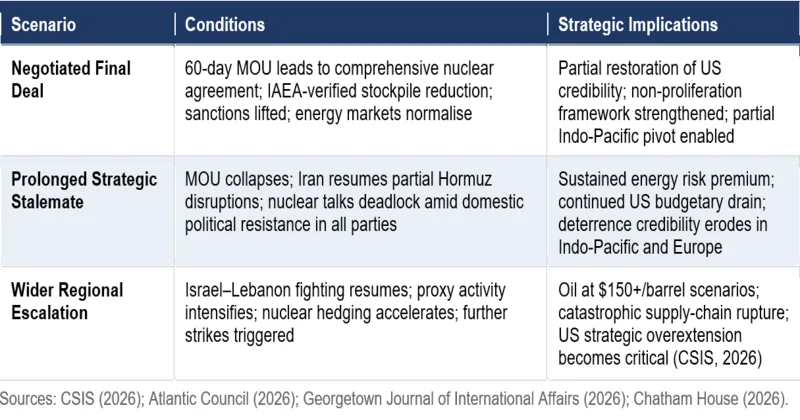
Third, declared victories must be conditioned on verified outcomes. The MOU’s nuclear and missile provisions remain unresolved through a 60-day window running to mid-August 2026, leaving open whether this deal matures into durable settlement, prolonged brinkmanship over Hormuz tolls, or renewed escalation if talks collapse again (CSIS, 2026). Table 3 maps the three scenarios and their strategic implications.
 What this means for India and the Indo-Pacific
India did not fight this war, yet it struck with acute economic and diplomatic force. Three Indian seafarers were killed in June when US naval strikes hit tankers near Oman, prompting New Delhi to summon the American Chargé d’Affaires; approximately 18,000 Indian mariners working Gulf routes spent months stranded inside the Strait. India’s rupee fell to a record low of 94.79 per dollar by late March 2026, LPG cylinder prices rose by ₹60 per unit, and QatarEnergy declared force majeure halting LNG deliveries (IEEFA, 2026). General Electric’s near-tripling of its quoted price for the F414 engine powering India’s Tejas Mk-2 and AMCA stealth fighter — from roughly ₹70–80 crore to over ₹200 crore per unit — has stalled a programme New Delhi considers central to its deterrent, even as Washington fast-tracks a different engine for Turkey’s Kaan jet. The strategic lesson extends beyond any single contract: India must diversify energy routes through Chabahar, expand LNG terminal capacity, deepen defence-industrial partnerships beyond a single supplier, and restore institutional autonomy as a credible neutral mediator before the next crisis forecloses that option.
The Verdict
Is Iran America’s Vietnam? Not in blood or duration — Vietnam’s toll dwarfs Iran’s, and no American soldier patrolled Iranian soil. But in grand-strategy terms the analogy survives where it should: a campaign that began with maximal political ambitions, achieved its narrowest military objectives, and ended by entrenching the forces it sought to dislodge, while leaving allies uncertain of Washington’s reliability. A senior Brookings fellow described the outcome as a total victory for Iran and a total defeat for the United States; a former Council on Foreign Relations president called it a massive victory for Iran (Brookings, 2026).
The deeper difference may be the more troubling one. Vietnam let America withdraw, absorb the trauma, and still win the Cold War. The Gulf offers no equivalent off-ramp, because the world’s energy arteries run through the same waters Washington has just spent four months failing to fully control. Whether the Islamabad Memorandum matures into durable peace or merely a pause will decide which war this ultimately resembles — but the burden of proof now rests with Washington’s diplomacy, not its air force. If American strategic culture cannot absorb this lesson before the next confrontation demands it, the Iran conflict will be remembered not as the exception that proved the rule, but as confirmation the rule was never really learned.