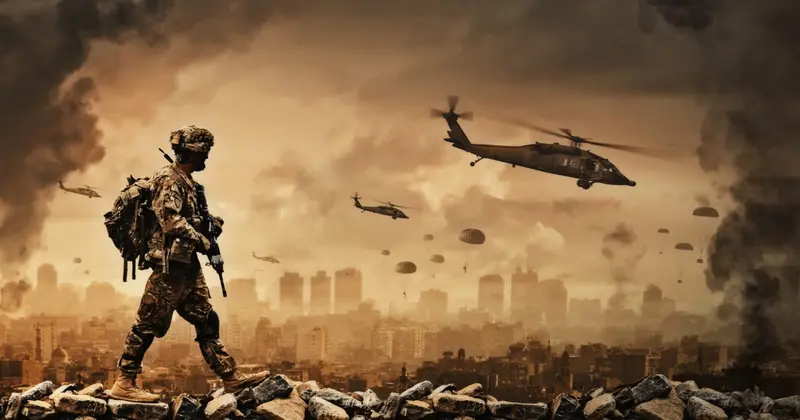
Most Indians are familiar with the episode from the Mahabharata in which the young warrior Abhimanyu declared that he knew how to enter the Chakravyuha (a complex military formation) but did not know the way to emerge from it. Today’s global landscape appears to reflect a similar reality. In the modern era, some nations and their leaders, driven by political, geographical and strategic ambitions, enter military conflicts with confidence, only to find themselves trapped in prolonged and complicated situations from which withdrawal with dignity becomes difficult, if not impossible.
Recent global developments have repeatedly demonstrated that despite advances in technology and military capability, initiating war may be relatively easy, but bringing it to a stable conclusion is far more complex and uncertain. History shows that those who initiate wars often assume they will be able to conclude them on their own terms and at a time of their choosing once their objectives are achieved. Reality, however, has frequently unfolded differently.
The Vietnam War remains one of the clearest historical examples. The United States entered the conflict largely with the objective of preventing the expansion of communist influence in South Vietnam. The war continued for nearly two decades (1955–1975), involving enormous military, economic, and political costs. Ultimately, after the loss of more than 58,000 American military personnel and growing domestic opposition, the United States withdrew without achieving many of its original strategic objectives.
A similar strategic entanglement emerged for the Soviet Union in Afghanistan in 1979. What began as military intervention evolved into a prolonged conflict that imposed severe economic and political burdens on the Soviet system. Although the Soviet withdrawal from Afghanistan was not the sole cause of the eventual dissolution of the Soviet Union, many historians consider it an important factor that exposed and intensified existing structural weaknesses.
Yet history did not fully absorb the lessons of this Afghan experience. Following the terrorist attacks of September 11, 2001, the United States entered Afghanistan with the objective of dismantling terrorist networks and removing the Taliban government that had provided sanctuary to them. Early expectations in some policy circles suggested a relatively swift campaign. Instead, it became the longest war in American history, lasting nearly twenty years.
In August 2021, after enormous financial expenditure and significant human loss, the United States completed its withdrawal under difficult circumstances, and Afghanistan ultimately returned to Taliban rule. The expectation of a “quick victory” remains visible in contemporary conflicts as well. When Russia launched its invasion of Ukraine in February 2022, many observers anticipated that the conflict would either conclude rapidly or remain geographically limited.
Years later, however, the war has evolved into a prolonged and costly confrontation in which both sides have suffered substantial human and economic losses, while political realities have complicated prospects for settlement. Likewise, military confrontations and regional tensions involving Iran, Israel and the United States have repeatedly demonstrated that operations initially expected to remain limited can generate wider strategic consequences.
Retaliatory cycles, regional instability, concerns over maritime trade routes including the Strait of Hormuz, and the expansion of proxy dynamics illustrate how quickly military engagements can evolve into broader geopolitical challenges. Several deeper forces drive this global Chakravyuha. One is the phenomenon known as the sunk cost fallacy i.e.the pressure created by prestige and prior investment. Once thousands of lives have been lost and billions of dollars spent, withdrawal without visible gains may appear politically unacceptable to national leadership.
Another factor is the globalization of conflict. Modern wars rarely remain confined to two countries; they increasingly involve local armed groups, external military assistance, arms suppliers, and international alliances, reducing the ability of the original actors to control events. Economic self-damage also becomes significant, as sanctions, disrupted supply chains, and instability in energy and food markets eventually affect not only targeted nations but also those initiating or supporting conflict.
The contemporary global situation offers a serious warning: modern weapons may enable nations to begin wars, but they do not guarantee control over how wars end. From Vietnam to Afghanistan and from Ukraine to tensions in West Asia, the lesson remains clear that military strength alone rarely delivers quick and lasting resolutions. Entering war without a credible exit strategy may be one of the most dangerous forms of strategic miscalculation in the present century. Until global leadership fully acknowledges this reality, peace may remain more an aspiration than an achievement.
Therefore, nations must strengthen the path of peace, respect one another’s sovereignty, and prioritize dialogue over confrontation. Only then can humanity redirect its resources from conflict toward reducing poverty, hunger, and underdevelopment. In this regard, the Indian civilizational ideal of “Vasudhaiva Kutumbakam” i.e. “the world is one family”, offers a timeless principle for building a more peaceful and prosperous world.