It is, perhaps, a coincidence that on the very day the nation celebrates the 165th birth anniversary of Gurudev Rabindranath Tagore, the Bharatiya Janata Party (BJP) in West Bengal has held the swearing-in ceremony for its new government. The address delivered by Prime Minister Narendra Modi at the BJP headquarters in New Delhi on May 4, 2026, following the mandate received in the BJP’s favor from West Bengal, can be viewed as a guiding roadmap for the state.
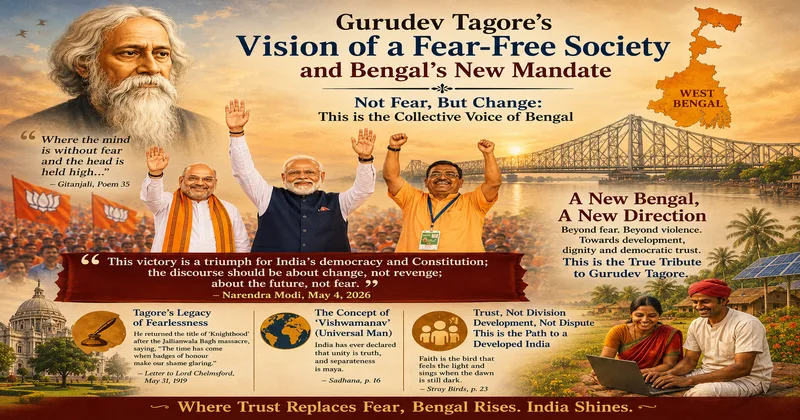
His assertion that “this victory is a triumph for India’s democracy and Constitution; the discourse should be about change, not revenge; about the future, not fear,” was undoubtedly a resounding affirmation of the fundamental ethos of Indian democracy.
Indeed, in this context, the question naturally arises, does Bengal’s nascent political consciousness signal, in some measure, a return to that very humanistic and cultural vision of Tagore, one in which harmony prevails over division and reconstruction takes precedence over retribution? Undoubtedly, the message of “Trust, Not Division,” articulated by Prime Minister Modi, serves as a contemporary political manifestation of this very universal humanistic consciousness espoused by Tagore.
Tagore’s Vision of a Fear-Free Society: The Return of the British Title of ‘Knighthood’
The entirety of Tagore’s literary oeuvre represents a spiritual quest to liberate humanity from the shackles of fear. In Poem 35 of his celebrated work, ‘Gitanjali’, he writes: “Where the mind is without fear and the head is held high…” (Gitanjali, Macmillan, London, 1913, Poem 35, p. 36.)
Following the Jallianwala Bagh massacre of 1919, Tagore renounced the title of ‘Knighthood’ that had been conferred upon him by the British. This act is regarded as one of the most courageous cultural responses in the annals of Indian history. In his letter, he wrote, “The time has come when badges of honour make our shame glaring.” (Rabindranath Tagore, Letter to Lord Chelmsford, 31 May 1919, reproduced in Selected Letters of Rabindranath Tagore, edited by Krishna Dutta & Andrew Robinson, Cambridge University Press, 1997, p. 192.)
This incident demonstrates that Tagore was not a litterateur who would bow down before authority. His nationalism was rooted in moral courage. Today, as voices are being raised in Bengal against violence and political vendetta, this very self-respecting voice of Tagore becomes relevant once again. When Prime Minister Modi speaks of “Development, not Dispute” and “Trust, not Division,” that message appears to be a modern political iteration of that very syncretic consciousness of Tagore.
Rabindranath Tagore composed approximately 2,230 songs, which are known today as “Rabindra Sangeet.” The cultural soul of Bengal resides within these songs. His poetry encompasses nature, spirituality, the nation, and the compassion that dwells within the human heart. The renowned literary critic Sisir Kumar Das aptly observes, “Tagore transformed Bengali literature into a modern yet deeply Indian creative tradition.” (A History of Indian Literature, Sahitya Akademi, Vol. VIII, 1991, p. 74.) The new mandate in Bengal, too, is in a sense a rediscovery of that very cultural consciousness, one that is driven not by violence, but by empathy.
The Concept of ‘Vishwamanav’ (Universal Man) and a Developed India
Gurudev Tagore did not view nationalism merely as a narrow political ideology. He believed in the concept of the ‘Vishwamanav’, the Universal Man. In his vision, India’s future lay in cultural self-confidence, education and moral evolution. In his book ‘Sadhana’, he writes- “India has ever declared that unity is truth, and separateness is maya.” (Rabindranath Tagore, ‘Sadhana: The Realisation of Life’, Macmillan, 1913, p. 16.)
This very idea resonates with the resolve for a developed India in the present day. When Prime Minister Modi speaks of a ‘Developed India’, one perceives at its core not only self-reliance but also cultural self-confidence. Prime Minister Modi’s assertion that “this victory is a victory for India’s democracy and Constitution” is a statement that lends a moral foundation to Indian democracy. Democracy is not merely a vehicle for the transfer of power, but rather a process of building trust within society. Tagore, too, placed this very faith at the center of his works. He wrote- “Faith is the bird that feels the light and sings when the dawn is still dark.” (Stray Birds, Macmillan, 1916, p. 23.) The change currently visible on Bengal’s political horizon is, perhaps, the first stirring of that very “light”, a light that Tagore had sensed long ago.
A New Bengal, A New Direction
The people of Bengal have signaled their desire to move beyond fear, violence and ideological narrowness. They seek a politics grounded in development, cultural respect and democratic dignity. On the occasion of Gurudev Tagore’s birth anniversary, this mandate acquires even greater significance; for in the India envisioned by Tagore, diversity is not a source of division, but rather the very foundation of its beauty.
Today, the imperative is for Bengal to emerge from the darkness of political vendetta and return to that tradition of knowledge, culture and development which once established it as the epicenter of the Indian Renaissance. The triumph of democracy will be complete only when trust replaces fear and cooperation takes the place of conflict in the political sphere.
In truth, this embodies the very spirit of Gurudev Tagore; it reflects the aspiration of India; and perhaps, it constitutes the most profound message of Bengal’s new mandate. Wherever the soul of the nation’s great poet and litterateur, Tagore- may reside today, it must surely be experiencing a sense of joy; that, albeit belatedly, a government rooted in the ideal of all-inclusiveness has finally taken root on the soil of Bengal. This is a government that advocates not for “revenge,” but for “change”! Indeed, were this transformation to take place in West Bengal today, it would constitute the truest tribute that the people of Bengal could offer to Gurudev Tagore on his birth anniversary.