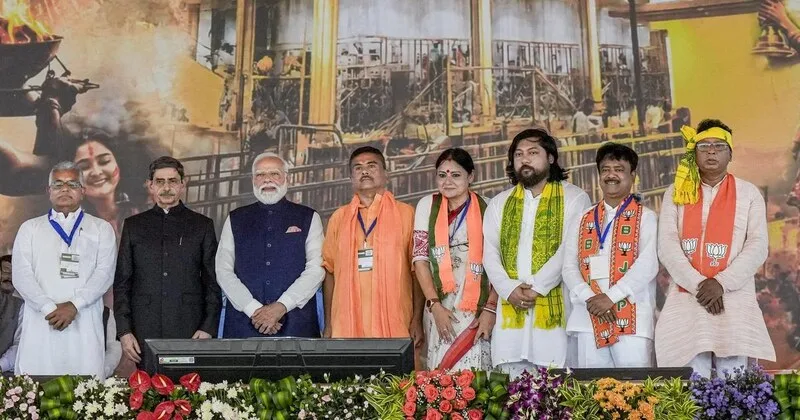
Kolkata: In a landmark political development, Bharatiya Janata Party (BJP) leader Suvendu Adhikari on May 9 took oath as the ninth Chief Minister of West Bengal, marking the party’s first-ever ascent to power in the state. The swearing-in ceremony, held at the iconic Brigade Parade Ground in Kolkata, also made history as the first time a Chief Minister in the state took oath at this venue.
The high-profile event drew the presence of top national leaders, including Prime Minister Narendra Modi, Union Home Minister Amit Shah, and Defence Minister Rajnath Singh. Several Chief Ministers from BJP-ruled states and allied governments also attended, underlining the significance of the moment for the party at the national level.
Governor RN Ravi administered the oath of office to Adhikari and his council of ministers. Alongside the Chief Minister, five MLAs were sworn in as ministers: Dilip Ghosh, Agnimitra Paul, Ashok Kirtania, Kshudiram Tudu, and Nisith Pramanik. The cabinet is expected to be expanded in the coming days.
The BJP’s victory in the recent assembly elections was decisive, with the party securing 207 out of 294 seats, a landslide mandate that reshaped the state’s political landscape. Suvendu Adhikari himself registered a significant personal victory by winning from Nandigram and defeating former Chief Minister Mamata Banerjee in Bhabanipur.
This electoral outcome brings an end to decades of non-BJP rule in the state, following nearly 34 years of Left Front governance and 15 years under the Trinamool Congress (TMC). The transition, however, has not been without controversy. Outgoing Chief Minister Mamata Banerjee has refused to concede defeat, alleging electoral irregularities and claiming that the mandate was influenced by external factors rather than public will.
As Suvendu Adhikari assumes office, all eyes are now on how the new government will navigate governance in a politically sensitive state and deliver on its promises amid heightened expectations and ongoing political tensions.