
Kargil Vijay Diwas: Victory and the visionary reforms
July 21, 2026
  • Read Ecopy
  • Circulation
  • Advertise
  • Careers
  • About Us
  • Contact Us
Android AppiPhone AppArattai
Organiser
  • ‌
  • Bharat
    • Assam
    • Bihar
    • Chhattisgarh
    • Jharkhand
    • Maharashtra
    • View All States
  • World
    • Asia
    • Europe
    • North America
    • South America
    • Africa
    • Australia
  • Editorial
  • International
  • Opinion
  • RSS @ 100
  • More
    • Op Sindoor
    • Analysis
    • Sports
    • Defence
    • Politics
    • Business
    • Economy
    • Culture
    • Special Report
    • Sci & Tech
    • Entertainment
    • G20
    • Azadi Ka Amrit Mahotsav
    • Vocal4Local
    • Web Stories
    • Education
    • Employment
    • Books
    • Interviews
    • Travel
    • Law
    • Health
    • Obituary
  • Subscribe
    • Subscribe Print Edition
    • Subscribe Ecopy
    • Read Ecopy
  • ‌
  • Bharat
    • Assam
    • Bihar
    • Chhattisgarh
    • Jharkhand
    • Maharashtra
    • View All States
  • World
    • Asia
    • Europe
    • North America
    • South America
    • Africa
    • Australia
  • Editorial
  • International
  • Opinion
  • RSS @ 100
  • More
    • Op Sindoor
    • Analysis
    • Sports
    • Defence
    • Politics
    • Business
    • Economy
    • Culture
    • Special Report
    • Sci & Tech
    • Entertainment
    • G20
    • Azadi Ka Amrit Mahotsav
    • Vocal4Local
    • Web Stories
    • Education
    • Employment
    • Books
    • Interviews
    • Travel
    • Law
    • Health
    • Obituary
  • Subscribe
    • Subscribe Print Edition
    • Subscribe Ecopy
    • Read Ecopy
Organiser
  • Home
  • Bharat
  • World
  • Operation Sindoor
  • Editorial
  • Analysis
  • Opinion
  • Culture
  • Defence
  • International Edition
  • RSS @ 100
  • Magazine
  • Read Ecopy
Home Bharat

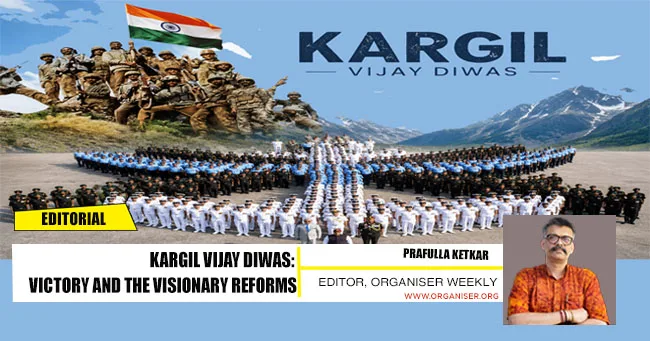
Kargil Vijay Diwas: Victory and the visionary reforms

Prafulla KetkarPrafulla Ketkar
Jul 20, 2026, 02:00 pm IST
in Bharat, Editorial
Follow on Google News
FacebookTwitterWhatsAppTelegramEmail

“Rapid development coupled with distributive justice cannot be achieved, without first ensuring stable peace and security in the country. Hence, the task of effectively safeguarding the country’s security assumes an overriding primacy and demands that the systemic reforms required for achieving this goal must be implemented without delay”
– Report of the Group of Ministers on National Security, (Kargil Committee Report), 2000

The Pakistani intrusion in the Kargil, Dras, and Batalik sectors of the Ladakh in the year 1999 was shocking for everyone. Politically, opposition parties used it as a failure to target the Vajpayee government alleging intelligence failure. After the Lahore bus diplomacy, such a backstabbing was unaccepted, that also in Ladakh, which is generally not patrolled during winters on both the sides. Bharat later turned the tables and achieved glorious victory and operational success by reclaiming lost territory in one of the most difficult terrains. Yet, the loss of more than five hundred brave hearts and many other issues, opened up possibilities for introspection in the form of Kargil Review Committee report. The Government, intelligence agencies, and armed forces all were taken on board along with the experts to review and reform the national security management. First time ever, national security was seriously discussed in a comprehensive manner as the need to overhaul the British colonial theatre system had become obsolete. The expected approval to the integrated theatre command, around the 27th anniversary of Kargil Vijay Diwas, was one of the key reforms that was evolved through this review process.

The intrusion in the Kargil sector was detected on May 3, 1999. The “shepherds” from the Bakkharwal community and the nationalist villagers from Garkon village, occasionally retained by the Brigade Intelligence Team for forward information gathering, informed the army, and on May 7, it was confirmed by the patrols sent out. Within three months of PM Vajpayee’s historic Lahore Bus Diplomacy on February 19, 1999, this was clearly another blow to the peace efforts by Pakistani Army. This misadventure of Pakistan proved to be a blessing in disguise for Bharat as it gave an opportunity to New Delhi to review and strengthen its military apparatus.

From snow boots to defence equipment, everything was trapped in the bureaucratic hurdles. Overdependence on foreign supply for artillery and guns was noted. The possible participation of the private sector in the defence production was explored. Media relations and communication strategy was identified as the important dimension of national security by the committee. Kargil was the first televised war involving Bharat. The need for border infrastructure upgradation was identified. The two most important recommendations were related to bringing jointness in the military operations. To introduce the post of the Combined Defence Staff (CDS) and transform the existing colonial-era command structure into an integrated theatre command. Realising that the future nature of war would be non-linear, with real-time surveillance, integrated Command, Control, Communications, Computer, Intelligence and Information (C4 I2 ) assets, target acquisition, and highly lethal precision weapon systems, the KRC did not focus just on the learnings from the past but undertook the herculean task of setting Bharat ready for future warfare.

Originally, the KRC had recommended a ten-year timeline to complete the overhaul. Unfortunately, the Sonia Gandhi-led UPA Government could not make much progress on the defence reform and modernisation front due to policy paralysis and rampant corruption. Only after PM Modi assumed the Prime Ministership, and especially when Late Manohar Parrikar became the Defence Minister, transparency and expediency in defence procurement became the national agenda with adequate budgetary provision. The private participation in defence production has improved. DRDO has become competitive, and we are now exporting significant parts of defence technology and equipment. The border infrastructure has improved a lot. The post of the Combined Defence Staff was an important decision, and Gen Bipin Rawat set the process in motion from January 1, 2020. Even as the proposal for the Integrated Theatre Command is taking its final shape, our armed forces hitherto displayed operational jointness and synergy during Operation Sindoor.

As we celebrate the valour and commitment of our armed forces in protecting our borders, on the 27th Kargil Vijay Diwas, it is also an occasion to review the lessons that the Armed Forces, Intelligence agencies, Parliament, Government, media, and the nation as a whole haslearnt We need to realise that national security goes beyond state security, defined in terms of border security. – Now information and narratives are among the enemy’s most potent tools in the fifth generation warfare. Therefore protecting our culture, institutions, and social fabric cannot be left to the security forces alone., It is an opportune time to discuss the changing nature of war, understand the roles of each stakeholder, and act in accordance with the expected roles as responsible constituents of this great civilisation. This way, we can pay tribute to soldiers for their sacrifices and ensure that “Kargils,” like intrusions of any description, will never ever be repeated.

 

Topics: PM ModiKargil Vijay DiwasOperation SindoorSonia Gandhi-led UPA GovernmentKargil sectorPakistani intrusion in the KargilVajpayee governmentCombined Defence Staff
Prafulla Ketkar
Prafulla Ketkar
Prafulla Ketkar, is the Editor, Organiser (Weekly) since 2013. He has a experience of over 20 years in the fields of research, media and academics. He is also Advisory Committee School of Journalism, Delhi University. He has been writing on issues related to International politics and foreign policy, with special reference to China and Democracy, Hindutva, and Bharatiya Civilisation. He was also a member of the Editorial team of the recently published Complete Works of Pt Deendayal Ji in 15 Volumes. He has 2 books, 29 academic articles, 2 entries in Encyclopedia of India and numerous articles to his credit. [Read more]
ShareTweetSendShareSend
✮ Subscribe Organiser YouTube Channel. ✮
✮ Join Organiser's WhatsApp channel for Nationalist views beyond the news. ✮
Previous News

Puri Jagannath Mandir: Ratna Bhandar ornaments counted, weighed & digitally documented during inventory drive

Next News

CJP Protest: Anjali Bharadwaj & Shabana Azmi, funded by Ford, Soros & deep state spotted at Delhi protest

Related News

Monsoon Session: PM Modi takes sharp swipe at Rahul Gandhi as “56 year-old youngster”; Hails Skyroot’s Vikram-1 success

India wins one gold and three silver medals at International Biology Olympiad 2026

Golden Brilliance in Biology: PM Modi Hails India’s medal sweep at International Olympiad 2026

Skyroot’s Vikram-1 Reaches Orbit: India’s first private orbital-class rocket powers rise in the global space frontiers

India is restoring ancient temples and heritage sites across Asia, using cultural diplomacy to preserve shared civilisational heritage

From Prambanan to Angkor Wat: How India is preserving ancient heritage to strengthen global cultural ties

Prime Minister Modi addresses public gathering in Punjab

Punjab: Centre committed to the development of state despite no BJP government, says PM Modi

1,668 MT mega cargo reaches Bihar via National Waterway-1, Sonowal hails Ganga logistics milestone

Load More

Latest News

Keralam Minister moves to stop free food distribution by NGOs in government hospitals, sparks backlash

NEET 2026 | Abhay Yadav Case: NTA warns against AI generated OMR sheets & scorecards; Reiterates strict legal action

Former Aam Aadmi Party (AAP) councillor Tahir Hussian with AAP leader and former Delhi Chief Minister Arvind Kejriwal. Notably, Delhi court convicted Tahir Hussain and four others for the 2020 murder of Intelligence Bureau (IB) staffer Ankit Sharma, who was brutally killed and his body was dumped into a drain in the Chand Bagh area during anti-Hindu Delhi riots

Anti-Hindu Delhi Riots 2020: When evidence outlasted narratives

NCUI Elections: Sahakar Bharati–BJP registers historic victory; Wins 19 of 20 seats & 10 candidates elected unopposed

Representative Image

Tamil Nadu: Authorities ‘demolish’ Annadaana Satram in Thiruvannamalai; Sparks outrage from public

India's BioE3 Policy aims to build a $2.6 trillion bioeconomy by 2047 through biotechnology-driven innovation, jobs and growth

India’s Bioeconomy Revolution: How NITI Aayog’s roadmap seeks to make the country a global biotechnology leader by 2047

Tri-Services Exercise 2025 was led by the Western Naval Command of the Indian Navy along with the Southern Command of the Indian Army and the South Western Air Command of the Indian Air Force as the principal participating formations

Theatre Command: Military reforms for integrated Actions

Court-Ordered Demolition: Periyar Arch Removed in Madurai Overnight

Tamil Nadu: Madurai authorities demolish EV Ramaswamy arch to ease traffic, acting on High Court orders

The then Prime Minister Atal Bihari Vajpayee with the soldiers in Kargil, June, 1999

Theatre Command: Review, revision and reforms

Pakistan tops the Global Terrorism Index and faces EU scrutiny over its human rights record, risking key trade benefits

GSP+ status review: EU wants Pakistan to improve human rights record, end enforced disappearances, or lose it

Load More
  • Privacy
  • Terms
  • Cookie Policy
  • Refund and Cancellation
  • Delivery and Shipping

© Bharat Prakashan (Delhi) Limited.
Tech-enabled by Ananthapuri Technologies

  • Home
  • Search Organiser
  • Bharat
    • Assam
    • Bihar
    • Chhattisgarh
    • Jharkhand
    • Maharashtra
    • View All States
  • World
    • Asia
    • Africa
    • North America
    • South America
    • Europe
    • Australia
  • Editorial
  • Operation Sindoor
  • Opinion
  • Analysis
  • Defence
  • Culture
  • Sports
  • Business
  • RSS @ 100
  • Entertainment
  • More ..
    • Sci & Tech
    • Vocal4Local
    • Special Report
    • Education
    • Employment
    • Books
    • Interviews
    • Travel
    • Health
    • Politics
    • Law
    • Economy
    • Obituary
  • Subscribe Magazine
  • Read Ecopy
  • Advertise
  • Circulation
  • Careers
  • About Us
  • Contact Us
  • Policies & Terms
    • Privacy Policy
    • Cookie Policy
    • Refund and Cancellation
    • Terms of Use

© Bharat Prakashan (Delhi) Limited.
Tech-enabled by Ananthapuri Technologies