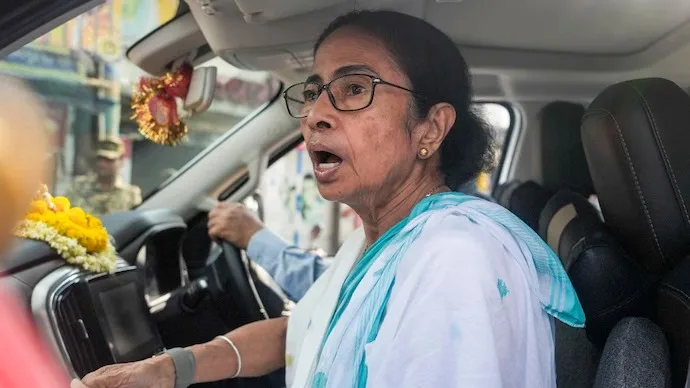
A day after the Bharatiya Janata Party (BJP) secured a decisive victory in the West Bengal Assembly elections, Trinamool Congress (TMC) chief Mamata Banerjee declared that she would not resign as Chief Minister.
Addressing a press conference in Kolkata, Banerjee said: “I have not lost, so I will not go to Raj Bhavan. I will not tender my resignation.”
She maintained that her party had not truly lost the mandate, alleging that the electoral outcome was manipulated.
“I don’t hold a chair, I’m a free bird,” Banerjee said at a packed press conference on May 5, a day after losing both Bengal and her Bhabanipur seat to arch rival BJP.
Escalating her attack, Mamata Banerjee claimed that nearly 100 seats had been “stolen”, attributing the BJP’s victory to manipulation.
She accused the Election Commission of India of bias and alleged collusion with the central government.
“This is not how democracy works. When the judiciary is not there, when the Election Commission is biased and the government wants one-party rule, a wrong message goes out to the world,” she said.
In a sharp remark, Banerjee claimed that her real opponent in the election was not the BJP but the Election Commission itself, alleging that the poll body had played “nasty games.”
She also alleged “direct interference” by the Centre and claimed that similar electoral “manipulations” had taken place in states such as Maharashtra, Haryana, and Bihar.
While refraining from detailing her next political move, Banerjee stated that leaders from the INDIA bloc had reached out to her and assured support in the aftermath of the results.
However, she did not clarify whether the party would challenge the results legally or politically.
What the constitution says: Is resignation mandatory?
Under India’s constitutional framework, there is no explicit provision that mechanically forces a Chief Minister to resign immediately after losing an election. However, governance operates on well-established constitutional conventions.
The key principle is that a Chief Minister must enjoy the confidence of the State Legislative Assembly. Once election results clearly indicate that the incumbent no longer commands a majority, convention requires the Chief Minister to resign and advise the Council of Ministers to do the same.
If a Chief Minister refuses to step down, the Governor can intervene using constitutional authority.
Under Article 164 of the Constitution of India, ministers hold office “during the pleasure of the Governor.”
This means:
1. If the CM loses majority support, the Governor can withdraw pleasure
2. The Chief Minister and Council of Ministers can be dismissed
3. The Governor may then invite the leader of the majority party to form the government
Alternatively, a floor test may be ordered to establish majority.
Article 172 of the Constitution of India defines the ‘Duration of State Legislatures’.
It says, “Every Legislative Assembly of every state, unless dissolved sooner, shall continue for five years from the date appointed for its first meeting and no longer and the expiration of the said period of five years shall operate as a dissolution of the assembly. Provided that the said period may, while a proclamation of emergency is in operation, be extended by Parliament by law for a period not exceeding one year at a time and not extending in any case beyond a period of six months after the proclamation has ceased to operate.
This means that on May 7, the Bengal Vidhan Sabha and the state government based on the 2021 Assembly election mandate will dissolve automatically.
What happens next in Bengal?
In the case of West Bengal, the election results indicate that the Trinamool Congress no longer holds a majority in the Assembly.
If Mamata Banerjee continues to refuse resignation, the Governor is expected to assess the situation based on the final seat tally and party positions.
Should it be established that the incumbent government lacks majority support, the Governor can proceed to dismiss the Council of Ministers and facilitate government formation by the majority party.
The developments mark a significant constitutional and political moment in West Bengal, where legal provisions, political claims, and democratic conventions are intersecting sharply.
As the situation unfolds, all eyes remain on Raj Bhavan and the next constitutional steps that will determine the state’s political future.