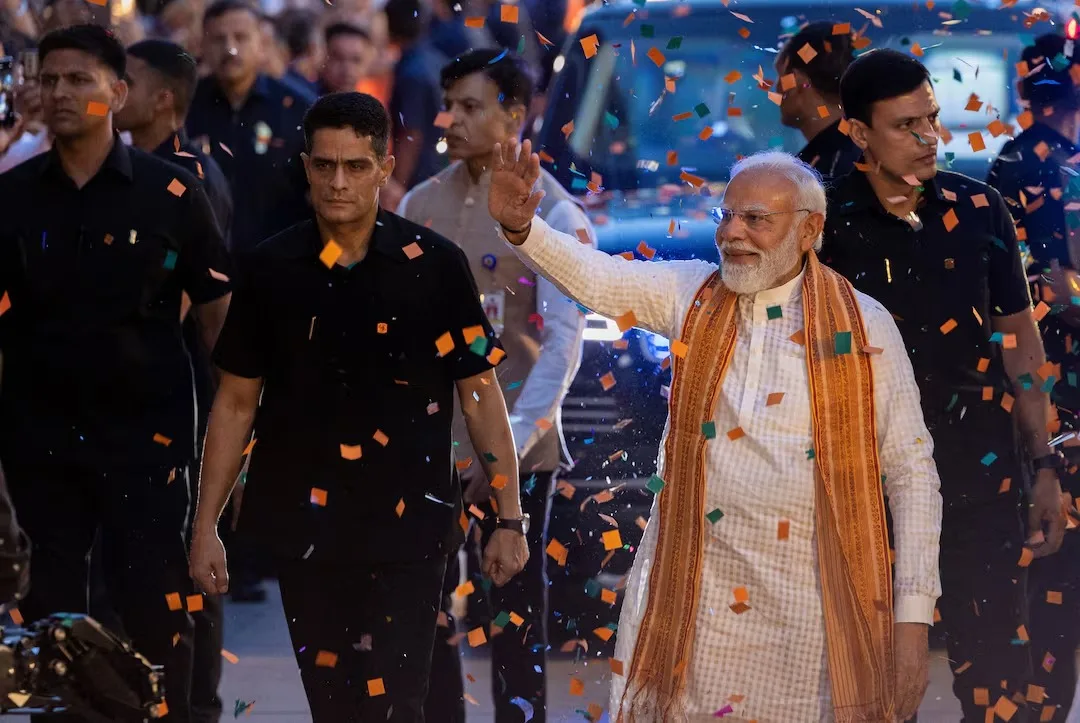
When Narendra Modi addressed party workers at the BJP headquarters on May 4, 2026, his speech was not structured as a conventional victory address. It was crafted as a declaration of a broader ideological and democratic moment.
Beginning with chants of “Bharat Mata Ki Jai,” Modi immediately elevated the tone of the address. Rather than focusing narrowly on seat tallies or political arithmetic, he framed the results as a reaffirmation of India’s democratic strength. Calling it “a very special day,” he described the mandate as a reflection of “trust in democracy, trust in governance, and trust in the Constitution.”
“Today, democracy has won. Today, India’s constitutional bodies have won,” he said, establishing the central thesis of his speech.
This was significant. In one stroke, Modi sought to shift the conversation away from partisan victory toward institutional validation, positioning the BJP’s success as aligned with the strength of India’s democratic framework.
The ‘Historic and unprecedented’ mandate
Repeatedly using the words “historic” and “unprecedented,” Modi highlighted the scale and significance of the BJP’s performance across states, particularly in West Bengal.
The emphasis was not just on the outcome, but on the journey. He credited years of organisational discipline, ideological commitment, and grassroots mobilisation. According to him, the visible enthusiasm among party workers was not merely celebratory, but symbolic of a long struggle reaching fruition.
He said, “When years of effort turn into success, the happiness you see is the happiness of every BJP worker across the country.”
By acknowledging workers at every level, Modi reinforced the BJP’s narrative of being a cadre-driven organisation where collective effort translates into political success.
West Bengal: The epicentre of political transformation
The most consequential portion of the speech revolved around West Bengal, where the BJP’s performance marked a dramatic shift in the state’s political landscape.
For over a decade, the All India Trinamool Congress had dominated the state’s politics. Modi’s speech presented the 2026 verdict as a decisive rupture with that past.
“From today, Bengal is fearless. Bengal has changed,” he declared.
The use of the word “poriborton” was deliberate. It connected the BJP’s victory to a broader narrative of transformation, both political and social. Modi framed the result as the end of a politics rooted in fear and the beginning of one centred on development and trust.
He further strengthened this narrative by invoking Syama Prasad Mookerjee, one of the ideological forefathers of the BJP.
“Syama Prasad Mookerjee dreamt of a self-reliant Bengal. We had to wait for long. But not anymore,” he said.
This invocation was layered with meaning. It tied the present moment to historical aspiration, suggesting that the BJP’s victory fulfilled a long-pending ideological vision.
Ending the cycle of political violence
One of the most striking and politically sensitive aspects of Modi’s speech was his focus on electoral violence in West Bengal.
For decades, elections in the state have been marred by allegations of intimidation and violence. Modi used this context to highlight what he described as a significant shift.
“Recall the kind of news that used to emerge during past elections, violence, fear, deaths of innocent people. This time, no innocent lives were lost,” he said.
This claim allowed him to position the 2026 election as a departure from past patterns, reinforcing the narrative of democratic maturity.
At the same time, Modi struck a conciliatory tone, urging political actors to abandon the politics of revenge.
“Not badla, but badlav. Not bhay, but bhavishya,” he said, calling for a change in political culture.
This appeal was both strategic and symbolic. While asserting victory, he also attempted to project restraint and responsibility.
Democracy as India’s global identity
Expanding beyond domestic politics, Modi placed the election results within a global framework.
He reiterated the idea of India as the “mother of democracy,” arguing that the conduct and outcome of elections across five states demonstrated the resilience of democratic institutions.
“Win and loss are part of the game, but the people have shown the world why India is the mother of democracy,” he said.
This narrative served multiple purposes. It reinforced national pride, strengthened India’s democratic credentials internationally, and aligned the BJP’s victory with a broader civilisational identity.
The geography of power: Ganga to Brahmaputra
One of the most memorable aspects of the speech was Modi’s use of geographical metaphors to explain political momentum.
Referring to his earlier remarks after the Bihar elections, he said, “The Ganga flows from Bihar to Bengal.” At that time, he had suggested that political success would follow a similar path.
With the Bengal victory secured, he expanded the metaphor.
“Along with Ganga, Brahmaputra has also been kind to me,” he said.
The symbolism was powerful. The Ganga represented the Hindi heartland, while the Brahmaputra symbolised the Northeast. Together, they illustrated a political mandate flowing from multiple regions and converging into a unified national endorsement.
This use of geography transformed electoral success into a narrative of national integration.
Expansion of the BJP-NDA ecosystem
A key takeaway from the speech was the emphasis on the expanding footprint of the BJP-led National Democratic Alliance.
Modi pointed out that the NDA now governs more than 20 states, showing its growing influence across India. He highlighted continued dominance in Assam, electoral gains in West Bengal, and sustained presence in Puducherry.
This expansion was framed not just as political success, but as a reflection of the idea of “Ek Bharat, Shreshtha Bharat.”
By linking electoral victories to national unity, Modi reinforced the BJP’s positioning as a pan-India political force.
Governance commitments: From health to security
While much of the speech focused on symbolism and narrative, Modi also made concrete governance promises.
He announced that the Ayushman Bharat scheme would be approved in the first cabinet meeting in West Bengal, signalling a commitment to expanding healthcare access.
On security, he adopted a firm tone, promising “strong action against infiltrators,” a reference to illegal immigration. This statement carried significant political weight, particularly in border states like West Bengal and Assam.
He also emphasised the need to create a safer environment for women and better employment opportunities for youth, outlining a governance agenda aimed at addressing key voter concerns.
Women as political stakeholders
Another important dimension of the speech was Modi’s focus on women voters.
Linking electoral outcomes to the opposition’s stance on the Women’s Reservation Bill, he argued that women had played a decisive role in shaping the verdict.
“Sisters and daughters have punished those who opposed women’s reservation,” he said.
This framing positioned women not just as beneficiaries of policy, but as active political agents influencing electoral outcomes.
Sharp political messaging against opposition
Despite the overarching tone of unity and reconciliation, Modi did not shy away from political attacks.
He criticised opposition parties, particularly the Congress, describing it as a hub of “urban Naxals.” He also targeted what he called politics of appeasement and fear.
These remarks served to sharpen the ideological contrast between the BJP and its opponents, reinforcing the narrative of a clear political divide.
At its core, the speech remained deeply emotional.
Modi repeatedly expressed gratitude to voters across states, including West Bengal, Assam, Tamil Nadu, Kerala, and Puducherry. He acknowledged their role in shaping what he described as a “decisive and historic verdict.”
He also paid tribute to party workers, emphasising that their dedication and discipline had made the victory possible.
“As a party worker, I share the joy of every BJP worker,” he said.
This identification with the cadre reinforced his image as a leader rooted in the organisation.
A call for political maturity
Beyond celebration, the speech carried a message of political maturity.
Modi urged all parties to move beyond cycles of violence and retaliation, emphasising the need for a constructive political culture.
“The focus should be on the future, not fear,” he said.
This call for restraint was particularly significant in the context of West Bengal’s political history, where post-election tensions have often escalated.
Towards the conclusion of his speech, Modi returned to the theme of transformation.
“Even though this evening is setting, a new sunrise has taken place in Bengal,” he said.
This metaphor encapsulated the broader message of the address. The election was not presented as an endpoint, but as the beginning of a new phase defined by development, trust, and opportunity.
He described the mandate as “a resounding expression of faith” that had “uprooted the politics of fear, appeasement, and violence.”
Redefining the political narrative
Narendra Modi’s May 4, 2026, address was more than a victory speech. It was an attempt to redefine the narrative of the election itself.
By combining themes of democracy, governance, national unity, and cultural symbolism, Modi positioned the BJP’s success as part of a larger transformation in Indian politics.
The speech sought to achieve multiple objectives simultaneously. It celebrated victory, legitimised the mandate, outlined governance priorities, and set the tone for future political engagement.
Whether viewed as political strategy or ideological articulation, the address leaves little doubt that the 2026 elections, particularly in West Bengal, have reshaped India’s political landscape in profound ways.
The emphasis on “democracy,” “change,” and “fearlessness” will likely continue to define the BJP’s narrative in the months and years ahead, as it seeks to translate electoral success into sustained governance and political consolidation.