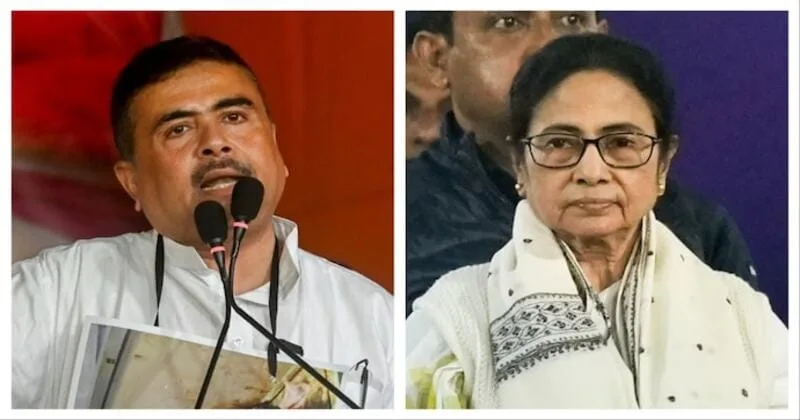
Kolkata: Suvendu Adhikari, Leader of Opposition for the Bharatiya Janata Party in the West Bengal Assembly, has emerged as the pivotal force in the state’s shifting political landscape. A string of major electoral gains, culminating in the 2026 verdict, has not only dealt a significant blow to the Trinamool Congress but also solidified his stature as the BJP’s foremost leader in Bengal. A former close aide of Chief Minister Mamata Banerjee, Suvendu Adhikari, has undergone a striking political transformation, rising from one of her most trusted lieutenants to one of her strongest challengers.
From Congress to TMC
Adhikari began his political journey with the Indian National Congress in the 1990s before joining the Trinamool Congress in 2000. Within a short span, he established himself as a key strategist in East Midnapore and a trusted member of Banerjee’s inner circle. He held significant portfolios such as Transport and Environment, served as Member of Parliament from Tamluk, and later as MLA from Nandigram and Contai South. His central role in the Nandigram movement was instrumental in reshaping the state’s political trajectory.
Break with TMC and switch to BJP
In 2020, Suvendu Adhikari parted ways with the Trinamool Congress amid internal rifts and joined the Bharatiya Janata Party, a move that dealt a significant organisational blow to the ruling party while strengthening the BJP’s position in Bengal.
Leveraging his insider knowledge of the TMC’s political structure, Adhikari crafted a strong grassroots pitch, repeatedly invoking the slogan “ami ekhankar chhele” (I am the son of this soil) to emphasise his local roots and connect with voters.
Nandigram 2021: The first major test
The 2021 Assembly election marked his first direct showdown with Chief Minister Mamata Banerjee, who chose to contest from Nandigram, Adhikari’s long-standing political bastion.
In a tightly contested battle, Suvendu Adhikari edged past Chief Minister Mamata Banerjee by a narrow margin, delivering one of the most symbolic upsets in West Bengal’s recent political history. Although Banerjee retained power, the defeat significantly altered the state’s political narrative and elevated Adhikari as the Bharatiya Janata Party’s principal face in Bengal.
Bhabanipur 2026: Another major milestone
The 2026 elections further reinforced Adhikari’s ascent, as he registered a decisive victory in Bhabanipur, long regarded as Banerjee’s safest constituency. Winning by a margin of over 15,000 votes, he dealt a fresh setback to the Trinamool Congress within its own stronghold.
The result was widely interpreted as an extension of the political momentum he had built since Nandigram. Adhikari framed the verdict as a reflection of public sentiment, describing it as a rejection of the status quo and, in a pointed remark, calling it “Mamata Banerjee’s retirement from politics.”
A rare political trajectory: Twin victories over a sitting CM
With wins in both Nandigram (2021) and Bhabanipur (2026), Suvendu Adhikari has accomplished a rare political feat, defeating a sitting Chief Minister, Mamata Banerjee, in successive elections across two constituencies.
The Bharatiya Janata Party’s broader gains in the 2026 elections, marked by significant advances in West Bengal, have further magnified the impact of his individual victories, contributing to a shift in the state’s political balance.
Riding on this strong performance, Adhikari’s standing within the BJP has risen sharply, with party leadership increasingly projecting him as the key architect of its expansion in Bengal and its most formidable challenger to the Trinamool Congress.