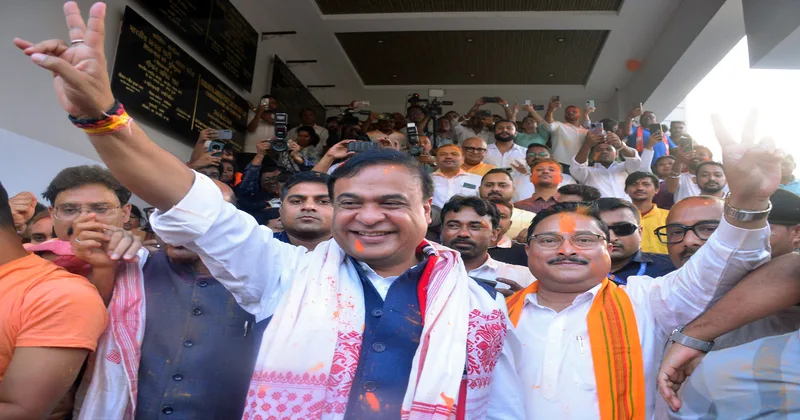
On a day when Himanta Biswa Sarma declared a “hat-trick with a century,” his political journey stands as a reminder of how moments of personal rupture can alter the course of regional and national politics.
Hat-Trick with a century!
— Himanta Biswa Sarma (@himantabiswa) May 4, 2026
Once a central figure in the Congress in Assam, Sarma’s eventual exit and rise within the BJP has come to define a decisive shift in the state’s political landscape.
The third landslide victory of the NDA in Assam is a testament to people's unwavering trust in BJP's double engine government under PM Modi Ji and CM Himanta Biswa Sarma Ji which is turning Assam into a land of hope & development from the land of disturbances.
I extend…
— Amit Shah (@AmitShah) May 4, 2026
The Snub That Became a Symbol
Before his exit, Sarma was among the most influential leaders in the Assam Congress and a close associate of then Chief Minister Tarun Gogoi. A consistent electoral performer from Jalukbari, he held key portfolios and wielded significant organisational influence.
However, dissatisfaction had been building within the party. Questions of leadership, limited scope for growth, and what he perceived as a clear disconnect between the high command and state leaders contributed to growing unease.
The now widely cited meeting with Rahul Gandhi became the breaking point. Senior leaders from Assam reportedly waited for a long time before the meeting began. During the interaction, tea and biscuits were served, and Sarma later recounted that Rahul Gandhi’s pet dog, Pidi, picked a biscuit from the plate, which was not replaced.
For Sarma, this moment was not about optics alone. It came to represent, in his telling, a deeper lack of regard for leaders who had built the party on the ground. He would later say that it was at this point he decided “enough is enough!” and that he could not continue in the Congress anymore.
Exit and Strategic Realignment
In August 2015, Sarma left the Congress and joined the BJP under the leadership of Amit Shah. The move marked a turning point not only in his career but also in Assam’s political trajectory.
Entrusted with a key organisational role, Sarma led the BJP’s election strategy in the state. His understanding of Assam’s political and social fabric helped the party build alliances and expand its base across regions and communities.
The results were evident in the 2016 Assembly elections, when the BJP-led alliance ended Congress’s 15-year rule in Assam. Sarbananda Sonowal became Chief Minister, while Sarma emerged as one of the most influential figures in the government.
Rise to Leadership
Following the 2016 victory, Sarma’s influence continued to grow. He played a central role in strengthening the BJP’s presence across the Northeast through coordinated political efforts and alliance-building.
In 2021, he assumed office as Chief Minister of Assam, marking the culmination of a political transformation that began with his departure from the Congress. His recent “hat-trick with a century” remark underscores the scale of his electoral and political success over the years.
A Moment of Reflection
The “Pidi” episode has remained a recurring reference in political discourse. While interpretations differ, its significance lies in what it came to represent for Sarma and his supporters.
When Rahul Gandhi reflects on what ails his once-dominant party, he may well revisit that moment, the “Pidi” episode, when, perhaps unwittingly, a gesture came to symbolise a deeper disconnect that cost the Congress one of its most formidable regional leaders.
A Turning Point in Assam Politics
Sarma’s journey illustrates how individual decisions can reshape political equations. His exit from the Congress and subsequent rise within the BJP altered the balance of power in Assam and contributed to a broader shift in the Northeast.
It began as a moment of dissatisfaction and evolved into a defining political realignment, one that continues to influence the region’s trajectory today.