Uttar Pradesh is a living civilisation. The banks of the Ganga, the ghats of Varanasi, the sacred soil of Ayodhya, the eternal flame of Mathura, these are not geographic coordinates but the beating heart of Bharatiya sanskriti. It’s a living spiritual tradition that predates every modern political institution by millennia. For decades, this identity was either ignored by those in power, treated as an inconvenience or at its worst. Often weaponised to consolidate vote banks while ordinary citizens of every faith were denied equal access to welfare and dignity.
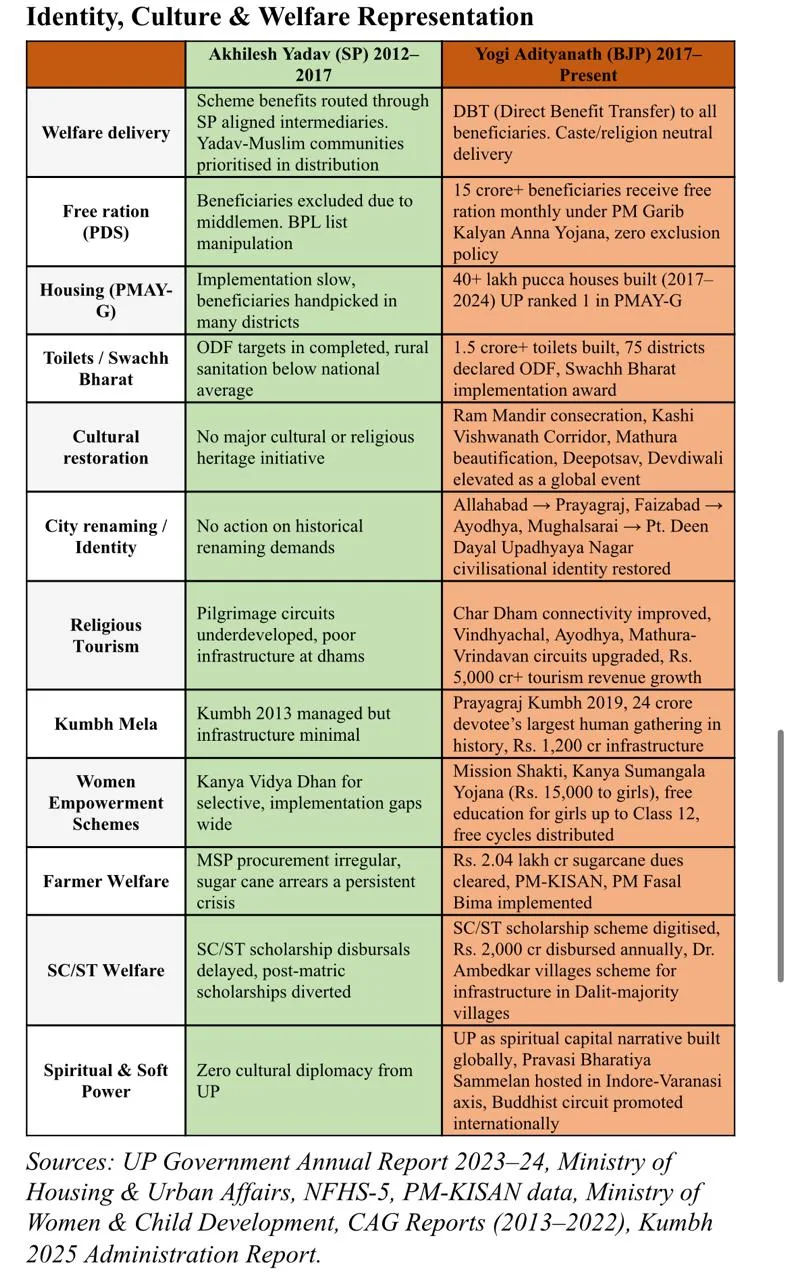
The Samajwadi Party, during its tenure from 2012–2017, governed UP through the familiar game of identity politics not to unite, but to divide. It’s MY (Muslim-Yadav) alliance was not an electoral calculation, it was a governing philosophy. Welfare schemes, police postings, administrative appointments and development funds flowed disproportionately through patronage networks aligned with this coalition. The result was a state fractured by perception where citizens from communities outside the favoured alliance felt excluded from their own government.
In 2017, with the election of Vidhan Sabha, Uttar Pradesh chose Yogi Adityanath as CM, a monk with a different governing philosophy. One grounded in the idea that the state must serve every citizen equally, the civilisational heritage is a source of pride and economic opportunity rather than communal tension and that the restoration of UP’s cultural identity is inseparable from the restoration of its dignity as a state.
Samajwadi Party Tenure: When Politics Favours a Party
The Samajwadi Party came to power in 2012 with generous welfare promises. Laptops for students, subsidised cycles for girls, and scholarships for minorities, the announcements were plentiful and the political intent transparent. These were not governance programmes in the classical sense; they were targeted instruments of electoral consolidation, designed to create visible benefits for specific communities while the broader administrative machinery continued to function on a patronage-first basis.
Scholarship schemes for minority students, for instance, became a byword for leakage. CAG reports and parliamentary committee findings documented widespread diversion of scholarship funds, ghost beneficiaries and institutional complicity. The Kanya Vidya Dhan scheme, meant to support girls’ education, struggled with implementation gaps that left large numbers of legitimate beneficiaries unpaid for months or years. BPL ration cards were widely reported to be issued along community lines in SP-influenced districts, leaving genuine beneficiaries from non-favoured communities without food security coverage.
UP’s rich cultural and spiritual heritage received no meaningful investment. The ghats of Varanasi remained neglected. Ayodhya, one of the holiest cities in Hinduism, was underdeveloped with crumbling infrastructure. Prayagraj, the site of the Kumbh Mela, the world’s largest human gathering, received only minimal preparation. The message communicated through administrative neglect was clear, as the identity and cultural aspirations of the UP Hindu majority were not a governance priority.
The Yogi Era: Civilisational Renewal as State Policy
When Yogi Adityanath was sworn in as Chief Minister on March 19, 2017, he arrived not as a conventional politician but as the head of the Gorakhnath Peetha, a centuries-old spiritual institution with deep roots in the cultural life of eastern UP. His governance from the very first days reflected this background of an administratively and civilisationally deeply rooted society.
The Kashi Vishwanath Corridor, inaugurated by Prime Minister Narendra Modi in December 2021, stands as the most visible symbol of this cultural renewal. The ancient Vishwanath mandir has remained encroached for centuries; it was freed and reconnected to the Ganga ghats through a sweeping Rs. 900 crore corridor project. Over 300 crore devotees visited within the first year of inauguration. The project was an act of civilisational restitution, restoring to Kashi a dignity commensurate with its spiritual significance.
Ayodhya’s transformation has been even more profound. The consecration of the Ram Mandir on January 22, 2024, after a decade-long legal and cultural struggle, was a moment of civilisational pride that moved millions of Hindus across the world. But beyond the mandir itself, the Yogi government invested massively in transforming Ayodhya into a world-class pilgrimage and tourism destination with a new international airport, a renovated railway station styled on mandir architecture, widened roads, riverfront development on the Saryu and a master plan that made Ayodhya the UP spiritual tourism capital.
The 2025 Kumbh Mela in Prayagraj remains one of the most extraordinary feats of event management in independent India’s history. In approximately 18 months, the Yogi government built temporary and permanent infrastructure to host 24 crore pilgrims, the largest peaceful human gathering ever recorded anywhere on Earth. Twelve kilometres of ghats were renovated. Forty-five pontoon bridges were constructed. A dedicated township was created with electricity, sanitation and policing. The entire event passed without a single major stampede or law and order incident. The world took notice.
The restoration of historical place names, Allahabad to Prayagraj, Faizabad to Ayodhya, Mughalsarai to Pandit Deen Dayal Upadhyaya Nagar, was an act of cultural reclamation, reconnecting living cities to their civilisational roots and restoring pride to communities that had long felt their heritage was being administratively erased. Far from creating division, these renamings were received with celebration by residents who had informally used the original names for generations.
Sabka Saath, Sabka Vikas: Welfare Without Discrimination
The most lasting transformation of the Yogi era has been the quiet revolution in welfare delivery, moving from a patronage-based, community-targeted model to a universal, technology-driven, Direct Benefit Transfer (DBT) system that has fundamentally altered the relationship between citizen and state.
Under PM Garib Kalyan Anna Yojana, over 15 crore beneficiaries in UP receive free ration every month, regardless of caste, religion or political affiliation. The DBT system, linked to Aadhaar has eliminated the middlemen who once extracted their cut from every welfare transaction. Studies by independent researchers have documented a reduction in exclusion errors to a perverse phenomenon by which genuinely poor families were denied benefits that were being diverted to ghost beneficiaries.
In housing UP achievement under PMAY-Gramin has been nationally recognised. Over 40 lakh pucca houses have been built since 2017, making UP as the top-performing state in the country under the scheme. The beneficiary selection has been conducted through the SECC (Socio-Economic Caste Census) database and verified through independent social audits, thus removing the scope for political intermediaries to determine who receives a home.
The Kanya Sumangala Yojana has transferred Rs. 15,000 directly into the bank accounts of girl children from birth through graduation, an unconditional investment in female human capital that has reached over 17 lakh beneficiaries. Mission Shakti has created a state-wide network of women help desks, one-stop centres and pink booths at police stations, ensuring that women across UP urban and rural communities.
The Scheduled Caste and Scheduled Tribe communities are among the most marginalised in UP. Under the Yogi government, the Dr Ambedkar Village Scheme has brought roads, drains, community halls and solar lighting to hundreds of Dalit majority villages that had been waiting for basic infrastructure since Independence. SC/ST scholarship disbursals, digitised and monitored, have reached beneficiaries with regularity. The message of this governance is simple and powerful: the state belongs to every citizen equally.
The Spiritual Economy: When Culture Meets Commerce
One of the most favoured dimensions of the Yogi government’s cultural agenda is its economic dividend. The restoration of UP’s spiritual identity has not been a retreat from development. Religious tourism to UP has grown at an increasing pace, with Prayagraj, Varanasi, Ayodhya, Mathura and Vindhyachal collectively attracting hundreds of millions of domestic and international visitors annually.
Ayodhya alone, following the Ram Mandir consecration, has seen the emergence of a new hospitality and retail economy. Hotels, Dharamshala’s, restaurants, handicraft shops and prasad outlets have proliferated, creating employment for tens of thousands of local residents. The Ayodhya Development Authority has issued master plan guidelines to ensure this growth is orderly and architecturally harmonious with the city’s sacred character. The Deepotsav festival at Ayodhya has become a global cultural event, setting Guinness records and drawing international media coverage that promotes UP’s soft power far beyond its borders.
Varanasi Devdiwali, the Buddhist Circuit connecting Sarnath-Kushinagar-Shravasti and the Braj 84 Kos Parikrama project in Mathura-Vrindavan are similarly combining spiritual restoration with economic development in ways that create livelihoods, generate tax revenue and project India’s civilisational depth to the world. This is the Yogi model in its most complete form, cultural pride and economic progress not as competing values but as inseparable partners.
Governance Rooted in Civilisation
For many decades, UP has identified with its spiritual traditions, its civilisational heritage, and its proud history as the crucible of Indian culture, which has been treated as a political liability by governments that governed through division. The Yogi era has demonstrated that a government confident in its civilisational roots can simultaneously restore cultural pride, deliver universal welfare without discrimination, attract investment at scale and project a state soft power to the world.
The Ram Mandir that stands in Ayodhya is not only a mandir. It is a monument that becomes possible when governance aligns itself with civilisational truth rather than electoral calculation. It is a symbol of Uttar Pradesh that has stopped apologising for who it is and started building the future it deserves. Yogi Adityanath prepares to complete two full terms, the cultural and spiritual renaissance stands as his most enduring contribution to the state and Bharat.