Akhilesh Yadav wore the badge of expressway honour throughout the 2017 election campaign. The voters rewarded him not in the way he had hoped. The problem was Infrastructure and economy that Uttar Pradesh was lacking. The problem was that it was largely the only expressway and in a state of 25 crore people, spread across 75 districts, with one of India lowest per-capita infrastructure investments, one road does not a legacy make. The economic landscape of SP-governed Uttar Pradesh has stalled industrial estates, investor summits where pledges evaporated into air, power cuts that ran to 18 hours in rural areas and a GDP that limped along without structural acceleration.
When Yogi Adityanath took charge in 2017, he inherited not just a law-and-order problem, but also an economic lag. A state with vast population, vast land and underperforming potential. What followed over the next nine years was the most aggressive infrastructure buildout that any Indian state has seen in a single decade.
Samajwadi Party: Many broken promises
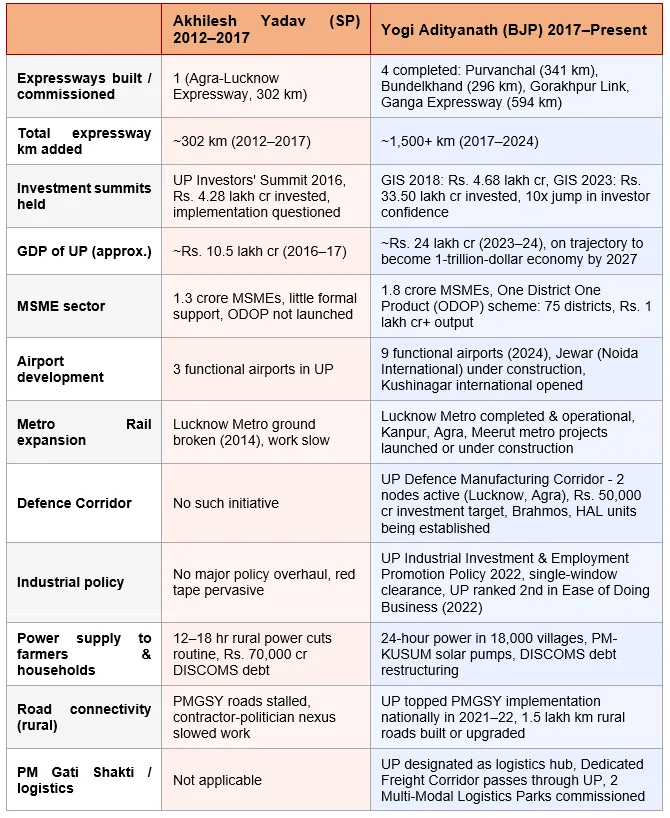
The Samajwadi Party economic record between 2012 and 2017 was bad. The 2016 UP Investors Summit was held with great fanfare in Lucknow, with Rs. 4.28 lakh crore in investment pledges announced. Follow-up reports including CAG assessments and independent analysis found that actual investment implementation was a fraction of announced investment. The reason was not hard to identify, in a state where law and order was unreliable, where electrical supply was regularly interrupted, where land acquisition could be weaponised politically and where bureaucratic red tape intersected with extortion networks, no investor of serious intent would commit capital at scale.
The MSME sector is UP employment backbone, supporting over 1.3 crore units at the time, received little coherent policy support. The One District One Product (ODOP) concept, which would later transform UP artisanal and manufacturing clusters, simply did not exist. Power supply to industry was unreliable, particularly in the industrial belts of Kanpur, Meerut and Noida. UP DISCOMS accumulated debt exceeding Rs. 70,000 crores, making further investment in the power sector politically difficult.
The most regression in economic verdict came from the Ease of Doing Business rankings. Under the SP government, UP was consistently ranked in the bottom quartile of Indian states on business environment parameters. Investors spoke privately of being asked for bribes at every stage of clearance, of political fixers who operated as informal tax collectors and of an administration that was structurally hostile to capital.
Yogi transforming expressways, defence corridors & the trillion-dollar dream
The infrastructure under Yogi Adityanath by any neutral measure is immense. Four major expressways were completed or substantially advanced the Purvanchal Expressway (341 km), the Bundelkhand Expressway (296 km), the Gorakhpur Link Expressway and the Ganga Expressway (594 km) the longest in India. UP, which had one expressway in 2017, now has more expressway kilometres than any other Indian state.
Airport development underwent from 3 functional airports in 2017, UP moved to 9 by 2024, with the greenfield Jewar International Airport, designed to become one of Asia’s largest under active construction near Noida. The Kushinagar International Airport was inaugurated in 2021, connecting Buddhist pilgrimage circuits to the world. Strategically these airports are not just infrastructure it reflects how UP sees itself becoming.
The Uttar Pradesh Defence Manufacturing Corridor deserves special mention as perhaps the most ambitious single economic initiative in the state’s post-Independence history. Spread across nodes in Lucknow, Kanpur, Agra, Aligarh, Jhansi and Chitrakoot, it has attracted commitments from Brahmos Aerospace, HAL and a range of defence component manufacturers. If it reaches its stated potential, it will permanently alter UP’s industrial character from an agrarian economy to a manufacturing powerhouse.
The Global Investors’ Summit of 2023 shattered all precedents by Rs. 33.50 lakh crore in investment pledges, eight times of the amount pledged at the 2016 SP summit. Critics rightly note that pledges are not disbursements. But the trajectory itself carries meaning the difference between Rs. 4.28 lakh crore in investor interest in 2016 and Rs. 33.50 lakh crore in 2023 reflects a fundamental shift in how corporate India and global capital perceive UP as an investment destination.
One District One Product (ODOP), launched in 2018 became a model adopted by the central government. By identifying a signature craft or product per district such as Varanasi silk, Lucknow chikankari, Agra leather, Moradabad brassware, Firozabad glassware. Also linking artisans to formal supply chains, e-commerce platforms and export markets, ODOP quietly changed the livelihoods of millions. UP MSME output crossed Rs. 1 lakh crore and its share of national MSME exports grew substantially.
Infrastructure & economy scorecard
Building a state from the ground zero
The Yogi government economic record must acknowledge its limitations. UP GDP growth, while impressive in absolute terms, has been substantially driven by central government transfers, PMAY construction and expressway spending all of which are capital-intensive but do not automatically translate into wage employment for UP citizens.
Agriculture which employs over 60 per cent of UP’s workforce has seen some gains from better irrigation and MSP implementation. A truly honest assessment of the Yogi government’s economic legacy is the data on income distribution, rural wage growth and the actual employment multiplier from the Defence Corridor and airport investments.
UP in 2024 is a different economic entity from UP in 2017, more connected, invested-in, diversified and regarded by global capital. The question of whether the fruits of this transformation reach the sugarcane farmer in Bijnor or the handloom weaver in Varanasi is the final report business of the Yogi era and the most important question for any government that follows.
Akhilesh Yadav built a road. But one road is not a vision, it is a project. Yogi Adityanath has built an ecosystem were expressways, airports, industrial corridors, defence manufacturing nodes, rural connectivity. The law-and-order environment without which no investment vision is credible. The two endeavours are not comparable in scale, coherence or ambition.
UP journey from a state that investors fled to a state they are competing to enter is not accidental. It is the product of policy choices, political will and a law-and-order environment that finally made business possible. The trillion-dollar economy target by 2027 may be aggressive. But the fact that it is being discussed by NITI Aayog, by global investors and by UP own bureaucracy is itself a measure of how far the state has travelled.