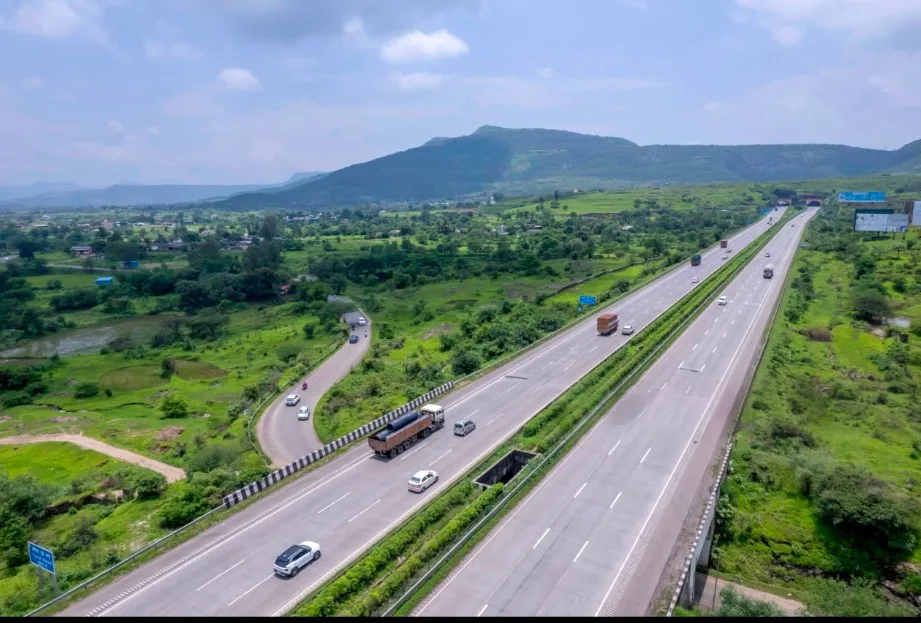
On April 14, 2026 Prime Minister Narendra Modi inaugurated the Delhi-Dehradun Expressway at the Forest Research Institute, Dehradun. The 210-kilometre, six-lane, access-controlled corridor, built at a total cost of approximately Rs 11,868 crore under the Bharatmala Pariyojana, is not a new road. It is a case study in how twenty-first century India is attempting to resolve the long-standing friction between high-speed development, ecological preservation and regional integration.
The most immediate impact will be visible over the journey between Delhi and Dehradun, which previously consumed six to seven hours on congested highways, now takes approximately two and a half hours. The corridor begins near Akshardham Temple in Delhi and passes through Uttar Pradesh districts of Baghpat, Baraut, Shamli and Saharanpur before entering Uttarakhand and ending in Dehradun. It connects three states and provides a direct spur to Haridwar, linking seamlessly with the Char Dham Highway.
What distinguishes this expressway beyond its speed is its ecological engineering. The final 20 kilometres pass through the sensitive terrain of Rajaji Tiger Reserve. To navigate this project incorporates a 12-kilometre elevated wildlife corridor described by Uttarakhand’s Forest Minister Subodh Uniyal as Asia longest designed to preserve the unhindered movement of elephants and other wildlife. Sound barriers, light barriers and 113 road underpasses complement the 340-metre tunnel near the Daat Kali temple. It represents a structural acknowledgment that infrastructure must coexist with ecology not eradicate it.
Developed across four phases, the expressway is equipped with an Advanced Traffic Management System (ATMS) and is designed to handle 20,000 to 30,000 vehicles per day at an average speed of 100 km/h. With link roads extending toward Haridwar and an eventual connection to the Ambala–Shamli Expressway, the project’s footprint expands well beyond its 210-kilometre mainline.
Indian road network before 2014
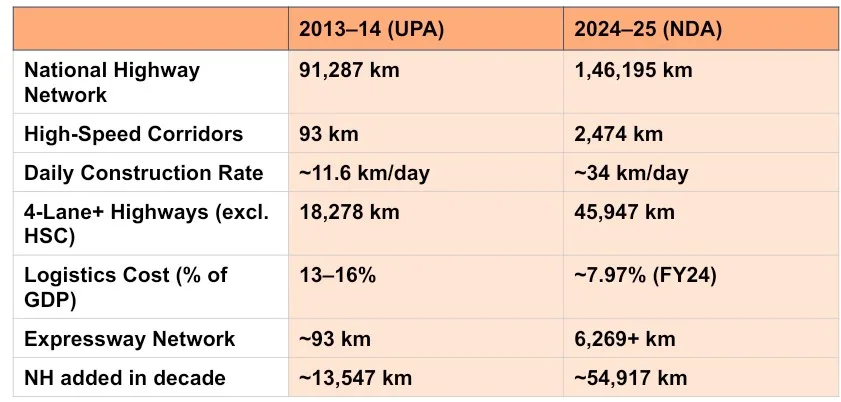
To understand the what has changed in one decade, one must return to where India stood before 2014. In 2013–14, India National Highway network measured 91,287 km. The pace of highway construction averaged 11.6 km per day a figure that appears modest when set against the demands of a 1.4-billion-person democracy with vast geographic diversity. High-speed corridors, expressways with access control and divided carriageways stood at just 93 km nationally.
The United Progressive Alliance government of 2004–2014 added approximately 13,547 km to the national highway network over an entire decade. Administrative bottlenecks, chronic delays in land acquisition, limited budgetary allocations and weak project monitoring mechanisms meant that sanctioned projects frequently exceeded deadlines and budgets. The National Highways Authority of India (NHAI) struggled with execution, while private sector participation stalled under an unfavourable policy environment. The road network is built by the standards of a rapidly industrialising economy.
India logistics cost during this period hovered at 13 per cent to 16 per cent of GDP, a figure that was nearly double the global average of 8 per cent for developed economies and a structural tax on every manufacturer, farmer and exporter in the country. National highways though comprising barely 2 per cent of the total road network, were already carrying approximately 40 per cent of road traffic, a mismatch that translated directly into congestion, vehicle wear, fuel waste and economic inefficiency.
Before and After: Indian highway at a glance
The Transformation: A decade of numbers
The Ministry of Road Transport and Highways has overseen a transformation that is, by any comparative measure extraordinary. India National Highway network has grown by 60 per cent over a decade, reaching 1,46,195 km by 2024. The construction rate has nearly tripled from 11.6 km per day in 2013–14 to approximately 34 km per day in 2025. High speed corridors have expanded from 93 km to 2,474 km, a growth of more than 26 times. The four lane and above highway network has expanded 2.5 times from 18,278 km in 2014 to 45,947 km today.
The budgetary commitment for this growth is equally supportive. Ministry investment in road infrastructure has increased 6.4 times between 2013–14 and 2024–25. The road transport and highways budget has seen a 570 per cent increase between 2014 and 2023–24. The Union Budget 2024–25 alone allocated Rs 2.72 lakh crore to the Ministry of Road Transport and Highways. Under the Bharatmala Pariyojana. India’s flagship road development programme approved in 2017 for 34,800 km at an estimated cost of Rs 6,92,324 crore over 26,425 km has been awarded and approximately 20,378 km completed by early 2025.
Projects like Bharatmala, upgraded expressways and dedicated freight corridors drove this acceleration, supported by faster environmental clearances. A reinvigorated Public-Private Partnership model and the Hybrid Annuity Model that incentivised private sector participation. As of 2023, Indian road network became the world second largest after the United States a milestone that reflects both scale and sustained policy intent.
How Roads Build Nations: The economic case
Infrastructure is not only about connectivity. It is the foundation on which economies are built, industries are located and agricultural produce reaches markets. Indian road network carries over 71 per cent of its freight and approximately 85 per cent of its passenger traffic. National highways, covering barely 2 per cent of the total road network, carry about 40 per cent of total road traffic. The economic multiplier is demonstrable every rupee spent on roads has delivered a return of 3.2 per cent to GDP according to government assessments.
The road infrastructure transformation is the fall in logistics costs. For much of the previous decade, India’s logistics costs hovered above 13 per cent of GDP, a structural handicap for manufacturing competitiveness, more than double the 6–8 per cent typical of advanced economies. A joint study by IIT Chennai, IIT Kanpur and IIM Bangalore documented progress from 16 per cent to approximately 10 per cent following the new expressways and economic corridors. The Economic Survey 2025–26, citing a DPIIT–NCAER study, confirms India’s logistics costs fell to 7.97 per cent of GDP in FY24, down from 8.84 per cent in FY23 dropping below the 8 per cent threshold for the first time.
This decline has profound downstream effects. Economists predict that India’s industrial profitability could increase by 3 per cent to 5 per cent and GDP growth that may rise by 0.5 per cent to 1 per cent as a result of logistics cost reduction alone. The Bharatmala programme was specifically designed with a vision to reduce supply chain costs from 18 per cent to 6 per cent supporting India’s ambitions as a global manufacturing hub under initiatives like Make in India.
Beyond macroeconomic aggregates, roads create direct employment. The Bharatmala project is anticipated to generate 100 million person-days of employment and close to 22 million jobs. The Cabinet Committee on Economic Affairs has approved eight major National High-Speed Corridor projects spanning 936 km, with a total investment of Rs 50,655 crore, projected to generate 4.42 crore man-days of employment. Under the Pradhan Mantri Gram Sadak Yojana-IV (2024–29), Rs 70,125 crore has been sanctioned to connect 25,000 unconnected habitations through 62,500 km of rural roads ensuring the benefits of national highway expansion percolate to the last village.
Regional integration and strategic connectivity
India’s expressway and highway development is not confined to its economic heartland. The strategic dimensions are equally significant. The Northeast long underserved and geographically challenging has received approximately 10,000 km of highways since 2014 with an outlay of Rs 1.07 lakh crore. An additional 5,000 km is under construction. As of December 2024, 190 projects spanning 3,848 km were active across the eight northeastern states, costing Rs 82,452 crore.
The all-weather Char Dham road project in Uttarakhand and the Delhi–Dehradun Expressway to Haridwar together constitute a new connectivity for India’s pilgrimage economy, an economy that sustains millions of livelihoods. The Gorakhpur Link Expressway connecting Gorakhpur to Azamgarh, the Purvanchal Expressway from Lucknow to Ghazipur, the Bundelkhand Expressway in Uttar Pradesh and the Samruddhi Mahamarg linking Mumbai to Nagpur represent the geographic breadth of the expressway revolution by connecting aspirational regions.
The integration of PM Gati Shakti the National Master Plan for multimodal connectivity, under which 293 infrastructure projects worth Rs 13.59 lakh crore have been evaluated by July 2025 ensures that highways are planned in conjunction with railways, ports and logistics parks. Thirty-five Multimodal Logistics Parks are being developed with an investment of approximately Rs 46,000 crore. The FASTag ecosystem with over 10.30 crore FASTag issued and an average daily collection of Rs 192 crore, with 98.5 per cent penetration in total fee collection at 1,051 National Highway fee plazas has digitised the user fee economy while eliminating queues and friction.
Challenges and government initiatives
The Delhi–Dehradun Expressway itself was inaugurated with wayside amenities such as rest areas, petrol pumps, restaurants still incomplete along much of its length. The expressway had missed its original December 2024 deadline. These are not incidental lapses they reflect the challenge of execution at different scale and the complexity of coordinating land acquisition, environmental clearance and construction across multiple state jurisdictions.
At the systemic level Indian logistics efficiency improvements have been uneven. Rural and last-mile connectivity remains fragmented. Around 60 per cent to 65 per cent of freight still moves by road and the lack of seamless integration between highways, rail lines, ports and warehouses sustains hidden inefficiencies particularly in agriculture, where perishable products often do not reach markets in time despite record highway construction. Multimodal thinking not completing only kilometre targets but it will define the next phase of India’s infrastructure agenda.
The expressway network now spans 6,269 km with over 11,000 km currently under construction. India’s road infrastructure sector, with a projected CAGR of 9.50 per cent from FY2025 to FY2032, is expected to reach $559 billion by FY2032. The canvas is vast, the momentum is real and the stakes in employment, manufacturing competitiveness and national cohesion could not be highest.