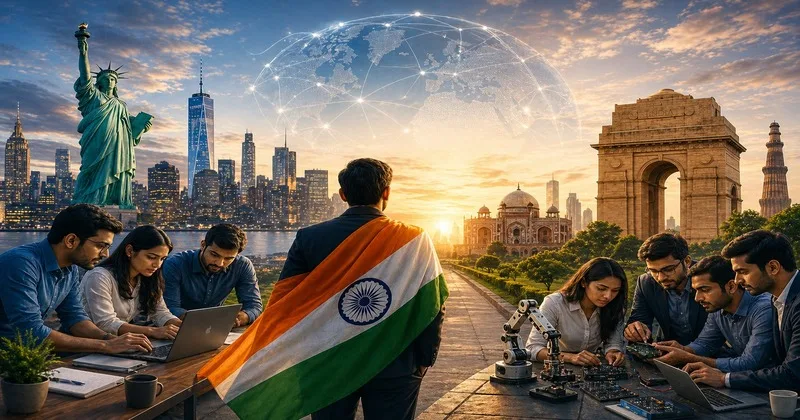
Indian professionals in the United States represent one of the most successful migrant communities in modern history. Arriving with strong educational foundations, cultural grounding, and immense determination, they have excelled across science, technology, medicine, finance, and entrepreneurship. Their achievements stand as a testament both to individual merit and to the intellectual capital nurtured in India.
Open letter to Indians in America.
—
Dear brothers and sisters from Bharat:Like I did 37 years ago, you arrived in America with no money but with a good education and cultural heritage from Bharat. You achieved outstanding success. America was good to us. For that we must…
— Sridhar Vembu (@svembu) April 27, 2026
Yet today, a complex shift in perception surrounds immigrant success in America. In certain sections of American society, across political divides, there is a growing debate about immigration and job competition. While Indian professionals continue to be valued deeply in sectors like technology and healthcare, they are also occasionally drawn into broader political narratives about globalisation, outsourcing, and labour markets. This evolving environment raises a deeper question for the Indian diaspora: not only how they are perceived abroad, but how they perceive their own long-term role in shaping the future of India.
From Migration to Mission
The first generation of Indian migrants to the United States often left not from abundance, but from aspiration. They carried with them India’s strongest export: intellectual rigour combined with cultural resilience. Over decades, they built careers, institutions, and communities that have earned global respect. However, a new phase is emerging. India today is no longer the India of scarcity that many left behind. It is a rapidly growing economy, a rising technological hub, and a nation attempting to position itself as a global innovation centre.
In this context, the diaspora faces a strategic question: should success remain geographically anchored abroad, or can it become a force multiplier for transformation in India itself?
The Shifting Global Perception of Indian Talent
Indian professionals abroad are widely respected, but global attitudes toward immigration and outsourcing remain fluid. In many advanced economies, economic uncertainty has fueled political narratives that question the role of foreign talent in domestic job markets. These debates are not unique to Indians; they reflect broader tensions in globalisation. Yet one reality remains constant: respect in the global order is increasingly tied to national capability. Countries that lead in artificial intelligence, semiconductors, biotechnology, space technology, and digital infrastructure command influence beyond population size or historical legacy. For India, this means that diaspora success alone is not sufficient for long-term civilizational recognition. It must be complemented by domestic technological strength.
India’s Technological Imperative
India today possesses one of the world’s largest pools of engineering and scientific talent. Its startup ecosystem is expanding, its digital public infrastructure is globally recognised, and its space and defence capabilities are advancing steadily. However, a persistent challenge remains: the migration of high-end talent to developed economies. This “brain drain” has historically contributed to global innovation but has also slowed the pace of deep technological consolidation within India. The central argument emerging from this perspective is not anti-migration, but pro-reinvestment: the idea that India’s most experienced global talent could play a transformative role if more actively engaged with domestic innovation systems.
The Call to Engage with Bharat’s Future
The appeal often made to the diaspora is not simply emotional—it is strategic. Returning to India, even partially or through structured engagement, allows professionals to contribute to a rapidly evolving ecosystem that now offers opportunities in:
* advanced manufacturing
* artificial intelligence and data science
* space technology and defence innovation
* digital governance and fintech infrastructure
The argument is that India’s next phase of growth requires not only capital and policy, but experienced global expertise capable of scaling systems, building institutions, and mentoring the next generation.
India’s global diaspora has often been described as a “soft power bridge” between nations. That role remains important. However, there is also a growing view that diaspora responsibility extends beyond representation to contribution. In this framing, success abroad is not seen as an endpoint, but as a phase in a larger civilisational journey, one that connects global experience back to national development. This perspective emphasises continuity: the idea that India’s cultural and intellectual identity is not diminished by migration, but strengthened when global knowledge flows back into its development process.
A Dual Path Forward
The future does not require a binary choice between staying abroad or returning to India. Instead, it may require a dual engagement model, where Indian professionals contribute globally while also participating in India’s technological and institutional rise. The underlying message of this appeal is simple: India’s rise as a global power will depend not only on its domestic policies and demographic strengths, but also on how effectively it reconnects with its global talent ecosystem. For many in the diaspora, the question is no longer just where success was built, but where it can matter most in the decades ahead.