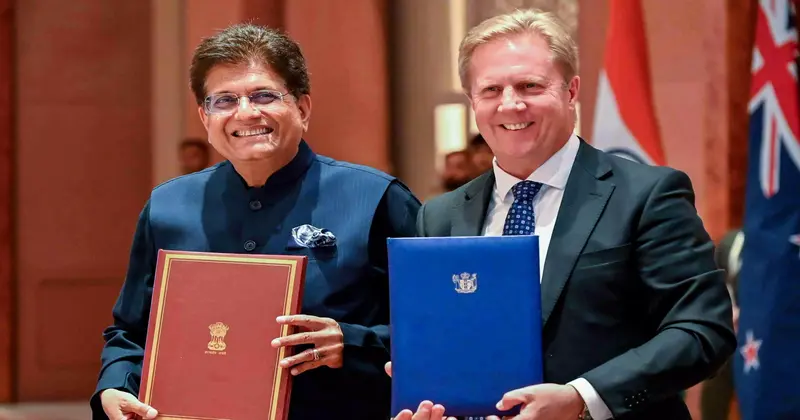
Bharat has once again demonstrated its economic prowess and strategic foresight on the global stage. The official seal placed on the Free Trade Agreement between Bharat and New Zealand paints a vivid picture of a ‘New Bharat’- one that identifies opportunities, gives them shape and moves forward by forging connections with the entire world.
Indeed, having finally materialized after a decade-long wait, this agreement is igniting a sense of renewed energy, fresh confidence and global identity within every Indian. Tracing its origins, discussions regarding this agreement between Bharat and New Zealand first began in 2010. After several rounds of negotiations, the process stalled in 2015. However, the tide turned, global economic equations shifted and in 2025, both nations once again took steps in this direction. Following just a few months of intensive negotiations, the agreement reached its final form. This rapid pace is, in itself, a testament to how capable and self-assured India has become today in making decisive decisions.
In a message, PM @narendramodi said that the India-New Zealand FTA marks a major milestone towards deeper global engagement and shared prosperity.
It strengthens economic ties between two vibrant democracies, unlocking opportunities for farmers, artisans, youth, entrepreneurs,… pic.twitter.com/zglAERVVcj
— PMO India (@PMOIndia) April 27, 2026
The most significant feature of this agreement is its wide-ranging impact. It paves the way for the simultaneous advancement of numerous sectors, including employment, investment, education, healthcare and skill development. In particular, this agreement presents a golden opportunity for India’s youth. For young Indians aspiring to showcase their skills abroad, the pathways have now become significantly smoother. Under a new visa regime to be introduced by New Zealand, thousands of Indian professionals will gain the opportunity to work there. Indian talent is set to make its mark across sectors such as IT, education, healthcare, finance and construction.
The agreement also offers a distinct glimpse of Indian culture and traditional knowledge. A global platform is being created for Yoga instructors, AYUSH practitioners, chefs specializing in Indian cuisine and artists who teach music. In this context, it must be said that this opportunity has emerged before us not merely as a means of generating employment, but also as a powerful medium for taking India’s cultural heritage to the world.
Just over a year ago, I met with Prime Minister Modi in India.
We agreed then, that we’d launch negotiations on a free trade agreement. For decades, many people said it couldn’t be done. But tonight, that deal gets signed.
This is a once-in-a-generation agreement that gives NZ… pic.twitter.com/miY4ldfXM5
— Christopher Luxon (@chrisluxonmp) April 27, 2026
The impact of this agreement is also expected to be profoundly positive for Indian industries. Sectors such as textiles, leather, plastics, engineering and food processing will now enjoy duty-free access to the New Zealand market. This directly implies that Indian products will become more competitive there, leading to a rapid surge in exports. For entrepreneurs in cities like Agra, which boasts a strong identity in the leather industry, this agreement opens the door to new opportunities.
This agreement holds immense significance for the pharmaceutical and medical device sectors as well. Indian companies will begin to receive expedited approvals in New Zealand. This will result in reduced costs and ensure that Indian medicines reach the local population much more rapidly. It will also serve to strengthen global health cooperation. Conversely, for New Zealand, this agreement represents nothing short of a major opportunity. A vast consumer market like Bharat will now become far more accessible for their products. Items such as kiwifruit, cherries, blueberries, avocados, wool, timber and seafood will become readily available in the Indian market.
In the realm of investment, too, this agreement unlocks new possibilities. Projections suggest that New Zealand is likely to undertake large-scale investments in Bharat over the coming years. Such investments spanning sectors like infrastructure, agricultural technology, education, tourism and healthcare will accelerate India’s economic momentum, thereby infusing fresh energy into the nation’s developmental journey.
Zero-duty access to New Zealand markets will benefit India's major sectors! 🇮🇳🇳🇿#IndiaNZFTA pic.twitter.com/XxMi9r5q7z
— Piyush Goyal (@PiyushGoyal) April 27, 2026
Another salient feature of this agreement is the meticulous attention paid to safeguarding the interests of India’s farmers and small-scale industries. Sensitive sectors- such as dairy, sugar and certain metals have been excluded from the scope of this agreement. This provides a protective shield to domestic producers, ensuring that their competitive edge remains intact. Furthermore, stringent import regulations have been established for products like apples, kiwis and Manuka honey, thereby shielding Indian farmers from undue pressure.
Viewed in this light, India’s strategic vision becomes abundantly clear; the nation aims to establish a strong foothold in smaller yet strategically significant global markets. This agreement with New Zealand marks a major stride in that very direction. It stands as a significant milestone in the ongoing efforts to bolster economic cooperation across the Indo-Pacific region. Current trade figures between Bharat and New Zealand are projected to multiply manifold in the times to come. New opportunities, new possibilities and new successes are associated with this agreement.
All in all, the India-New Zealand FTA marks a moment of immense pride for every Indian today. This agreement narrates the saga of a self-reliant and self-confident Bharat that is marching forward, keeping pace with the world. It represents a new beginning, a new direction in which India is establishing a strong presence on the global economic map, day by day.