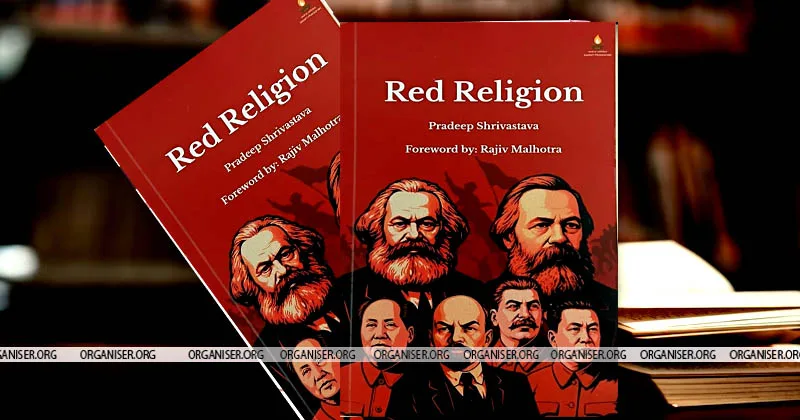
Many of us have said and heard remarks that Communism is a cult, a religion like any Abrahamic religion. To many, it would be blasphemous to compare an anti-religious ideology with orthodox ones. While Communism is all about materialism in this life, Western religions are about spiritual well-being and the afterlife. As you read the book, it dawns on you that the author is putting forward something that is there in the open but missed by normal readers. No researcher that I know of has presented evidence going deeper into this ideology to show why it is a religion in itself, and how it fits into the Western framework of religion.
This is why the book ‘Red Religion’ becomes important. Pradeep Shrivastava has done a great deal of research, going to the very roots of this “religion” and presenting historical context by comparing it with Abrahamic religions like Christianity and Islam. The book has enough gravitas to persuade renowned scholar Rajiv Malhotra to write its foreword. The author perceptively notes that the fundamental human longing for transcendence is at the heart of both Communism and religion. Communism promises an earthly Eden, a classless utopia purged of inequality and suffering. Religion beckons to a heavenly kingdom, a realm of eternal bliss beyond the earthly coil. Both offer escape from the present’s limitations.
Stories given by the author bring forth the nature of the movement. I must admit, even I did not know of many such stories. It has a very rich bibliography. For this, the author, Pradeep Shrivastava, deserves full credit
The book is divided into neat sections, and within them, very precise, compact chapters. Sections define the broad categories of ideological issues, while chapters take up individual points within each section. For example, there is the Book of Fundamentals, Book of Beliefs, Book of Practices, and so on. In the Book of Beliefs, there is a comparison between the Ten Commandments and Marx’s commandments, along with the idea of Original Sin. There are eight books (sections) in the book. The book ends with a chapter titled ‘Book of Present and Beyond’. It is most important because it explains, pithily, the evolution of Marxism and goes on to present new-fangled forms of Marxism such as Cultural Studies, Critical Theory, Gender Studies, etc. To quote the author again: “The seeds of Communism may have scattered, but their tendrils still reach across the globe, influencing our discourse, shaping our movements.”
Now for some critique. This book is a path-breaking study and a starting point for any young thinker to understand the historical background of the communist movement, its founders, and the principles that power it. The stories given by the author bring forth the nature of the movement. I must admit, even I did not know of many such stories. It has a very rich bibliography. For this, the author, Pradeep Shrivastava, deserves full credit, as do the publishers who have published it. However, this book needed at least 20 more pages (there are 173 pages now) without diluting its pithy presentation and readability.
The chapters on ‘The Role of Women’ in Marxism and Abrahamic religions needed expansion. The status of women, their persecution, and religion-based sanction for unequal treatment of half of the population needed more elaboration. Similarly, the chapter on ‘Intolerance’ could have included examples from the Indian communist movement as well. The chapter on ‘Contradictions’ could have become a full section by itself. It is the Achilles’ heel of Communism that was exposed by Dattopant Thengadi, a great RSS ideologue, way back in the 1970s. He had, in fact, predicted its downfall at a time when it was at its peak.
While discussing the failure of the idea of a communist community via collective farming, which resulted in great famines in the USSR and China in different periods, the author should have mentioned the “Great Leap Backward” by Mao. The Great Sparrow Campaign (1958–1960) was launched by Mao Zedong during China’s ‘Great Leap Forward’ to eradicate sparrows, which were wrongly labeled a “pest” that ate grain and reduced its availability for human consumption. Citizens were mobilised to kill millions of birds through noise-induced exhaustion, destroying nests, and shooting. The resulting ecological imbalance led to a massive surge in the locust population, severely damaging crops and contributing to the catastrophic Great Chinese Famine, which caused 15 to 55 million deaths. In the chapter ‘Importance of Faith’, the horrible Inquisitions by the Church also needed mention.
To be fair, this book does present alarming figures of the loss of human lives under Communism and Abrahamic religions. The only reason they were killed was that they refused to accept the new “religions” of Communism or Abrahamic faiths. However, it misses examples from Bharat of the three religions—Red Religion versus Christianism and Islamism.
The success or survival of Marxism — the original inspiration of Communism — should be credited to the innovative thinking of its new-age thinkers like Gramsci, its nimbleness, and the quick adaptability of its followers to changing society at the intellectual level. Pradeep brings out the morphing of communists into different hydra heads quite well. Similarly, Islamic thinkers also used the vehicle of neo-Marxism, which changed the definition of oppression from a single oppressor and a single oppressed class to multiple oppressing groups versus multiple oppressed groups. They used it effectively to present themselves as a minority (though they are about to surpass Christianity as the most followed religion), oppressed by Christians, whites, and others. Thus, from perpetrators of some of the most heinous genocides and terror attacks, they transformed themselves — using academia and media — into an “oppressed” class, and Islamophobia became an accepted term.
Despite my critique, I believe that Pradeep Shrivastava has filled a vacuum in academic studies with a theoretical framework for recognising Marxism and Communism as the “Red Religion,” though many consider it a cult. This book needs an expanded, updated version. It should become standard reading material for beginners in political science and for researchers who wish to get to the roots of the Left movement and understand it better before starting their own research. A must for any student or researcher in the field of humanities.