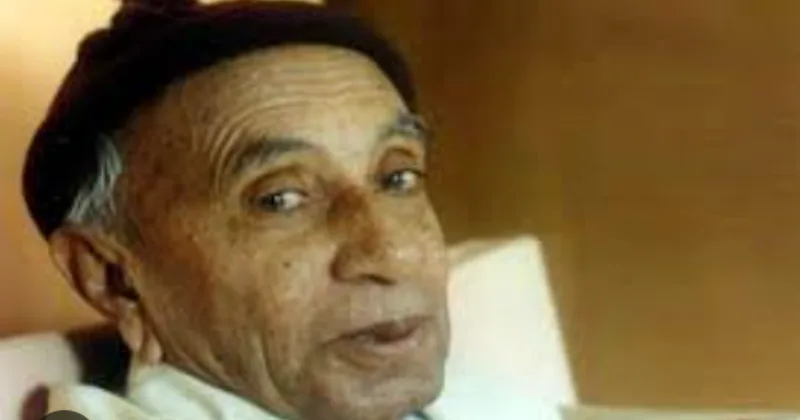
The chief of the Sindhudesh Revolutionary Army (SRA), Syed Asghar Shah, has said that the “thought and struggle” of GM Syed remain the guarantee of Sindh’s “survival and freedom,” marking the nationalist leader’s 31st death anniversary.
In a statement, he said the Sindhi nation and its movement must reassess their position in light of rapidly changing political conditions and adopt new methods to advance what he described as the struggle for freedom. “The historic personality, thought, and struggle of GM Syed are the guarantee of Sindh’s survival and freedom,” he said.
He said freedom was the “natural and historical right” of the Sindhi nation and alleged that a state like Pakistan, which he described as “unnatural and ahistorical,” could not suppress it for long, arguing that its history and recurring crises reflected flawed foundations, according to a report in The Balochistan Post.
He said the Pakistan nation state was intensifying political and economic exploitation of what he described as “forcibly annexed nations,” including Sindhis, Baloch and Pashtuns, while continuing to rely on international financial assistance. The Sindhis have contributed most significantly in the sphere of business and Balochistan, of all provinces, has the largest area, rich in minerals but the local Baloch gain nothing as Punjabis take away all the wealth of the region.
GM Syed Asserted Sindhi Identity
Referring to regional developments, he said the world, particularly West Asia, was once again witnessing conflict, adding that such conditions historically lead to changes in borders and alliances. It is a time when the Sindhi movement must reorganise and move forward with strategies rooted in GM Syed’s ideas of “reason, awareness and understanding”. Incidentally, Syed had contributed significantly to the creation of an independent Pakistan but was dumped later.
He also spent long years in Pakistani jails after being branded as a Sindhi nationalist and anti-national and anti-Pakistan. He worked for Jinnah’s dream of Pakistan but was later disillusioned with the way the new nation state was dominated by Punjabis riding roughshod over other ethnicities. He later proposed ideological groundwork for a distinct Sindhi identity and laid the foundations of the Sindhdesh movement. He had died on April 25, 1995, at the age of 91 but by then he had done so much for Sindhi nationalism.
The Punjabi-dominated Pakistan governments branded GM Syed as someone who betrayed the cause of Pakistan because he had demanded equal rights for the Sindh province. He argued that in a federal set-up, the federating units must be taken into confidence by the Federal government while taking any decisions about the entire nation. These decisions must not be imposed forcibly on smaller provinces like Sindh, Khyber Pakhtunkhwa and Balochistan.
The Sindhudesh Revolutionary Army chief said that there is a clear distinction between diplomacy and what he described as “flattery,” criticising the Pakistani state’s ability to play a meaningful diplomatic role given what he called weaknesses in its political, judicial and economic structures.
He said the ongoing situation required the Sindhi nation, particularly its youth, to remain connected to its movement and continue its struggle. The youth of Sindh must guard against their rights being snatched away by Punjab which takes a lion’s share of resources in Pakistan. Awareness about their history, rights and equality with Punjab alone can safeguard the interests of Sindhis, he asserted.
“A nation in which resistance is embedded in its memory cannot be subdued by any oppressive state,” he said, calling for what he described as a “revolutionary struggle”.