On April 12, 2026, Bharat firmly rejected Communist China’s renewed attempt to impose so-called “standardised” or “fictitious” names on locations within Arunachal Pradesh. The move came alongside reports that China has established a new administrative unit, “Cenling” county, in Xinjiang, strategically located near Afghanistan and Pakistan-occupied Jammu & Kashmir.
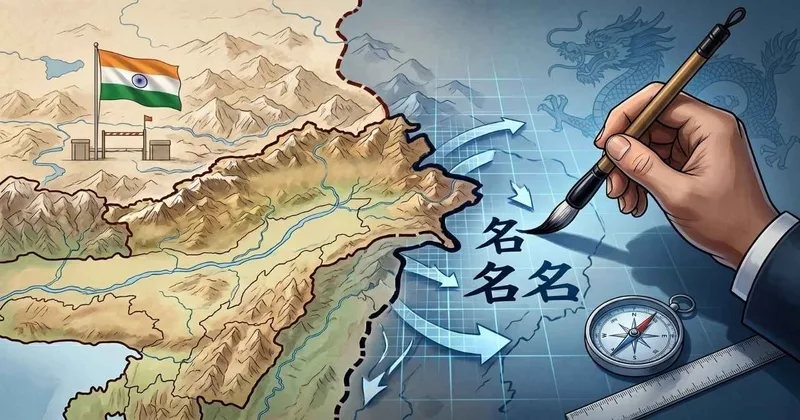
This is not merely an exercise in bureaucratic renaming. It reflects a deliberate strategy—often described as cartographic aggression—where maps, place names, and administrative measures are used as instruments to fabricate legitimacy over territories that are neither historically nor legally part of China.
A Pattern of Incremental Assertion
From 2017 to 2026, a clear pattern emerges, underscoring China’s sustained effort to reinforce its territorial claims through symbolic and administrative actions:
* 2017: The process began with the renaming of six locations in Arunachal Pradesh.
* 2021: The list expanded to fifteen sites, covering rivers, mountains, and inhabited areas.
* 2023: Eleven more locations were “standardised,” accompanied by maps depicting Arunachal Pradesh as “Zangnan” or South Tibet.
* 2024: A significantly larger list of thirty renamed locations was released.
* 2025: Twenty-seven additional names were announced, signalling a rise in both scale and frequency.
* 2026: The latest round coincides with administrative restructuring near strategically sensitive border regions.
Each phase follows a familiar script: unilateral announcements, dissemination through official or state-backed platforms, and gradual efforts to introduce and normalise these names in global discourse.
Bharat’s Consistent Position
New Delhi’s stance has remained firm and consistent across governments and over time. From 2017 through 2026, the Ministry of External Affairs has repeatedly rejected these actions, describing them as “absurd,” “baseless,” and entirely “invented.”
The core position remains unequivocal: Arunachal Pradesh was, is, and will always remain an integral part of India. Renaming exercises—no matter how frequent or elaborate—do not alter sovereignty or change realities on the ground.
Beyond Names: The Wider Strategic Context
What may appear symbolic is, in fact, part of a broader strategic design.
1. Legal Signalling Through Maps: China’s renaming efforts are often paired with revised maps, aimed at gradually constructing a quasi-legal narrative. This reflects a longer-term approach of shaping perception as a precursor to asserting claims.
2. Administrative Consolidation: The creation of new units such as “Cenling” county indicates attempts to formalise territorial claims through governance structures, even in disputed or sensitive regions.
3. Leveraging LAC Ambiguity: The 2020 standoff in Eastern Ladakh highlighted how China exploits the undefined nature of the Line of Actual Control to shift facts on the ground. Incidents in the Galwan Valley and Pangong Tso marked a decisive rupture, exposing the limits of earlier confidence-building arrangements.
4. Sustained Multi-Sector Pressure: The dispute is not limited to Arunachal Pradesh. Areas like Barahoti in Uttarakhand—a demilitarised grazing zone—demonstrate how even smaller sectors are kept active to maintain continuous strategic pressure.
Barahoti: A Quiet but Persistent Flashpoint
Barahoti represents a subtler dimension of the boundary issue. Unlike heavily militarised high-altitude zones, it has no permanent troop presence, yet remains contested, with China referring to it as “Wu Je.”
Its importance lies less in its size and more in what it signifies: the geographic spread of the dispute and the impossibility of isolating it to a single sector.
Renaming as Psychological and Diplomatic Strategy
China’s repeated use of terms like “Zangnan” is part of a calculated narrative-building effort aimed at reinforcing domestic legitimacy, influencing international academic and cartographic discourse, and introducing ambiguity into future negotiations.
Yet such efforts face inherent limits. In the absence of effective control on the ground or broader international acceptance, these names remain politically driven constructs rather than recognised realities.