

In the rapidly evolving character of modern warfare, the maritime domain has emerged as the decisive arena of power projection, deterrence and geopolitical influence. The age when land wars alone determined strategic outcomes is receding. Today, control over the seas—spanning trade routes, choke points and undersea domains—defines not only military superiority but also economic security and diplomatic leverage. This transformation is reflected globally, where even traditionally land-centric theatres are increasingly being shaped by maritime leadership. The current leadership of United States Central Command (CENTCOM) by US Navy Admiral Brad Cooper is emblematic of this shift, signalling how naval thinking now informs broader joint-force strategy.
Within this changing strategic landscape, Bharat finds itself at a crucial inflection point. Two recent developments—Japan’s proposal to co-produce Mogami-class stealth frigates in Bharat and the long-delayed but now advancing Project 75(I) submarine programme—illustrate a transition from cautious incrementalism to purposeful maritime assertion. Japan’s offer to jointly manufacture Mogami-class stealth frigates represents a watershed moment in Indo-Pacific defence cooperation.
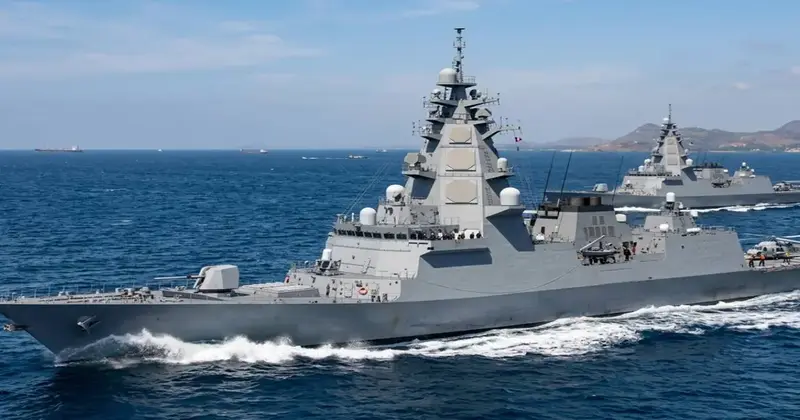
The Mogami-class, designated as 30FFM or 30DX, is among the most advanced multi-role stealth frigates in service with the Japan Maritime Self-Defence Force. These warships combine reduced radar cross-section with high-end combat capabilities, making them difficult to detect and highly lethal in contested environments. With a displacement ranging from approximately 3,900 tonnes standard to over 5,500 tonnes fully loaded and powered by a Combined Diesel and Gas (CODAG) propulsion system incorporating the Rolls-Royce MT30 turbine, these vessels can achieve speeds exceeding 30 knots. Their advanced automation allows them to operate with a remarkably lean crew of around 90 personnel, reflecting the future of efficient naval warfare.
Beyond their physical specifications, the Mogami-class stands out for its modular and network-centric design. Equipped with a 127mm naval gun, Mk41 Vertical Launch System, SeaRAM defence system and Type 17 anti-ship missiles, the platform is capable across the full spectrum of naval operations. Its anti-submarine warfare suite, including variable depth sonar and towed arrays, is particularly significant in an era where undersea threats are intensifying. Notably, its ability to deploy unmanned underwater and surface vehicles positions it as a “mother ship” for next-generation mine countermeasure operations. In essence, the Mogami-class is not merely a warship; it is an integrated combat system designed for the hybrid battlespace of the future.
Tokyo’s willingness to transfer not just platforms but also design and production capabilities marks a historic departure from its traditionally restrictive defence export policies. For Bharat, this proposal aligns seamlessly with the vision of Atmanirbhar Bharat and Make in India. Indian shipyards, particularly Mazagon Dock Shipbuilders Limited, have already demonstrated competence in constructing complex platforms such as the Scorpene-class submarines and Project 17A frigates. The absorption of Mogami-class technology would not only enhance India’s naval capabilities but also catalyse its emergence as a global shipbuilding hub.
Strategically, this collaboration strengthens the Indo-Pacific security architecture. Both Bharat and Japan share concerns over China’s expanding maritime footprint, from the East and South China Seas to the Indian Ocean Region. The co-production of advanced frigates thus serves as both a capability enhancement and a geopolitical signal—reinforcing alignment within frameworks such as the Quad and underscoring a shared commitment to a free, open, and rules-based maritime order.
If the Mogami proposal represents forward-looking strategic collaboration, the evolution of Project 75(I) reflects the importance of political will in overcoming institutional inertia. For nearly two decades, the programme to build six advanced diesel-electric submarines with Air Independent Propulsion (AIP) remained entangled in procedural delays, shifting requirements, and complex negotiations. However, recent developments—driven in large part by the focused efforts of Defence Minister Rajnath Singh—indicate that this prolonged impasse is finally being resolved.
Cost negotiations between the Ministry of Defence and Thyssenkrupp Marine Systems have been concluded, and the deal is now approaching finalisation. This breakthrough marks a significant achievement for the current government, demonstrating its commitment to addressing legacy delays that have long hindered India’s maritime preparedness. What was once emblematic of bureaucratic stagnation is now being transformed into a symbol of decisive governance and strategic urgency.
This progress is particularly critical given the operational realities facing the Indian Navy. A substantial portion of its conventional submarine fleet comprises ageing platforms, many of which are approaching the end of their service life. The absence of operational AIP capability has further constrained underwater endurance and stealth. The timely execution of Project 75(I), therefore, is not merely a procurement milestone; it is a strategic necessity. By moving the project forward after years of stagnation, the government has effectively halted a trajectory of decline and set the stage for capability renewal.
More importantly, the P-75(I) programme, once finalised, will contribute to rebuilding India’s underwater deterrence. Submarines remain among the most potent instruments of naval power, offering stealth, survivability, and strategic ambiguity. In an era of intensified maritime competition, the ability to dominate the subsurface domain is indispensable. The renewed momentum in this programme signals that Bharat is no longer content with managing decline but is actively pursuing capability enhancement.
Taken together, these developments underscore a broader strategic shift. Naval power today is not defined solely by the number of platforms but by the ability to integrate technology, maintain production timelines, and align industrial capacity with strategic objectives. Control over sea lanes ensures economic resilience, while a robust submarine fleet provides credible deterrence. The integration of unmanned systems and network-centric warfare capabilities further amplises the importance of technologically advanced platforms such as the Mogami-class.
Equally significant is the emphasis on indigenous capability. Strategic autonomy in defence production reduces vulnerability to external pressures and enhances long-term resilience. Collaborative models that involve technology transfer and local manufacturing offer a pragmatic pathway to achieving this goal. In this context, both the Mogami proposal and the progress on P-75(I) reflect a maturing approach to defence planning—one that balances external partnerships with internal capacity building.
Bharat’s maritime journey is thus entering a new phase. The Indo-Pacific is increasingly becoming the centre of global geopolitics and nations that command its waters will shape the emerging world order. For Bharat, this is not merely an opportunity but an imperative. The transition from delay to decisiveness, from dependence to self-reliance, and from regional presence to maritime leadership is now underway.
As Bharat aspires to reclaim its civilisational role as a Vishwaguru, it must anchor that vision in hard power capabilities that secure its interests and project stability. The recent strides in naval modernisation—both in surface and subsurface domains—indicate that the country is beginning to internalise this reality. The seas, once seen as peripheral, are now central to Bharat’s strategic future. And in recognising this, the nation is not only adapting to the demands of modern warfare but actively shaping the contours of a maritime century.