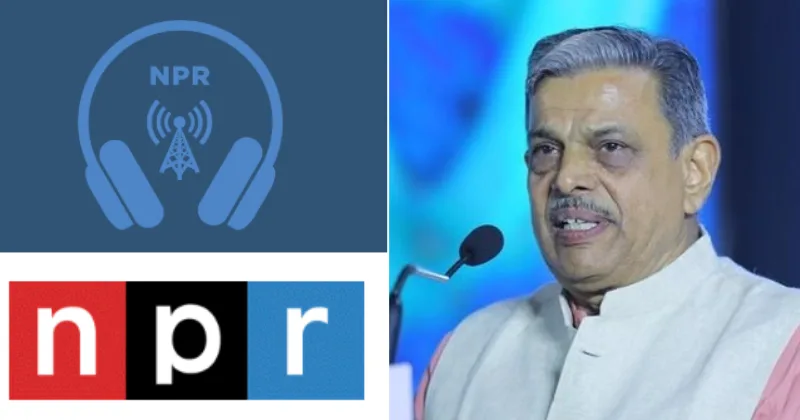
In a detailed interaction with NPR, a US based media organisation, Dattatreya Hosabale ji, Sarkaryavah (General Secretary) of the Rashtriya Swayamsevak Sangh, laid out the organisation’s ideological position, responded to criticism, and addressed questions on India’s civilisational identity, minorities, and global perception.
The interview, conducted by NPR’s Rob Schmitz in Washington D.C. during Hosabale ji’s visit to the Hudson Institute, on 23 April, marked an outreach by the RSS to Western media.
Purpose of Visit and Engagement with Media
Hosabale ji explained his presence in the US capital, stating: “To address to the wider audience about my organization and also about the role that India can play at this critical juncture in the world.”
According to NPR, Hosabale ji and his team aimed to present a perspective of the RSS that highlights “culture, civic responsibility, and family values”.
In a key exchange on the ideological position of the RSS, he said: “We are not establishing newly any Hindu nation. It is only making them realize that our civilization roots are Hindus.”
When the interviewer followed up — “So what you’re saying is you’re emphasizing the fact that it is a Hindu nation.” — Hosabale ji responded:
“Yeah. Right. It is.”
On Minorities and Their Place in Society
Responding to a direct question — “Where do they fit? in the RSS’s vision for India.” — he stated: “They are part and parcel of our nation and society. They are very much citizens as myself, and their forefathers have also been the people from India.”
Addressing concerns about Muslims being labelled as invaders, he said: “Invasion on India is a fact of history. Invasion by the Mughals.”
He further clarified: “We do not consider that the present day Muslims are invaders. The present day Muslims and their forefathers are of Indian origin. I mean majority of them, they are not the inheritance of the invasion. But India was invaded, that is true.”
When asked again, “Are you saying then that Muslim citizens of today are not referred to as invaders?”, he replied: “Not at all. They are part and parcel of our Indian society.”
“Hindu is a way of life”
In another significant exchange, Hosabale ji said: “That’s what I have repeatedly said. and we identify them as civilizationally, culturally Hindus.”
When asked, “You regard them civilizationally as Hindus?”, he responded: “Yes. They are. If you consider Hindu, by some religious angle, there is no one Hindu religion.”
He added: “It’s a way of life. Right. It’s a way of life. The Supreme Court of India has observed that Hindu is a way of life.”
To the question, “Do you think Muslims would agree with your statement?”, Hosabale ji said: “Many of them are agreeing.”
On Allegations of Extremism and Violence
The NPR interview also raised allegations linking individuals associated with Hindu nationalist groups to incidents of violence.
Responding to this, Hosabale ji said: “RSS is not an extremist organization in the sense. We are not an underground organization. We are an open organization.”
He further added: “Yeah, we are a grassroots organization and we are seen every day. We are not doing any activity behind the curtain.”
On specific cases cited during the interview, he stated: “all those incidents have been tried in the court of law and they have been disproved that no RSS member was involved. The court of law has given the verdict.”
And reiterated: “No, no RSS member was punished.”
“No such thing. Some of the people were arrested by the police, the accusation of involvement in this accident, but none of them was tried, proved to be a culprit and no one was punished.”
On India-US Relations and Remarks by Trump
Responding to a question about remarks by Donald Trump, Hosabale ji said: “Indians have contributed in United States. They have always been law abiding citizens and their allegiance has always been of high order.“
Closing Note
The NPR report concluded that the RSS continues to hold significant influence in India’s civic and cultural landscape, while expanding its global engagement, with Hosabale ji indicating a desire for the organisation to play a role in shaping India’s future.