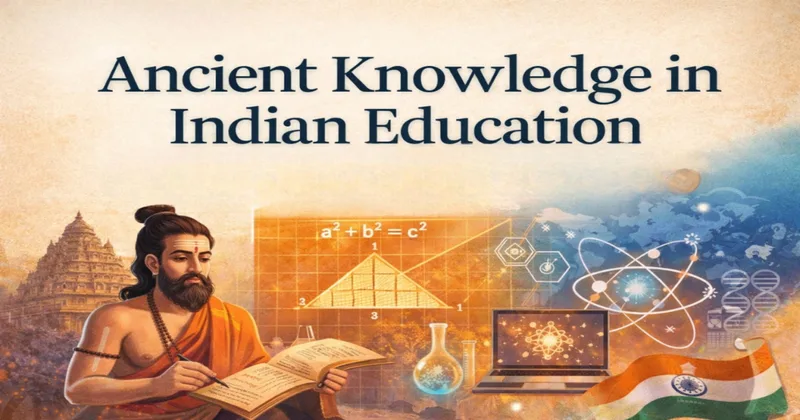
The inclusion of ancient Indian knowledge in the present day curriculum has emerged as a significant and timely subject of discussion, particularly in the context of ongoing educational reforms aimed at making learning more holistic, contextual and culturally rooted. India’s intellectual heritage spans thousands of years and encompasses a wide spectrum of disciplines, including science, mathematics, medicine, linguistics, philosophy, arts, governance, economics and environmental studies. The central challenge today is not merely to acknowledge this rich legacy, but to determine the most effective way to integrate it into the modern educational framework in a meaningful, relevant, and pedagogically sound manner.
One widely considered approach is the introduction of Indian Knowledge Systems (IKS) as a separate subject with dedicated textbooks. While this method may appear structured and systematic, it carries an inherent limitation. When ancient knowledge is presented as an independent discipline, it risks being perceived by students as disconnected from mainstream learning. This separation creates an artificial divide between traditional and modern knowledge systems, despite the fact that both are part of a continuous and evolving intellectual tradition.
To understand the implications of this approach, it is important to consider the learner’s perspective. Students today are primarily trained within a framework of modern education, which emphasizes empirical methods, analytical reasoning and contemporary applications. Over years of study, they develop a cognitive structure aligned with these principles. If ancient knowledge is introduced later as a distinct subject, it may appear unfamiliar, abstract or even irrelevant. In some cases, it may be viewed as an additional academic burden rather than a valuable intellectual resource.
Therefore, the more effective approach lies in integration rather than separation. Instead of creating standalone textbooks for ancient knowledge, relevant elements should be thoughtfully incorporated into existing curricula across all disciplines. This ensures that students encounter traditional insights in direct connection with contemporary concepts, allowing for a natural synthesis of ideas.
A practical and student friendly strategy for achieving this integration is the use of contextual text boxes, case studies or thematic inserts within chapters. These elements can highlight historical perspectives, traditional practices, classical theories, or cultural insights related to the subject matter being taught. They should be concise, engaging and directly linked to the core topic, thereby enriching the content without disrupting its flow.
In the sciences, ancient knowledge can be connected to modern principles. For instance, discussions on sound may include references to traditional architectural acoustics, lessons on materials can incorporate historical metallurgical practices and studies of health can draw parallels with holistic systems of well-being. In mathematics and logical reasoning, historical developments such as number systems, geometric constructions and problem solving techniques can be integrated into standard topics, helping students appreciate the evolution of mathematical thought.
In the humanities and social sciences, ancient Indian contributions to philosophy, ethics, political thought, economics and governance can be embedded within discussions of modern theories. Classical texts and ideas can be used to provide comparative perspectives, enriching student’s understanding of societal development.
In arts and literature, traditional aesthetics, dramaturgy, musicology and linguistic frameworks can be seamlessly incorporated into the study of creative expression, language and cultural history. This not only deepens artistic appreciation, but also strengthens cultural continuity. In commerce and management studies, ancient insights related to trade, ethics, statecraft and economic organization can be connected with modern business practices, sustainability models, and leadership principles.
In environmental studies, traditional ecological knowledge such as water conservation practices, biodiversity preservation and sustainable living, can be linked with contemporary concerns about climate change and environmental management. Beyond inclusion within chapters, an equally important component is the comparative analysis of ancient and modern perspectives. This can be presented at the end of chapters in a structured and balanced manner. Such sections should highlight similarities, differences, strengths and limitations of both approaches, without bias or uncritical glorification. The objective is not to position one system above the other, but to encourage students to engage in critical evaluation.
This comparative framework plays a crucial role in developing analytical and critical thinking skills. Students learn to interpret knowledge within its historical and cultural context, assess its relevance, and synthesize diverse viewpoints. These skills are essential for higher education, research and informed decision-making. Another key advantage of this integrated model is that it avoids increasing academic burden. By embedding ancient knowledge within existing subjects, students engage with it organically, without the pressure of an additional discipline. This also enhances retention, as concepts are learned in relation to familiar frameworks.
Over time, such integration can transform the educational experience. Students begin to perceive knowledge not as fragmented or compartmentalized, but as an interconnected continuum. This perspective bridges the gap between tradition and modernity and opens pathways for innovation, where traditional insights inspire new ideas, research directions, and practical solutions. Further, this approach fosters a sense of cultural connection and intellectual confidence among students. When learners see their own heritage reflected in the curriculum, it generates curiosity, engagement and a deeper sense of belonging. This, in turn, can motivate independent exploration and lifelong learning.
However, it is essential that this integration is carried out with academic rigor and integrity. All references must be authentic, accurately interpreted and aligned with established knowledge frameworks. Care must be taken to avoid misrepresentation, oversimplification, or ideological bias. The goal is to present ancient knowledge as a valuable intellectual resource, not as unquestionable authority.
In contrast, treating Indian Knowledge Systems as a separate subject may lead to unintended consequences. It can create conceptual isolation, reduce student engagement and reinforce the misconception that traditional knowledge is either outdated or unrelated to modern disciplines. Such outcomes undermine the very purpose of its inclusion. Therefore, the objective should be to create a seamless and interdisciplinary integration, where ancient and modern knowledge systems complement each other. Education should not present knowledge in isolated compartments but as an evolving, interconnected body of human understanding.
The inclusion of ancient Indian knowledge in the contemporary curriculum is not merely an academic reform, it is a step toward building a more balanced, inclusive and intellectually enriched education system. Rather than introducing it as a separate subject, it should be woven into existing disciplines through carefully designed contextual elements and supported by objective comparative analysis. This approach respects the cognitive development of learners, enhances critical thinking and fosters a unified understanding of knowledge.
By bridging the wisdom of the past with the innovations of the present, we can prepare students not only to comprehend the world more deeply, but also to contribute meaningfully to its future.