
Why Women’s Reservation Bill Failed Despite a Majority: Two-Thirds ‘Special Majority’ in Constitution Bill Explained!
June 30, 2026
  • Read Ecopy
  • Circulation
  • Advertise
  • Careers
  • About Us
  • Contact Us
Android AppiPhone AppArattai
Organiser
  • ‌
  • Bharat
    • Assam
    • Bihar
    • Chhattisgarh
    • Jharkhand
    • Maharashtra
    • View All States
  • World
    • Asia
    • Europe
    • North America
    • South America
    • Africa
    • Australia
  • Editorial
  • International
  • Opinion
  • RSS @ 100
  • More
    • Op Sindoor
    • Analysis
    • Sports
    • Defence
    • Politics
    • Business
    • Economy
    • Culture
    • Special Report
    • Sci & Tech
    • Entertainment
    • G20
    • Azadi Ka Amrit Mahotsav
    • Vocal4Local
    • Web Stories
    • Education
    • Employment
    • Books
    • Interviews
    • Travel
    • Law
    • Health
    • Obituary
  • Subscribe
    • Subscribe Print Edition
    • Subscribe Ecopy
    • Read Ecopy
  • ‌
  • Bharat
    • Assam
    • Bihar
    • Chhattisgarh
    • Jharkhand
    • Maharashtra
    • View All States
  • World
    • Asia
    • Europe
    • North America
    • South America
    • Africa
    • Australia
  • Editorial
  • International
  • Opinion
  • RSS @ 100
  • More
    • Op Sindoor
    • Analysis
    • Sports
    • Defence
    • Politics
    • Business
    • Economy
    • Culture
    • Special Report
    • Sci & Tech
    • Entertainment
    • G20
    • Azadi Ka Amrit Mahotsav
    • Vocal4Local
    • Web Stories
    • Education
    • Employment
    • Books
    • Interviews
    • Travel
    • Law
    • Health
    • Obituary
  • Subscribe
    • Subscribe Print Edition
    • Subscribe Ecopy
    • Read Ecopy
Organiser
  • Home
  • Bharat
  • World
  • Operation Sindoor
  • Editorial
  • Analysis
  • Opinion
  • Culture
  • Defence
  • International Edition
  • RSS @ 100
  • Magazine
  • Read Ecopy
Home Politics

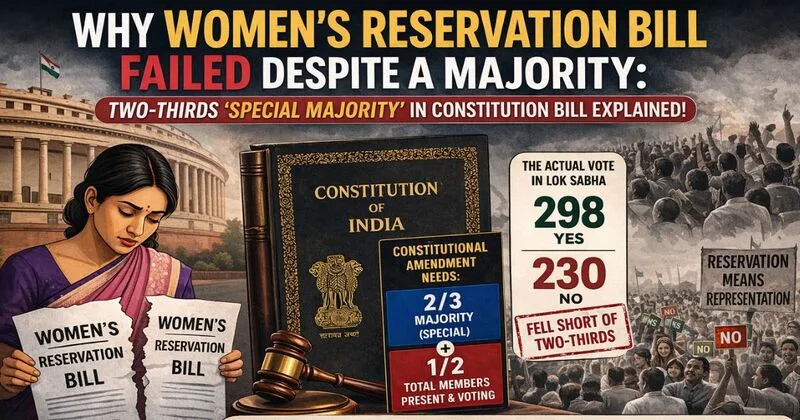
Why Women’s Reservation Bill Failed Despite a Majority: Two-Thirds ‘Special Majority’ in Constitution Bill Explained!

Black Day In Democracy! In a shocking display of political pettiness, the Opposition, led by Congress and its INDIA allies, defeated the NDA’s bold and visionary Constitution (131st Amendment) Bill that sought to finally deliver 33% women’s reservation from the 2029 Lok Sabha elections. The bill aimed to expand the Lok Sabha from 543 to 815 seats through fair delimitation based on 2011 population data, ensuring no state loses even a single existing seat. Despite the NDA’s clear majority and 298 votes in favour, the bill was blocked by narrow regional interests and vote-bank politics as the Opposition stubbornly voted against it to safeguard their comfort zones and prevent a fair redistribution that truly reflects today’s Bharat. Now, why was even a simple majority insufficient to push the Constitution Amendment Bill forward? Explained

Lakshmi RanjithLakshmi Ranjith
Apr 18, 2026, 01:00 pm IST
in Politics, Bharat, Analysis, India, Special Report
Follow on Google News
FacebookTwitterWhatsAppTelegramEmail

In a historic legislative standoff on April 17, 2026, The Nari Shakti Vandan Adhiniyam (106th Amendment Act) or the Women’s Reservation bill, 2026—designed to operationalize the 33% women’s quota—was defeated in the Lok Sabha. Despite receiving a significantly higher number of “Aye” votes than “No” votes, the Bill fell because of the unique mathematical hurdles required for constitutional changes in India.

The defeat marks a dramatic shift from the near-unanimous support seen for the Nari Shakti Vandan Adhiniyam in 2023. The Nari Shakti Vandan Adhiniyam (106th Amendment Act) or the Women’s Reservation bill which reserves one-third (33%) of seats for women in the Lok Sabha and state legislative assemblies, with sub-quotas for SC/ST women did indeed pass with an overwhelming majority in September 2023.

To operationalize the quota, the government argued that a fresh delimitation and a seat increase were the only ways to grant women 33% representation without displacing sitting male legislators. However, the Opposition remained unyielding; they feared that redrawing the map based on the 2011 Census would dilute their regional influence, despite personal assurances from PM Modi and Home Minister Amit Shah regarding the stability of North-South seat shares.

Nari Shakti Vandan Adhiniyam | Parliamentary Math: A Steep Climb for the NDA

For any Constitutional amendment to pass the Lok Sabha, a “Special Majority” is non-negotiable not a “Single Majority”. If all members are present, the government needs 360 votes. Currently, the BJP remains the single largest party with 240 seats, bringing the total NDA tally to 293 (excluding seven independents).

This leaves the ruling coalition 67 votes short of the required mark, while the non-NDA bloc holds a formidable 241 seats, led by the Congress at 98. However, it didn’t sale through the Lok Sabha, let’s see what might have happened if it had gone to the Upper House- Rajya Sabha.

The Rajya Sabha Equation
The struggle for numbers would have been equally tight in the Upper House. To reach the two-thirds majority in the 245-member Rajya Sabha, the government must secure 163 votes. NDA Strength: 145 Seats The ruling alliance currently sits at 145 members, including:

Core Strength: BJP (106), AIADMK (5), NCP (4), JD(U) (4), and various regional allies including TDP, Shiv Sena, and RLD.

Additional Support: The tally includes 7 nominated members, 1 independent (Kartikeya Sharma), and single-seat support from the MNF, NPP, and PMK.

Five nominated members who joined the BJP are already factored into the party’s 106-seat count.
Opposition Strength: The ‘No’ Vote The opposing camp, comprised of parties likely to vote against the BJP’s line, remains a significant barrier. This bloc includes:

The Leaders: Congress (29), TMC (13), and AAP (10)
Regional Blocs: DMK (8), BJD (6), Samajwadi Party (4), and a collective of 14 other parties including the CPI(M), RJD, and JMM.

What Happened on April 17 in Lok Sabha?

On April 17, 2026, the key 131st Amendment Bill was put to vote in the Lok Sabha. The result was:

  • 298 votes in favour
  • 230 votes against

This was a clear simple majority (more yes than no). But constitutional amendments under Article 368 of the Indian Constitution require a special majority

  • A majority of the total membership of the House, and
  • At least two-thirds of the members present and voting.

With around 528–540 members voting or present, the two-thirds threshold was approximately 352–360 votes. The bill fell short by roughly 50–60 votes and was declared not passed. As a result, the government withdrew the other two linked bills.

Changes that Constitution (131st Amendment) and Delimitation Bills Proposed

The Constitution (131st Amendment) Bill, 2026 aimed to increase the total strength of the Lok Sabha from 543 to 815 seats. The main idea was to bring in the women’s reservation without cutting down the existing number of seats for any state. Along with this, the government introduced the Delimitation Bill, 2026, which laid down a new process to redraw constituency boundaries based on the latest available population figures from the 2011 Census.

A third bill, the Union Territories Laws (Amendment) Bill, 2026, was brought in to make similar changes in the representation of Union Territories. At the heart of the entire exercise was delimitation. This is the process that decides how many Lok Sabha seats each state should get and where the boundaries of each constituency should be drawn.

Delimitation Stalled Since 1970s

For decades, since the 1970s, this exercise has been kept on hold, so the distribution of seats between states has remained the same even as populations have changed dramatically over time. The new bills sought to end this long freeze and allow a fresh delimitation exercise.

A Delimitation Commission would have been set up, and its decisions on the number of seats for each state, the drawing of boundaries, and the allocation of reserved seats would have been final and binding. If all three bills had been passed by Parliament, the women’s reservation would have kicked in from the 2029 Lok Sabha elections.

Topics: Women's Reservation BillRajya SabhaLok SabhaParliament
Lakshmi Ranjith
Lakshmi Ranjith
A digital journalist with over 18 years of experience in mainstream media, she began her career in television news before expanding into print, social media, and digital platforms. She has travelled extensively across India to cover elections, political developments, and major business events, reporting on issues ranging from politics and governance to business and social affairs. Her key strengths include sharp analysis of national and state politics, as well as international relations. Over the years, she has worked with The Times of India, Google, News24 Digital, MMTV, TV News, and the Ministry of Information & Broadcasting. She currently serves as Assistant News Editor at Organiser, overseeing digital platforms. She is Committed to continuous learning; she maintains high editorial standards and a strong commitment to ethical journalism in a rapidly evolving media landscape. [Read more]
ShareTweetSendShareSend
✮ Subscribe Organiser YouTube Channel. ✮
✮ Join Organiser's WhatsApp channel for Nationalist views beyond the news. ✮
Previous News

AMU Under Lens: Eight years of security lapses, campus unrest and rising concerns over institutional oversight

Next News

10 CPM Workers Convicted for Attempted Murder of RSS-BJP Workers in Kerala’s Kannur Thaliparambu

Related News

Prime Minister Narendra Modi addressing the NDA leaders meeting, marking his becoming India’s longest-serving elected prime minister and the completion of 12 years of the NDA government, at
Bharat Mandapam, in New Delhi

12 years of Modi Government: Golden chapter of stability, continuity and decisive leadership

PM Narendra Modi addressing the gallery

Women’s Reservation Bill: “Country witnessed anti-women face…,” PM Modi slams Congress, Samajwadi Party

The Unravelling of the ‘Aam Aadmi’ Illusion: Power, Pretence, and the inevitable national realignment

Womens’ Reservation Bill : Senseless Sabotage

Representative Image

FCRA: Why foreign funding is a catalyst for Maoism and religious conversion!

7 AAP MLAs join BJP

Rajya Sabha Chairman clears seven AAP MPs’ merger with BJP, taking tally to 113 in Upper House

Load More

Latest News

The Indian women's cricket team has qualified for the LA28 Olympics as the ICC confirmed the qualification pathway for cricket's historic Olympic return

Cricket’s return to the Olympic Games is a landmark moment: ICC Chairman Jay Shah

President Droupadi Murmu paid tribute to the heroes of the Santhal rebellion on the occasion of Hul Diwas

Hul Diwas: President Murmu pays tribute to heroes of Santhal rebellion, says their sacrifice will inspire forever

A representative image

Escalating unrest and civilian casualties in Pakistan Occupied Jammu and Kashmir: A 15 year overview

A representative image

Twelve years of pension reforms: Over 3.28 lakh PPOs issued through Bhavishya platform

Representative image made using AI

Religious festival or display of violence? 12 incidents of killings and attempts to kill Hindus during Muharram

A representative image

Nirbhay Chetna: Govt launches world’s largest gender sensitisation drive for women, targets 17.5 lakh representatives

A representative image made from AI

From Digital Consumer to Technology Powerhouse: How India is building technologies that are shaping Viksit Bharat 2047

Representative image

FCRA Amendment Bill 2026: Why evangelical groups are rattled over India’s oversight on foreign funding

Sir Dinshaw Maneckji Petit Birth Anniversary: Remembering Bombay's Textile Pioneer

Birth Anniversary of Sir Dinshaw Petit: The visionary who built Bombay’s textile empire

Guru Hargobind ji

Remembering Guru Hargobind Ji on Prakash Parv: Visionary who united spirituality with the sword of justice

Load More
  • Privacy
  • Terms
  • Cookie Policy
  • Refund and Cancellation
  • Delivery and Shipping

© Bharat Prakashan (Delhi) Limited.
Tech-enabled by Ananthapuri Technologies

  • Home
  • Search Organiser
  • Bharat
    • Assam
    • Bihar
    • Chhattisgarh
    • Jharkhand
    • Maharashtra
    • View All States
  • World
    • Asia
    • Africa
    • North America
    • South America
    • Europe
    • Australia
  • Editorial
  • Operation Sindoor
  • Opinion
  • Analysis
  • Defence
  • Culture
  • Sports
  • Business
  • RSS @ 100
  • Entertainment
  • More ..
    • Sci & Tech
    • Vocal4Local
    • Special Report
    • Education
    • Employment
    • Books
    • Interviews
    • Travel
    • Health
    • Politics
    • Law
    • Economy
    • Obituary
  • Subscribe Magazine
  • Read Ecopy
  • Advertise
  • Circulation
  • Careers
  • About Us
  • Contact Us
  • Policies & Terms
    • Privacy Policy
    • Cookie Policy
    • Refund and Cancellation
    • Terms of Use

© Bharat Prakashan (Delhi) Limited.
Tech-enabled by Ananthapuri Technologies