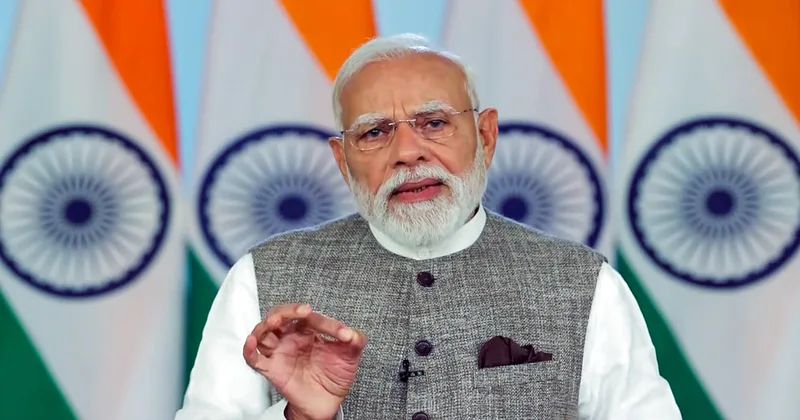
In a strongly worded address following the developments around the Nari Shakti Vandan Amendment, Prime Minister Narendra Modi launched a sharp critique of opposition parties, accusing them of obstructing a crucial reform aimed at empowering women. Framing the issue as one of rights, dignity, and long-overdue representation, the Prime Minister asserted that the government remains firmly committed to ensuring greater political participation for women despite the legislative setback.
Positioning the debate beyond mere numbers in Parliament, he emphasised that the amendment was not about political credit but about delivering justice to half of the country’s population. He also sought to reassure citizens that concerns around representation and delimitation were being misrepresented, reiterating that no state would lose its share and that the reform was designed to ensure balanced growth across regions.
Key Highlights from the Address
- Even though today we did not get the required 66% votes to pass the bill, I know that we have the blessings of 100% of the nation’s women with us.
- By opposing women’s rights, they were thumping desks in celebration. What they did was not just noise—it was an attack on women’s dignity and self-respect. A woman may forget many things, but she never forgets an insult.
- The Nari Shakti Vandan Amendment is the need of the hour. It was an effort to ensure equal growth for all states—North, South, East, and West.
- This honest effort was destroyed by Congress and its allies in Parliament, in full view of the nation.
A major reason for opposing this amendment is fear. These dynastic parties are afraid that if women are empowered, their family-based leadership will be threatened. - From day one, the government has made it clear that no state’s share or representation will be reduced. Instead, seats will increase proportionately for all states.
- By opposing women’s reservation, Congress has once again proven that it is an anti-reform party. Delay, distract, and derail—this has always been its approach.
- This issue was never about success or credit. I had said in Parliament that let women get their rights, and I would even give full credit to the opposition if needed.
- I assure every woman in the country that we will remove every obstacle in the path of women’s reservation.
- To all parties that opposed the Nari Shakti Vandan Amendment in Parliament, I want to say clearly: you are taking women’s power for granted.
The Lok Sabha took up Constitution (One Hundred and Thirty-first Amendment) Bill, Delimitation Bill, and Union Territories Laws (Amendment) Bill together for passing. In the division that took place on the Constitution Amendment Bill following the debate on the three bills, 298 members voted in favour and 230 against.
With Constitution Amendment Bill defeated, the government later said it did not want to pursue the two other linked bills.
The bills aimed to take the strength of Lok Sabha from 543 to 816 with 33 per cent reservation for women. The delimitation was to be carried out based on the 2011 census. The government said there will be proportionate increase in seats for all states.
Opposition parties said that they are strongly in favour of women’s reservation but were against the Delimitation Bill. They called upon the government to implement the women’s reservation in the existing strength of Lok Sabha.