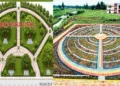
Jaipur/New Delhi 03 May। Through yet another innovation and novel initiative by the Speaker of the Rajasthan Legislative Assembly, Dr. Vasudev Devnani, a ‘Nakshatra Vatika’ (Celestial Garden) and a ‘Herbal Vatika’ (Herbal Garden) are being established within the premises of the State Assembly building. These gardens will serve as a living testament to the harmonious blend of Indian spiritual traditions, ancient astrological wisdom, Ayurvedic medicine, and environmental conservation.
Dr Devnani will inaugurate these gardens on Tuesday, May 5th, at 10:00 AM, accompanied by the Speakers of five other states. Witnessing this innovative undertaking at the Assembly will be the Speakers of the Legislative Assemblies of Madhya Pradesh, Uttar Pradesh, Himachal Pradesh, Odisha, and Sikkim—namely, Narendra Singh Tomar, Satish Mahana, Kuldeep Singh Pathania, Surma Padhy, and Migma Nabu, respectively. Also present on this occasion will be Rajasthan’s Minister for Parliamentary Affairs, Jogaram Patel, and the Leader of the Opposition, Tikaram Jully.
Nakshatra Vatika to Feature Plants Representing the 27 Celestial Constellations
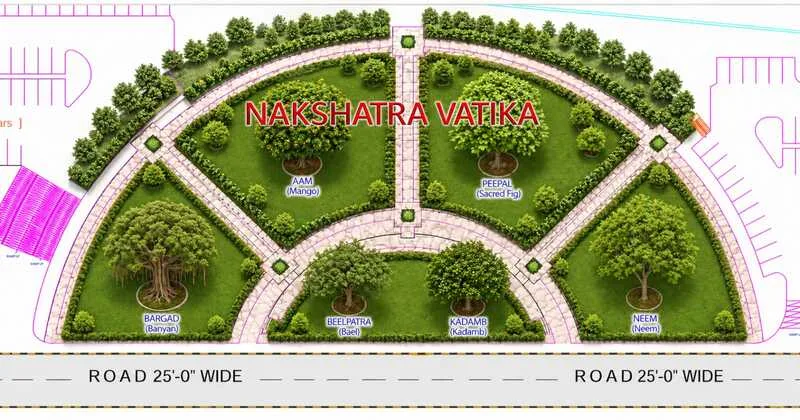
Dr Devnani explained that the concept behind the Nakshatra Vatika is rooted in the 27 celestial constellations (Nakshatras) of Indian astrology. In astrology, each constellation is believed to be associated with a specific tree. To realize this vision, a crescent-shaped garden spanning 5,000 square meters has been developed in the southern section of the Assembly complex, situated between the two parking areas. This garden will feature plants corresponding to the 27 constellations: Ashwini, Bharani, Krittika, Rohini, Mrigashira, Ardra, Punarvasu, Pushya, Ashlesha, Magha, Purva Phalguni, Uttara Phalguni, Hasta, Chitra, Swati, Vishakha, Anuradha, Jyeshtha, and Mula. Trees associated with the Nakshatras (lunar mansions)—specifically Purvashadha, Uttarashadha, Shravana, Dhanishtha, Shatabhisha, Purvabhadrapada, Uttarabhadrapada, and Revati—are being planted. These include, respectively: Kuchla, Amla, Gular, Jamun, Khair, Sheesham, Bamboo, Peepal, Nagkesar, Banyan/Bat, Palash, Pakad, Reetha/Jasmine, Bel, Arjun, Katari, Maulsri, Chir/Sambhal, Sal, Jalvetar/Ashoka, Jackfruit, Shami/Aak, Madar/Shami, Kadamba, Mango, Neem, and Mahua. Furthermore, these plants hold significance in relation to the nine planets, the twelve zodiac signs, and the Trinity (Trimurti)—Brahma, Vishnu, and Mahesh (Shiva).
Herbal Garden to Feature 38 Medicinal Plants
Dr Devnani stated that a dedicated herbal garden is also being developed within the Assembly complex, spanning an area of 850 square meters. To this end, plants belonging to 38 different species are being planted in 38 well-organized beds—each measuring 8 by 13 feet—located in the northwest zone of the Assembly premises. In each bed, 20 to 25 saplings of a single species are being planted. The collection of medicinal plants includes Rosemary, Clove, Samudra Bel, Ajwain, Baijanti, Peppermint, Patchouli, Insulin Plant, Henna (Mehndi), Patharchatta, Odomas, Keshvardhani, Ashwagandha, Citronella, Kalmegh, Agnimantha, Hadtjod, Aloe Vera (Gwarpatha), Lemongrass, Vetiver Grass (Khas), Vekhand (Sweet Flag), Tulsi, Cardamom, Pippali, Camphor, Guj, Danti, Marwa, Akkada Kada, Stevia, Ajavriksha, Shatavari, Ratanjot, Nirgundi, Red Adusa (Lal Vasa), Sarpagandha, Betel Leaf (Pan/Nagarbel), and Brahmi—all of which are plants of immense significance from an Ayurvedic perspective. Gardens: Symbols of the Indian Knowledge Tradition
Dr Devnani stated that these gardens are not merely ornamental parks, but rather living symbols of the Indian knowledge tradition. This initiative will not only promote environmental conservation but also raise public awareness regarding the specific trees associated with their respective birth Nakshatras (lunar constellations). He noted that the preservation of these Ayurvedic trees—described in ancient mythological texts—will bring prosperity and positive energy to the general public.
Future Generations to Become Acquainted with Indian Culture, Astrology, and Nature
Dr Devnani remarked that these gardens, developed within the Assembly complex, will prove instrumental in enriching biodiversity, conserving medicinal plants, and fostering a positive atmosphere. Furthermore, they will serve as an inspiring medium to introduce future generations to the profound interconnections between Indian culture, astrology, and nature.