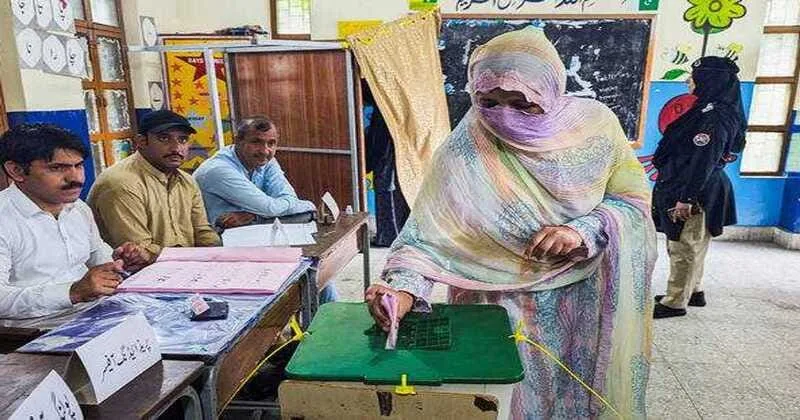
Poonch: Polling in four constituencies of Poonch Division’s Bagh and Haveli districts concluded on August 10 evening at 5 pm as part of the third phase of elections in Pakistan Occupied Jammu & Kashmir (POJK). Elections are being held across the region amid large-scale violence and shooting of dozens of supporters of the Joint Awami Action Committee (JAAC), representing all sections of society, a non-political organisation.
Citing law and order problems, the Election Commission had earlier postponed polling in Poonch and Sudhnoti districts that was originally set for today. No voting could be held on Monday in the third phase in seven constituencies of these two districts.
On Monday morning, polling began at 8 am and continued until 5PM in four constituencies. The Pakistan Peoples Party (PPP), which had accused the Pakistan Muslim League-N of rigging in the previous two phases, made the same charges on Monday as well.
In the first two phases, PPP chief Bilawal Bhutto Zardari had led his party in making charges of rigging and other electoral malpractices against PML-N. In the third phase, he was conspicuous by his absence in campaigning for his party. For the past couple of days, he has not appeared in public, and his whereabouts are not known.
In response to PPP charges of rigging, some PML-N leaders said the PPP had no evidence for its claims. They also reiterated that they will soon form the government in the region based on the seats their party has already secured.
The PML-N has so far bagged 24 seats, nine out of 13 segments from Mirpur division on July 27 and then 15 seats in the second phase comprising Muzaffarabad Division and the 12 refugee seats. On the other hand, the PPP has been victorious in 10 constituencies only.
With 24 out of 38 seats the voting for which has taken place so far, the PML-N is a clear winner and all set to form the government in POJK. It is contesting all seven seats for which voting has not been held so far. The party is likely to win some of these seats also whenever the elections are held, most likely on August 20 or 21.
Besides the seven seats on which no elections have been held, there are eight nominated members also. Of these eight seats, the PML-N is going to get a majority in the next few days or weeks whenever the nominations to these seats are made by the government.
Overall, in the 53-member assembly of POJK, 45 seats are those for which elections are held, including 12 refugee seats which have been the basis of all violence so far. Despite JAAC’s demand to abolish these seats, which have been manipulated for the past many decades, these have been continued by the government headed by Prime Minister Shehbaz Sharif.
The Election Commission had classified most of the 803 polling stations in the four constituencies as either sensitive or highly sensitive. True to these apprehensions, clashes were reported from some areas.
“Apart from the regular police of both districts, we have dispatched an additional 10,300 troops to maintain law and order and provide a fear-free atmosphere to voters,” Election Commission Secretary Raja Mohammad Shakeel said, according to a report of Dawn newspaper.
Elections are being held across the region in phases, a clear departure from what had happened across the four provinces of Pakistan in February 2024. This indicates how serious clashes have been between Joint Awami Action Committee (JAAC) protesters and the authorities. Overnight banning of JAAC and declaring it a terrorist organisation has not impacted its support base among the POJK masses.
Polling in Mirpur and Muzaffarabad divisions was held on July 27 and Aug 2, respectively, with the PML-N securing 24 seats and the PPP 10 seats so far.
The third phase of the polls was originally meant to cover all of Poonch Division. The division comprises 11 constituencies, including three in Bagh, one in Haveli, five in Poonch district and two in Sudhnoti district. However, last week the AJK Election Commission announced that polling would only go ahead as scheduled in Bagh and Haveli due to concerns over the law and order situation. There are some indications that polling on the remaining seven constituencies could be held by August 20 or 21.
Rathore, two more ex-PMs face test
Prime Minister Faisal Mumtaz Rathore and two of his predecessors, Sardar Tanveer Ilyas and Sardar Attique Ahmed Khan, face a battle for political survival as voters head to the polls. Around 238,664 men and 221,707 women are eligible to cast their ballots at 803 polling stations comprising 1,254 polling booths.
A total of 82 candidates were in the fray, with LA-14 (Dhirkot) attracting the highest number of candidates at 30 and LA-17 (Haveli) the lowest at nine.
In LA-17, Rathore is facing PML-N candidate Engr Mohsin Aziz and independent candidate Khawaja Tariq Saeed. Rathore and Saeed were political allies once and had agreed to contest the seat alternately. However, after becoming PM, Rathore asked Saeed to step aside in his favour, a request he did not accept, turning the former allies into bitter rivals.
Aziz, whose father, Chaudhry Mohammad Aziz, had won the seat at least three times, draws support from the sizeable Gujjar community. His recent large election rally in Forward Kahuta reportedly surprised his rivals and underscored the strength of his campaign.
In LA-15 (Wasti Bagh), former PM Ilyas is facing PML-N candidate Mushtaq Ahmed Minhas and others.
In LA-16 (Sharqi Bagh), former ministers Sardar Mir Akbar and Sardar Qamar Zaman are the principal contenders, representing the PML-N and PPP, respectively.
The fourth contest, LA-14 (Dhirkot), has drawn particular attention because of the challenge faced by Sardar Attique, head of the once-dominant Muslim Conference (MC). Attique is reportedly facing a strong challenge from Sajid Iqbal Abbasi of the relatively new Awam Dast-o-Bazu Party. A contractor and philanthropist, Abbasi is said to have spent millions of rupees from his own resources on public welfare projects in the constituency, helping him build a sizeable personal following.