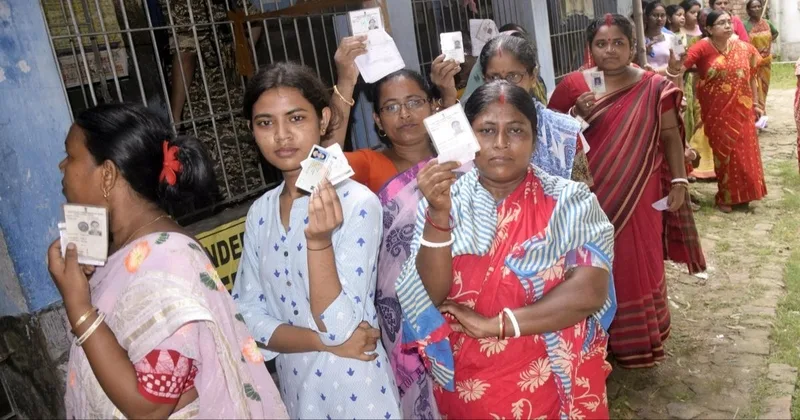
The recent repoll result in the Falta Assembly Constituency has triggered an important political conversation in Bengal. Beyond party victories and electoral arithmetic, the result has challenged one of the most deeply repeated narratives in the state’s politics: the assumption that constituencies with a substantial Muslim population are electorally inaccessible to Hindu candidates unless they depend on communal polarisation or minority appeasement. The outcome of this repoll suggests something more complex and perhaps more significant about the changing political consciousness of Bengal.
According to Census 2011 figures, the Muslim population in the Falta Assembly stands at around 87,352, roughly 35% of the constituency’s total population. In conventional electoral discourse, such demographic realities are often used to construct political “vote-bank equations.” For years, Bengal politics, particularly under the dominance of the All India Trinamool Congress, has been shaped by the belief that minority consolidation determines electoral outcomes in such constituencies. This narrative also helped create the parallel assumption that Hindu candidates, especially those associated with the Bharatiya Janata Party, would struggle to gain acceptance in areas with sizeable Muslim populations.
Yet the Falta repoll appears to tell a different story. The BJP candidate reportedly secured nearly 1.5 lakh votes, while another Hindu candidate from the Communist Party of India (Marxist) received approximately 40,000 votes. In contrast, candidates from the Muslim community collectively received only around 20,000 votes. What makes this even more striking is the fact that voter turnout in the repoll touched nearly 87%, indicating widespread participation across communities and social groups. The numbers raise a significant political question: if demographic determinism were truly decisive, how did Hindu candidates receive overwhelming support in a constituency where Muslims constitute more than one-third of the population? The answer perhaps lies in the gradual erosion of identity-based electoral assumptions and the emergence of a broader issue-based voting pattern.
For decades, Bengal’s political ecosystem cultivated the idea that minority voters formed a monolithic bloc and that electoral success depended primarily on appealing to that bloc. This was not merely a political strategy; it became a dominant narrative repeated by parties, commentators, and sections of the media. In many ways, the TMC’s political rise was intertwined with this perception. The party projected itself as the principal guardian of minority interests while simultaneously portraying the BJP as unelectable in Muslim-majority or Muslim-influenced constituencies.
However, the Falta result indicates that electoral realities may be shifting faster than political narratives. One important aspect of the result is that the BJP did not field a single Muslim candidate in the election, yet still managed to secure a commanding victory. This is politically important because it undermines the argument that representation must always be strictly demographic in nature. Voters, it appears, may increasingly prioritise organisational strength, leadership perception, governance issues, welfare delivery, ideological clarity, and broader political alignment over purely communal calculations. This does not mean that identity politics has disappeared from Bengal. Far from it. Caste, religion, and community continue to play an undeniable role in Indian elections. But Falta suggests that such factors are no longer singularly decisive. The electorate seems capable of transcending rigid communal expectations when broader political motivations come into play.
Another significant takeaway from the repoll is the possible fragmentation of minority voting patterns themselves. The assumption that all Muslim voters uniformly support a particular party has always been an oversimplification. Muslim communities, like Hindu communities, are socially, economically, and politically diverse. Employment, local governance, infrastructure, education, law and order, and political credibility influence voting behaviour across communities. The Falta result may indicate that even minority voters are no longer voting exclusively through the lens of communal identity.
At the same time, the opposition vote pattern is equally revealing. The CPI(M), despite its diminished organisational strength compared to its Left Front heyday, still managed to secure a sizeable number of votes with a Hindu candidate. This further weakens the idea that Hindu candidates are structurally disadvantaged in constituencies with significant Muslim populations. Instead, the result suggests that voters are willing to support candidates across communal lines when political credibility or ideological preference aligns with their expectations.
The broader implication for Bengal politics is profound. The BJP’s growth in the state has often been interpreted solely through the framework of Hindu consolidation. While there is certainly an element of that, Falta indicates that the party’s acceptance may also stem from fatigue with older forms of identity-centric politics. Many voters, particularly younger generations, appear more interested in political alternatives than in inherited narratives of communal arithmetic. For the TMC, the repoll serves as a warning sign. The party’s long-standing strategy of balancing welfare populism with minority consolidation may no longer be sufficient in constituencies where broader political sentiments are changing. If the perception spreads that the BJP can comfortably win even in areas with large Muslim populations, the psychological advantage that the TMC once enjoyed may begin to weaken.
Politics is often shaped not only by victories but by the narratives created around those victories. Falta may become symbolically important precisely because it challenges entrenched assumptions. The election result does not merely represent a seat won or lost; it represents a disruption in Bengal’s conventional political thinking. Yet caution is also necessary in interpreting the outcome. One constituency alone cannot define the entire political future of Bengal. Electoral behaviour remains highly local and context-driven. Repolls, in particular, may reflect unique circumstances that differ from general election patterns. Overgeneralization would therefore be unwise. But even with that caveat, Falta undeniably provides a strong counterpoint to the long-standing myth that demographic composition alone determines electoral destiny.
The deeper democratic lesson from Falta is perhaps this: voters are more politically autonomous than parties often assume. Communities cannot permanently be treated as fixed vote banks. Political parties that rely excessively on demographic calculations without addressing broader aspirations eventually risk losing credibility. Elections in modern India are becoming increasingly fluid, and voters are demonstrating a greater willingness to break expected patterns. In that sense, the Falta repoll is more than a local political development. It reflects a larger transition underway in Indian politics: the gradual decline of rigid electoral stereotypes and the rise of a more unpredictable electorate. Whether one supports the BJP, the TMC, the Left, or any other party, the message from Falta is difficult to ignore: democracy becomes healthier when voters refuse to be reduced to communal equations. And perhaps that is the real significance of this result.