
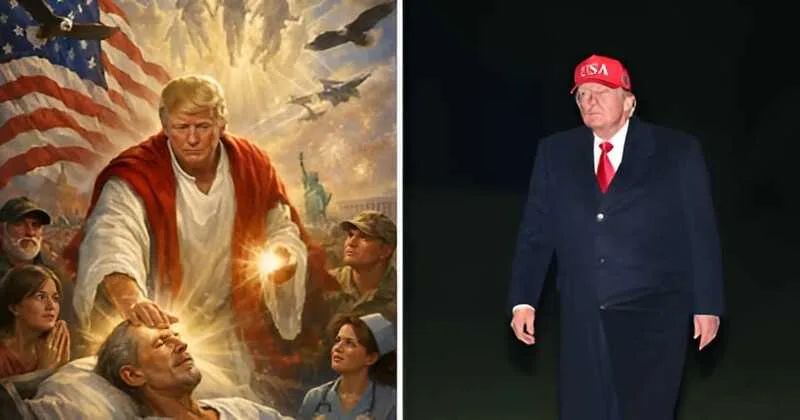
Washington: Fresh political moves by Donald Trump are triggering intense debate and protests across sections of the global Christian community. The controversy erupted after Trump shared an artificial intelligence-generated image on his platform, Truth Social, depicting himself as Jesus Christ. The image, which shows Trump’s face superimposed onto a scene of Christ healing a patient in a hospital, has drawn sharp criticism, with many calling it outright blasphemous. This is not the first time Trump has been accused of misusing sacred religious imagery for political messaging. However, what makes this episode particularly striking is that the backlash is not limited to political opponents. Instead, it has come from sections of ultra-conservative Christian groups that have historically supported him. Several Catholic priests have publicly distanced themselves from such representations, stating, “We follow Christ first, not the movement.”
Controversy within conservative Christian circles
Observers online have pointed to what they describe as “disturbing elements” within the shared image. Some claim that the original visual may have been altered in a way that introduces obscure symbolic references. A section of commentators has even speculated that a demonic figure, identified in conspiracy narratives as “Baphomet”, may have been embedded or substituted in the imagery. While such claims remain unverified, they have contributed to a wave of suspicion and alarm among certain religious groups.
The controversy has deepened an already growing divide between Trump and sections of the Catholic Church. Since the death of Pope Francis, Trump has taken a confrontational tone toward the Church’s leadership, including criticism of the newly elected Pope Leo XIV. His remarks and actions are being viewed by many as disrespectful to long-standing religious traditions, further widening the rift among Catholic voters in the United States. Political observers warn that the instrumental use of religion for political gain can have unintended consequences. The current backlash suggests that even loyal voter bases may reconsider their support when deeply held beliefs are perceived to be undermined.
Allies turn Critics as rhetoric escalates
Perhaps the most surprising development has been criticism from within Trump’s own support base. Marjorie Taylor Greene, once considered a staunch ally, has openly condemned the imagery and rhetoric, describing it as reflective of an “anti-Christ attitude.” Such remarks indicate a significant shift, with even committed supporters expressing discomfort over the direction of Trump’s messaging. Trump’s spiritual advisor, Paula White-Kane, has also come under scrutiny. Her comparisons of Trump’s legal challenges to the suffering of Jesus Christ have been widely criticised as inappropriate and exaggerated. Critics argue that such narratives attempt to position Trump in a quasi-religious role, blurring the line between political leadership and spiritual symbolism.
Media commentators in the United States have described this as one of the most extreme examples of the politicisation of faith in recent times. The blending of religious imagery with political identity is increasingly being viewed as a risky strategy that could alienate both moderate and devout voters.
War rhetoric, faith, and electoral stakes
Trump’s recent statements linking religion with geopolitical tensions have further intensified concerns. His warnings directed at Iran, including statements suggesting catastrophic consequences, have alarmed peace advocates. The timing of such rhetoric, particularly around Easter, has been seen as deeply ironic and troubling. Critics argue that invoking religious symbolism while issuing threats of war undermines the core message of peace associated with the occasion. Prominent voices, including podcast host Tucker Carlson, have expressed unease over Trump’s conduct. Carlson has described the use of Easter as a backdrop for war rhetoric as unchristian and has even suggested that there appears to be a kind of “spiritual conflict” unfolding within the political establishment. He has also noted that Trump’s behaviour at times seems to verge on irrationality.
At the same time, lingering controversies, such as allegations of a cover-up related to the Jeffrey Epstein case, have contributed to growing scepticism among segments of Trump’s support base. Conspiracy theories, including claims of hidden influences or darker allegiances, are circulating widely online, though without credible evidence.
The political implications are significant. Catholic voters, numbering around 53 million and comprising roughly 20–25% of the American electorate, remain a crucial bloc. Trump secured a majority of this vote in both 2016 and 2024. However, his current confrontations with the Church risk alienating this key demographic. Analysts are closely watching whether a shift similar to 2020, when he lost to Joe Biden, could occur again.
There is also a growing perception that Trump may be operating under considerable psychological and political pressure during his second term. His strong pro-Israel stance and escalating rhetoric toward Iran have unsettled many observers. Critics argue that invoking religious imagery in the context of war not only deepens domestic divisions but also carries serious global repercussions.