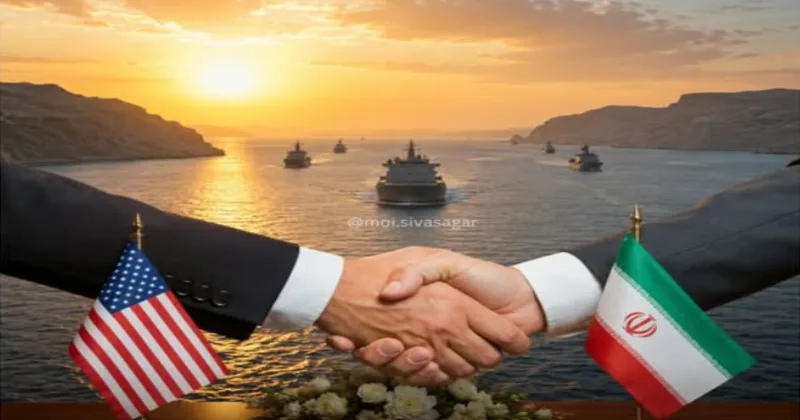
The fires of war that have been scorching West Asia for months now appear to be subsiding. After a long period of tension, military confrontation, and diplomatic wrangling, the US and Iran have finally reached a consensus on a peace agreement. US President Donald Trump himself announced the deal, describing it as historic. The official signing of the draft agreement is scheduled to take place in Switzerland on June 19.
Announcing the development on the social media platform Truth Social, US President Donald Trump stated that the agreement with the Islamic Republic of Iran has been finalized. Congratulating the world, he claimed that the Strait of Hormuz would be opened without tolls and that approval had been granted for the immediate lifting of the US Navy’s blockade. Meanwhile, the Iranian leadership claims that, despite facing pressure and military challenges, it did not compromise its national interests. A statement from the council noted that the joint efforts of the nation’s people, leadership, and security forces made this agreement possible.
The Deal with the Islamic Republic of Iran is now complete. Congratulations to all! I hereby fully authorize the toll free opening of the Strait of Hormuz, and, simultaneously herewith, authorize the immediate removal of the United States Naval blockade. Ships of the World, start… pic.twitter.com/5LQ0y03Wbg
— Commentary Donald J. Trump Truth Social Posts On X (@TrumpTruthOnX) June 14, 2026
Iran Says: Fulfill Promises First, Then Talks Will Proceed
Despite the draft agreement, Iran has laid down three clear conditions for the US. Iranian Deputy Foreign Minister Kazem Gharibabadi stated that the 60-day negotiation process leading toward a final, comprehensive agreement would only commence once the US fulfills its initial promises. Iran demands the complete lifting of the US naval blockade, a halt to all military actions, and the release of Iran’s frozen funds.
Tehran’s message is clear: it is unwilling to rely merely on assurances and instead seeks to see concrete action on the ground. The most striking aspect of this agreement is the reconstruction package of at least $300 billion proposed by the US for Iran. For a country that has endured years of sanctions and conflict, this package could prove to be an economic lifeline.
This Great Deal will bring Peace and Security to the whole Region. Many presidents have tried to make Peace with Iran, and all have failed before me. The Leaders of the Region have, for the first time, found a President who can help them achieve real Peace. With the opening of… pic.twitter.com/pbTEUHaW3l
— Commentary Donald J. Trump Truth Social Posts On X (@TrumpTruthOnX) June 14, 2026
14-Point Draft: Roadmap to End the Conflict Prepared
The 14-point draft published by Iran’s semi-official Mehr News Agency includes several key provisions. These include the immediate and permanent cessation of military actions on all fronts, including Lebanon; a pledge by the US to respect Iran’s sovereignty and refrain from interfering in its internal affairs; and the complete lifting of the naval blockade within 30 days.
Other provisions include the withdrawal of US forces from areas surrounding Iran; the reopening of the Strait of Hormuz under Iranian administration within 30 days; the lifting of sanctions on Iran’s oil, petrochemical products, and related exports; and ensuring Iran has full access to revenues generated from energy exports. There is also a pledge by the US and its allies to present a reconstruction plan for Iran worth at least $300 billion.
The draft allows for a 60-day negotiation period to reach a final agreement on nuclear issues and significant sanctions relief. It includes a renewed pledge by Iran, under the Nuclear Non-Proliferation Treaty, not to develop nuclear weapons, and a US promise not to increase military deployments in the region or impose new sanctions during negotiations. It also provides for the release of $24 billion in frozen Iranian assets during the talks, with half the amount to be released before negotiations begin.
Further provisions include establishing a monitoring mechanism to oversee the agreement’s implementation and ratifying the final deal through a UN Security Council resolution. Under this framework, military actions on all fronts, including Lebanon, would cease permanently and the US would commit to respecting Iran’s sovereignty and not interfering in its internal affairs.
Major Dispute Remains: No Clear Consensus on Nuclear Program
Although Trump describes the agreement as nearly complete, the most sensitive issue remains unresolved. The document lacks any clear or detailed provisions regarding Iran’s nuclear program. The draft merely states that Iran will reaffirm its commitment not to develop nuclear weapons under the Nuclear Non-Proliferation Treaty. However, crucial issues, such as limits on uranium enrichment, the status of nuclear facilities, and additional international inspections, remain unresolved. This is why the negotiations over the next 60 days are being viewed as the true test of this entire peace effort.
All eyes are now fixed on the signing ceremony scheduled for June 19 in Switzerland. If this agreement is successfully implemented, it could not only restore stability to West Asia but also bring about significant shifts in global energy markets, international trade, and regional politics.