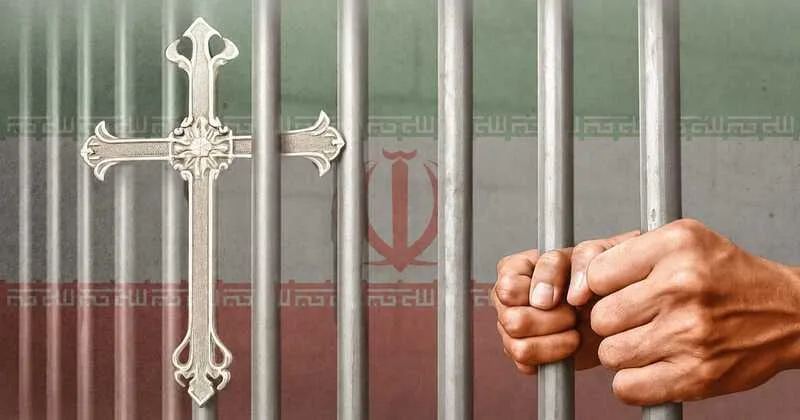
A new annual report titled Scapegoats: Rights Violations Against Christians in Iran, published by Article18 in partnership with Open Doors, Christian Solidarity Worldwide and Middle East Concern, documents a significant escalation in state action against Christians in Iran. The report details an increase in arrests, lengthy prison sentences, prosecutions linked to Bible distribution, church raids, confiscation of Christian literature, and the growing role of the Islamic Revolutionary Guard Corps (IRGC) in targeting Christian communities.
According to the report, at least 21 Christians received custodial sentences during 2025 for their alleged involvement in distributing Bibles. Alongside prison terms, Iranian courts also imposed additional punishments, including financial penalties, internal exile and restrictions affecting social rights.
Criminal cases linked to bible distribution
One of the cases highlighted in the report concerns two Christian converts convicted in June 2025 under Article 500 of Iran’s penal code for engaging in what authorities described as the “propaganda activity of deviant Christian ‘Zionist’ beliefs opposed to the system of the Islamic Republic of Iran.” Each was sentenced to ten years’ imprisonment.
The same individuals were also prosecuted under Articles 22 and 24 on charges of distributing “smuggled goods”, a reference to Bibles. The court imposed an additional two-year prison sentence along with fines. Proceedings were conducted in absentia, and the evidence presented reportedly consisted of Bibles and other Christian publications recovered from their homes.
FAITH UNDER FIRE: Ghazal Marzban, a 42-year-old Catholic woman, is on a hunger strike inside Iran's brutal Evin Prison while serving a 10-year sentence for practicing Christianity. Her case has drawn sharp condemnation from the State Department as regional tensions soar.…
— Fox News World (@FNCGlobalNews) July 9, 2026
The report states that official court documents increasingly portray the Bible itself as unlawful material. In another indictment involving two Iranian-Armenians and three Christian converts, prosecutors described the Bible as a “prohibited book.” Those five individuals were charged in June 2025 with “propaganda” and “collusion” before being sentenced in November to a combined prison term exceeding 50 years.
Other judicial rulings issued during 2025 referred to the Bible using terms such as “distorted,” “deviant,” “corrupt,” and “misleading,” according to the report.
Article 500 and expanding IRGC operations
The report identifies Article 500 of the penal code as the principal legal instrument used against Christians. The provision criminalises “propaganda contrary to the holy religion of Islam” and has become the basis for the overwhelming majority of prosecutions involving Christian believers.
It also highlights the increasing operational role of the Islamic Revolutionary Guard Corps in identifying, monitoring and arresting Christians, particularly those associated with Bible distribution and house churches.
The report notes that the IRGC’s stated responsibility is protecting the Islamic Republic and indicates that its expanding involvement reflects the authorities’ treatment of Christian communities as a security concern. House churches have increasingly been classified as hostile groups, while IRGC-led operations are described as involving greater levels of force and intimidation than earlier enforcement actions.
Christians have also reportedly been monitored for activities outside Iran, including participation in overseas theological seminars.
Raid on Gatab House Church
Among the incidents documented is a large-scale IRGC raid conducted on the evening of February 6, 2026, in Gatab, Mazandaran Province. According to the report, at least 20 plainclothes IRGC personnel entered a gathering attended by around 80 Christians.
Agents confiscated Bibles and musical instruments before arresting Christian convert Somayeh Rajabi. During the operation, officials reportedly identified individuals wearing crosses, removed the crosses from them and conducted body searches. Several participants were injured, while emergency medical personnel attempting to provide assistance were prevented from reaching those wounded.
Rajabi was permitted a brief telephone conversation with her family the following day, informing them that she was being held in a prison in Sari. She was subsequently transferred to Mati Kola Prison in Babol.
#Iran's crackdown on religious freedom continues. Five Christian converts, including two women, have been sentenced to a combined 55 years in prison after Tehran's Appeals Court upheld convictions based on "national security" charges. #HumanRights https://t.co/nRPkIg1Iqz pic.twitter.com/SyTamU86iJ
— David Afrash (@AfrashDavid) July 9, 2026
On March 8, she secured release after posting bail exceeding US$40,000. Authorities charged her with “gathering and collusion” and “propaganda against the regime.” On April 15, Rajabi and six other Christians appeared before the prosecutor’s office in Babol to submit their final defence, the final procedural stage before an indictment. At the time the report was published, no further judicial developments had been recorded.
Legal changes and sharp rise in arrests
The report links the intensified crackdown to amendments introduced by Iran’s parliament in 2021 to Articles 499 and 500 of the penal code. Those revisions expanded the scope of offences connected with membership of organisations allegedly seeking to undermine national security and activities classified as propaganda against the Islamic Republic.
Article18 had warned when the amendments were adopted that the revised provisions could be used to suppress fundamental freedoms and increase prosecutions targeting religious minorities. The United Nations Human Rights Committee later called on Iran to repeal or amend the revised legislation.
The report concludes that the amended laws have been widely applied against Christians.
During 2025, authorities arrested 254 Iranian Christians, almost double the number recorded in 2024. Those convicted received combined prison sentences amounting to more than 280 years.
Nearly 90 per cent of all charges brought against Christians during the year relied on the amended Article 500, which criminalises “propaganda contrary to the holy religion of Islam.”
The report also records continued imprisonment of Christians during 2026. On July 3, Article18 announced that an appeals court had upheld prison sentences imposed on five Iranian Christians. Together they received more than 70 years in prison for activities including prayer meetings, baptisms, Holy Communion and Christmas celebrations.
Besides imprisonment, authorities confiscated personal property belonging to the convicted Christians, including Bibles and Christian literature, stating that the materials would be transferred to the Ministry of Intelligence for research purposes.
The report compares this with another case from the previous year in which two Christians each received 12-year prison sentences for smuggling Bibles into Iran.
Church property seizures and closure of the Bible society
The report also documents actions directed against historic Christian institutions and church-owned property.
Last month, Iranian security authorities moved to take control of Saint Peter Evangelical Church in Tehran, also known as Qavam Church. Residents living within the church compound were instructed to leave their homes, while members of the congregation were told to attend services elsewhere.
The church, constructed in 1876, serves members of Iran’s officially recognised Armenian and Assyrian Christian communities.
The action followed enforcement of a Revolutionary Court order originally issued in 1998 directing that the approximately ten-acre church compound, including two schools and dozens of residential buildings, be transferred to the Execution of Imam Khomeini’s Order (EIKO).
According to the report, EIKO has previously overseen confiscation of Assyrian Presbyterian churches in Tabriz and Mashhad, an Assemblies of God church in Gorgan, and a Christian retreat centre in Karaj.
The report also traces restrictions on Bible publication to 1990, when Iranian authorities raided the Bible Society of Iran in Tehran and ordered its closure. Before the closure, the organisation had served as the country’s principal publisher and distributor of Persian-language Bibles and Christian literature.
Its closure effectively ended the legal printing and publication of Christian texts in Persian, the language spoken by the overwhelming majority of Iranians. Since then, importing and distributing Bibles has increasingly been treated as a criminal offence.
https://twitter.com/i/status/2075429159589773358
The Bible Society’s presence in Iran dated back to 1811, beginning with the visit of Henry Martyn and the revision of his Persian translation of the New Testament.
One year after the organisation was shut down, Iran’s representative to the United Nations informed the UN Special Rapporteur that the Bible Society had been “temporarily closed” pending investigations into unspecified violations of Iranian laws and that its activities could resume after the legal process concluded.
The report notes that 36 years later the Bible Society remains closed, while Bibles and other Christian publications continue to be treated as illegal contraband and used as evidence in criminal prosecutions.
Wider restrictions on Christian worship
The report states that Iranian authorities continue to criminalise ordinary Christian religious practices alongside Bible distribution.
Charges have been brought against believers for participating in baptisms, Holy Communion, prayer meetings and Bible study gatherings, including activities conducted outside Iran. House churches continue to be raided, followed by arrests, interrogations, demands to identify other Christians, lengthy prison terms and substantial bail requirements.
According to Open Doors, Christian converts remain the principal targets of these measures. The organisation reports that those released from custody frequently face additional restrictions, including internal exile or limitations on religious expression, while many converts ultimately leave Iran to escape continuing persecution.
The report places these developments within the broader pattern of political repression under the Islamic Republic.
It notes that the government has continued to suppress political dissent through surveillance, arbitrary detention and force against those challenging state policies. It also refers to measures directed at women who refuse to comply with compulsory hijab regulations, including arrests, imprisonment and abuse by morality police.
The report further states that on December 28, 2025, mass protests began across Iran and developed into nationwide demonstrations calling for an end to the Islamic Republic’s leadership. It records that the state’s response resulted in the deaths of many thousands of people, including several Christians, while affecting Iranians across religious communities.
Throughout the report, the organisations conclude that Christian converts, Bible distribution, house churches and Christian worship continue to face extensive legal restrictions under Iran’s current legal framework, with arrests, prosecutions, confiscation of religious materials and lengthy prison sentences remaining central features of the state’s approach.