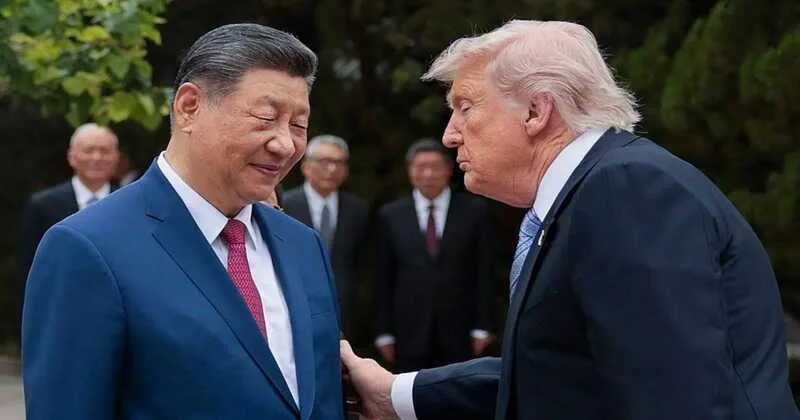
Competing narratives emerged from the Beijing summit between US President Donald Trump and Chinese President Xi Jinping after both governments issued sharply different accounts of what was discussed during their May 14 meeting at the Great Hall of the People. The meeting brought together senior officials from both countries responsible for foreign affairs, defence and economic policy. According to Chinese state broadcaster CCTV, the Chinese delegation consisted of 13 officials while the American side included 11.
Xi described the relationship in familiar terms, saying cooperation benefits both countries while conflict harms both. Trump, meanwhile, declared that ties between Washington and Beijing were “going to be better than ever before.”
Behind the ceremonial statements, however, the summit exposed the absence of major agreements, the persistence of strategic distrust and Beijing’s reluctance to elevate Trump’s visit politically or symbolically.
Chinese state media outlet Xinhua reported that Xi directly raised Taiwan as “the most important issue” in U.S.–China relations. Xi warned that mishandling Taiwan could lead to confrontation or conflict and repeated Beijing’s position that “Taiwan independence” is incompatible with peace and stability in the Taiwan Strait. The White House account of the meeting did not foreground Taiwan. Instead, Washington focused on Iran, the Strait of Hormuz, global energy security and economic cooperation. The differing readouts reflected two parallel messaging strategies. Beijing emphasized sovereignty and red lines. Washington attempted to frame the summit around broader geopolitical cooperation and stability in West Asia.
Taiwan remained Beijing’s central message
Taiwan dominated China’s official narrative surrounding the summit, even as Washington attempted to avoid presenting the issue as the centrepiece of the talks. Beijing continues to portray Taiwan as the defining issue in bilateral relations and uses it to shape public perception. Chinese officials may have amplified Taiwan discussions to divert attention from sensitive topics such as Iran, nuclear issues and trade.
The summit took place one day after a bipartisan group in the US House of Representatives introduced a resolution reaffirming longstanding American commitments to Taiwan. The measure stated that the Taiwan Relations Act, the Three Communiques and the Six Assurances remain the foundation of U.S. policy and should not be treated as bargaining tools in diplomacy.
JUST IN: President Trump touts a "historic" visit to China, announcing a massive deal for Boeing and General Electric that includes hundreds of aircraft and engines.
The President praised President Xi as an "incredible guy," noting that the trade agreements could ultimately… pic.twitter.com/7hvvYB4mA5
— Fox News (@FoxNews) May 15, 2026
Since 1979, the Taiwan Relations Act has shaped unofficial U.S.–Taiwan ties while supporting Taiwan’s democratic and economic development. The Six Assurances, formally conveyed in 1982, reiterated that Washington did not agree to set a date for ending arms sales to Taiwan, would not consult Beijing in advance on such sales, would not mediate between Taiwan and the Chinese Communist Party, would not revise the Taiwan Relations Act, would not take a position on Taiwan’s sovereignty and would not pressure Taiwan into negotiations with Beijing.
The Three Joint Communiques, the 1972 Shanghai Communique, the 1979 Joint Communique establishing diplomatic relations with Beijing and the Aug. 17, 1982 Communique, continue to define the framework of the U.S. “One China” policy. Taiwan’s Ministry of Foreign Affairs later stated that China remains “the sole risk to regional peace and stability” and pledged continued cooperation with the United States and other international partners.
Despite the rhetoric, the summit produced no breakthrough on Taiwan. Xi reiterated familiar positions while Washington offered no indication of policy changes or concessions.
Trade promises produced little movement
Chinese state media attempted to portray the summit as economically constructive, but the meeting yielded few tangible results beyond limited and uncertain trade announcements.
Xinhua reported that Xi told Trump that recent economic discussions had produced “generally balanced and positive results.” U.S. Treasury Secretary Scott Bessent and Chinese Vice Premier He Lifeng had also met separately in South Korea earlier in the week for economic discussions.
After the summit, China’s Ministry of Commerce said Beijing was willing to expand cooperation while narrowing differences with Washington.
Yet the actual outcomes fell short of expectations built before the visit.
One of the few concrete developments involved the licensing of U.S. slaughterhouses for beef exports to China. Even that concession quickly appeared uncertain after reports suggested reversals and renewed pressure from Chinese agricultural interests seeking protection from foreign imports. Anticipated agreements involving Chinese purchases of Boeing aircraft also failed to materialise at the scale markets had expected. Reports ahead of the summit had suggested China could commit to buying 200 Boeing jets, but no substantial confirmation emerged during or after the visit, disappointing investors and markets.
There was also no visible progress on major geopolitical disputes involving Iran, Taiwan or Japan. Trump claimed Xi had “strongly” promised not to supply Iran with weapons. However, the statement lacked verifiable commitments, and no formal agreement on Iran emerged from the summit.
The White House attempted to highlight discussions around the Strait of Hormuz and global energy security, but Chinese readouts barely emphasized those topics. The summit ultimately produced neither a significant trade breakthrough nor a strategic reset in bilateral ties.
Beijing downplayed Trump throughout the visit
Unlike previous visits by American presidents, Beijing deliberately avoided turning Trump’s arrival into a major political spectacle. Chinese state media coverage remained restrained and at times visibly indifferent. On the day Trump arrived, the front page of the state-run English-language newspaper China Daily prominently featured Xi shaking hands with the president of Tajikistan. Coverage of Trump’s visit remained secondary. The Communist Party newspaper People’s Daily relegated commentary on Trump’s visit to Page 3.
State broadcaster CCTV’s flagship nightly news programme Xinwen Lianbo devoted only 12 seconds to announcing Trump’s arrival on Monday. Immediately afterward, the programme aired a nearly six-minute segment celebrating economic development in the Yangtze River Delta.
And that’s a wrap on President Trump’s state visit to China!
47’s now BACK on US soil, and Air Force One is currently being refueled in Alaska
Trump will be back on DC tonight 🇺🇸 pic.twitter.com/ggISqPFhRe
— Nick Sortor (@nicksortor) May 15, 2026
Even on the day of the summit itself, coverage of the Trump-Xi meeting received only around two and a half minutes on the broadcast and appeared in 13th position in the programme lineup.
The subdued treatment contrasted sharply with earlier presidential visits by Bill Clinton, George W Bush, Barack Obama and even Trump’s own 2017 visit, all of which received extensive media promotion and public attention inside China. This time, Beijing appeared unwilling to politically invest in Trump’s visit or present it domestically as a landmark diplomatic moment.
The caution reflected uncertainty over Trump’s unpredictability. Unlike previous American presidents who generally adhered to agreed diplomatic messaging, Trump remained difficult for Chinese officials and censors to manage publicly.
Chinese media outlets avoided portraying the visit too positively amid fears that sudden controversies or inflammatory remarks could quickly transform favourable coverage into a political liability. Social media activity inside China also remained heavily restricted during the visit. Public discussion was limited largely to sardonic commentary about US difficulties in the Iran conflict and occasional praise for Trump’s unusually deferential public posture toward Xi.
One of the few figures from Trump’s entourage who generated visible excitement in China was Jensen Huang, the Taiwanese American technology executive accompanying the delegation.
Trump sought optics while Xi repeated old positions
Despite the scale of the visit, Xi largely repeated long-standing political positions rather than offering new initiatives or compromises. The Chinese leader reiterated Beijing’s familiar “red lines”: Taiwan, democracy and human rights and China’s political system. Xi also returned repeatedly to themes he has promoted for years, stability over confrontation, rejection of great-power conflict and warnings against the so-called “Thucydides Trap” between an established and a rising power.
No major joint initiatives emerged from the summit. No strategic framework was announced. No visible breakthroughs occurred on Taiwan, Iran, military tensions or broader geopolitical disputes. Instead, much of the political theatre appeared centred on Trump himself seeking validation from Xi.
During media appearances after the summit, Trump praised Xi in unusually personal terms. Speaking to Fox News, Trump said that if Hollywood searched for someone to play the leader of China in a film, “you couldn’t find a guy like him, even his physical features.”
The contrast with earlier U.S. presidential visits was striking. Previous American leaders arrived in Beijing representing a globally dominant United States seeking to manage relations with China. This time, Beijing projected confidence while Washington appeared focused on optics and personal diplomacy. By the end of the visit, the summit had produced sharply divergent narratives, modest trade gestures and extensive symbolism, but little evidence of strategic progress.