Re-reading B. R. Ambedkar in his full intellectual integrity
June 25, 2026
  • Read Ecopy
  • Circulation
  • Advertise
  • Careers
  • About Us
  • Contact Us
Android AppiPhone AppArattai
Organiser
  • ‌
  • Bharat
    • Assam
    • Bihar
    • Chhattisgarh
    • Jharkhand
    • Maharashtra
    • View All States
  • World
    • Asia
    • Europe
    • North America
    • South America
    • Africa
    • Australia
  • Editorial
  • International
  • Opinion
  • RSS @ 100
  • More
    • Op Sindoor
    • Analysis
    • Sports
    • Defence
    • Politics
    • Business
    • Economy
    • Culture
    • Special Report
    • Sci & Tech
    • Entertainment
    • G20
    • Azadi Ka Amrit Mahotsav
    • Vocal4Local
    • Web Stories
    • Education
    • Employment
    • Books
    • Interviews
    • Travel
    • Law
    • Health
    • Obituary
  • Subscribe
    • Subscribe Print Edition
    • Subscribe Ecopy
    • Read Ecopy
  • ‌
  • Bharat
    • Assam
    • Bihar
    • Chhattisgarh
    • Jharkhand
    • Maharashtra
    • View All States
  • World
    • Asia
    • Europe
    • North America
    • South America
    • Africa
    • Australia
  • Editorial
  • International
  • Opinion
  • RSS @ 100
  • More
    • Op Sindoor
    • Analysis
    • Sports
    • Defence
    • Politics
    • Business
    • Economy
    • Culture
    • Special Report
    • Sci & Tech
    • Entertainment
    • G20
    • Azadi Ka Amrit Mahotsav
    • Vocal4Local
    • Web Stories
    • Education
    • Employment
    • Books
    • Interviews
    • Travel
    • Law
    • Health
    • Obituary
  • Subscribe
    • Subscribe Print Edition
    • Subscribe Ecopy
    • Read Ecopy
Organiser
  • Home
  • Bharat
  • World
  • Operation Sindoor
  • Editorial
  • Analysis
  • Opinion
  • Culture
  • Defence
  • International Edition
  • RSS @ 100
  • Magazine
  • Read Ecopy
Home Bharat

Beyond Selective Citations: Re-reading B. R. Ambedkar in his full intellectual integrity

Ambedkar’s writings on Islam, particularly in his work Pakistan or the Partition of India, present a candid and critical assessment of Muslim society and its socio-political implications in the Indian context. One of his most striking observations reads: “The brotherhood of Islam is not the universal brotherhood of man. It is brotherhood of Muslims for Muslims only. For those who are outside the corporation, there is nothing but contempt and enmity"

Diganta ChakrabortyDiganta Chakraborty
Apr 14, 2026, 08:00 pm IST
in Bharat, Analysis
Follow on Google News
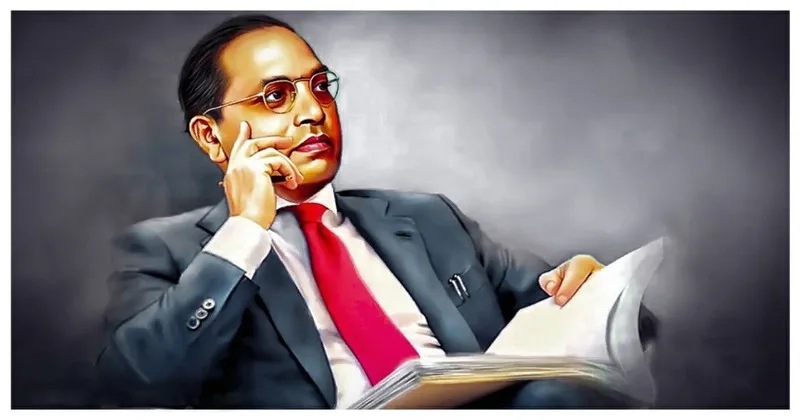
Dr. B.R. Ambedkar

Dr. B.R. Ambedkar

FacebookTwitterWhatsAppTelegramEmail

In contemporary academic and political discourse, few figures are as frequently invoked—and as selectively interpreted—as Dr. B. R. Ambedkar. Revered as the principal architect of the Indian Constitution and a relentless crusader against caste oppression, Ambedkar’s intellectual legacy is vast, nuanced and often inconvenient for rigid ideological frameworks. Yet, a troubling pattern has emerged over the decades: sections of left-leaning historiography have persistently highlighted Ambedkar’s critiques of Hindu society while downplaying—or altogether ignoring—his equally sharp observations on other religious and social structures, particularly Islam.

This selective appropriation does not merely distort Ambedkar’s thought; it diminishes his stature as an independent thinker who refused to be confined within ideological binaries. To understand Ambedkar truthfully is to engage with the entirety of his writings, not curated excerpts that serve contemporary political narratives. Ambedkar’s critique of Hindu society, especially the caste system, is well-documented and widely cited. His seminal work Annihilation of Caste remains one of the most powerful indictments of caste-based discrimination. However, what is often overlooked is that Ambedkar’s criticism was not rooted in hatred for any particular religion but in his unwavering commitment to social justice, equality and human dignity. His method was analytical, not ideological; reformist in intent, not partisan in allegiance.

Ambedkar’s writings on Islam, particularly in his work Pakistan or the Partition of India, present a candid and critical assessment of Muslim society and its socio-political implications in the Indian context. One of his most striking observations reads: “The brotherhood of Islam is not the universal brotherhood of man. It is brotherhood of Muslims for Muslims only. For those who are outside the corporation, there is nothing but contempt and enmity”. In this same book, he also wrote, “In other words, Islam can never allow a true Muslim to adopt India as his motherland and regard a Hindu as his kith and kin”.

This statement, though controversial, reflects Ambedkar’s broader concern about the limitations of religiously bounded fraternities. He argued that any social system—whether Hindu, Muslim or otherwise—that restricts equality and fraternity within exclusive boundaries fails the test of universal humanism. Yet, this dimension of Ambedkar’s thought is conspicuously absent in most academic narratives shaped by leftist historians. The result is a one-dimensional portrayal that casts Ambedkar solely as a critic of Hinduism, thereby aligning him conveniently with a particular ideological agenda.

The question arises: why this selective emphasis? The answer lies in the broader intellectual framework that has dominated sections of Indian academia for decades. Rooted in Marxist historiography, this framework often interprets Indian society through the lens of class struggle, minority-majority dynamics and colonial legacies. Within this paradigm, Ambedkar is positioned as a counterweight to what is perceived as “majoritarian dominance”. Consequently, his critiques of Hindu society are amplified, while his criticisms of other religions—especially those considered “minority”—are either softened or ignored. This asymmetrical treatment is not merely an academic oversight; it is a conscious or unconscious bias that seeks to fit Ambedkar into a predetermined ideological mould.

Also Read: Trump’s ‘Madman Theory’ in West Asia: Brinkmanship, coercion, and the limits of strategic unpredictability

To understand Ambedkar fully, one must recognise that his ultimate allegiance was not to any religious identity, but to the principles of a just and harmonious society. His emphasis on fraternity was not limited to intra-community solidarity but extended to the idea of a shared civilizational ethos. In this sense, Ambedkar’s thought resonates with broader Indic traditions that have long emphasised unity amidst diversity. His critique of social evils was not aimed at destroying civilizational continuity, but at purifying and strengthening it.

Even his decision to embrace Buddhism can be seen in this light—not as an act of negation alone, but as an attempt to anchor social reform within an indigenous philosophical framework that upheld equality and rationality. A more balanced engagement with Ambedkar would require moving beyond selective readings. It would involve acknowledging that his critiques were wide-ranging and often uncomfortable, cutting across religious and social lines.

Such an approach would not diminish his relevance; rather, it would restore the depth and integrity of his thought. It would also encourage a more mature public discourse—one that is capable of self-reflection and internal reform without resorting to defensive silences or selective outrage. At a time when historical figures are frequently appropriated for narrow political purposes, there is a pressing need to reclaim Ambedkar as a thinker who stood for universal principles. His life’s work was dedicated to the creation of a society rooted in dignity, equality, and mutual respect.

Reducing him to a sectional icon—whether by overemphasising one aspect of his critique or by ignoring others—does a disservice not only to his legacy but also to the larger project of nation-building. A truly meaningful engagement with Ambedkar would involve embracing his courage to question, his commitment to reform, and his insistence on intellectual honesty. It would mean recognising that no society is above critique, and that true progress lies in the willingness to confront one’s own shortcomings.

The challenge before us today is not merely to defend or critique particular interpretations of Ambedkar, but to rise above selective readings altogether. By engaging with his writings in their entirety, we can move towards a more truthful and balanced understanding. Only by reclaiming this holistic vision can we do justice to Ambedkar’s enduring legacy.

Topics: Dr B R AmbedkarIntellectual ThoughtIntegrityCriic of Islam
ShareTweetSendShareSend
✮ Subscribe Organiser YouTube Channel. ✮
✮ Join Organiser's WhatsApp channel for Nationalist views beyond the news. ✮
Previous News

West Bengal Assembly Polls:15 Years of chaos under Mamata government

Next News

West Bengal Assembly Polls: Collective aspirations for good governance

Related News

Dr Ambedkar: The architect who prevented India from becoming a communist state

Dr B R Ambedkar was against burqa

When ‘Islamophobia’ becomes a shield for purdah: Ambedkar’s unforgiving verdict on religious oppression

Samvidhan Diwas: The spirit of constitution was rooted in Bharatiya ideals

Representative Image

Rights in Full, Duties in Fragments : Is This the Freedom We Fought For?

CJI BR Gavai

Article 370 was against Dr Ambedkar’s vision of one Constitution for united India: Chief Justice of India Bhushan Gavai

Epistemological violence against the Indian Constitution—Betrayal of Ambedkar’s vision”

Load More

Latest News

Fifty years after the Emergency, India reflects on a defining test of democracy, freedom and citizen resilience

The Emergency at Fifty: Democracy’s darkest hour, India’s finest test

History of Venezuela Earthquakes: How the oil rich nation remains engulfed in natural, political, economic & crises

(Left) Bharatiya Kisan Sangha National General Secretary Mohini Mohan Mishra ji (Right) Padma Shri awardee Shrirang Devba Lad address the media on the issue of BT cotton

Bharatiya Kisan Sangh demands centre to de-notify BT Cotton varieties BG-I & BG-II amid production slump

BJP councillors of the Tiruvananthapuram Corporation during the re-oath-taking ceremony

Keralam: BJP councillors retake oath after High Court verdict; CPM plea to cancel elections dismissed

Moshiur Khan alias Aman Khan ( Image Courtesy- Janam TV Keralam

Keralam: Another Bangladeshi national arrested from Islamic madrasa in Kollam with forged Indian documents

For 40 years, Bastar’s “Badi Didi” Dr. Budhri Tati walked across 570 villages to educate tribal girls and transform lives

Bastar’s ‘Badi Didi’: Inspiring story of Padma Shri Dr Budhri, who walked across 570 villages to educate tribal girls

The landmark India-UK FTA balances greater market access with domestic industry interests while opening new export opportunities for India's rapidly growing electric vehicle sector

India-UK FTA: How the trade deal opens new global markets for Made-in-India EVs

US Congressman Sanford Bishop(File Photo)

US: “We must stand against Hinduphobia”; Congressman Sanford Bishop hails Georgia’s anti-Hindu hate resolution

Tamil Nadu Higher Education Minister P. Viswanathan (Black T Shirt)

Tamil Nadu: TVK minister faces POCSO complaint over alleged inappropriate conduct with girl athletes in viral videos

Emergency Anniversary: Jaishankar says 1975 tested India's Democracy

Samvidhan Hatya Diwas: EAM Jaishankar recalls 1975 Emergency, lauds those who stood up for constitutional values

Load More
  • Privacy
  • Terms
  • Cookie Policy
  • Refund and Cancellation
  • Delivery and Shipping

© Bharat Prakashan (Delhi) Limited.
Tech-enabled by Ananthapuri Technologies

  • Home
  • Search Organiser
  • Bharat
    • Assam
    • Bihar
    • Chhattisgarh
    • Jharkhand
    • Maharashtra
    • View All States
  • World
    • Asia
    • Africa
    • North America
    • South America
    • Europe
    • Australia
  • Editorial
  • Operation Sindoor
  • Opinion
  • Analysis
  • Defence
  • Culture
  • Sports
  • Business
  • RSS @ 100
  • Entertainment
  • More ..
    • Sci & Tech
    • Vocal4Local
    • Special Report
    • Education
    • Employment
    • Books
    • Interviews
    • Travel
    • Health
    • Politics
    • Law
    • Economy
    • Obituary
  • Subscribe Magazine
  • Read Ecopy
  • Advertise
  • Circulation
  • Careers
  • About Us
  • Contact Us
  • Policies & Terms
    • Privacy Policy
    • Cookie Policy
    • Refund and Cancellation
    • Terms of Use

© Bharat Prakashan (Delhi) Limited.
Tech-enabled by Ananthapuri Technologies