Samvidhan Diwas: Constitution rooted in Bharatiya ideals
June 25, 2026
  • Read Ecopy
  • Circulation
  • Advertise
  • Careers
  • About Us
  • Contact Us
Android AppiPhone AppArattai
Organiser
  • ‌
  • Bharat
    • Assam
    • Bihar
    • Chhattisgarh
    • Jharkhand
    • Maharashtra
    • View All States
  • World
    • Asia
    • Europe
    • North America
    • South America
    • Africa
    • Australia
  • Editorial
  • International
  • Opinion
  • RSS @ 100
  • More
    • Op Sindoor
    • Analysis
    • Sports
    • Defence
    • Politics
    • Business
    • Economy
    • Culture
    • Special Report
    • Sci & Tech
    • Entertainment
    • G20
    • Azadi Ka Amrit Mahotsav
    • Vocal4Local
    • Web Stories
    • Education
    • Employment
    • Books
    • Interviews
    • Travel
    • Law
    • Health
    • Obituary
  • Subscribe
    • Subscribe Print Edition
    • Subscribe Ecopy
    • Read Ecopy
  • ‌
  • Bharat
    • Assam
    • Bihar
    • Chhattisgarh
    • Jharkhand
    • Maharashtra
    • View All States
  • World
    • Asia
    • Europe
    • North America
    • South America
    • Africa
    • Australia
  • Editorial
  • International
  • Opinion
  • RSS @ 100
  • More
    • Op Sindoor
    • Analysis
    • Sports
    • Defence
    • Politics
    • Business
    • Economy
    • Culture
    • Special Report
    • Sci & Tech
    • Entertainment
    • G20
    • Azadi Ka Amrit Mahotsav
    • Vocal4Local
    • Web Stories
    • Education
    • Employment
    • Books
    • Interviews
    • Travel
    • Law
    • Health
    • Obituary
  • Subscribe
    • Subscribe Print Edition
    • Subscribe Ecopy
    • Read Ecopy
Organiser
  • Home
  • Bharat
  • World
  • Operation Sindoor
  • Editorial
  • Analysis
  • Opinion
  • Culture
  • Defence
  • International Edition
  • RSS @ 100
  • Magazine
  • Read Ecopy
Home Politics

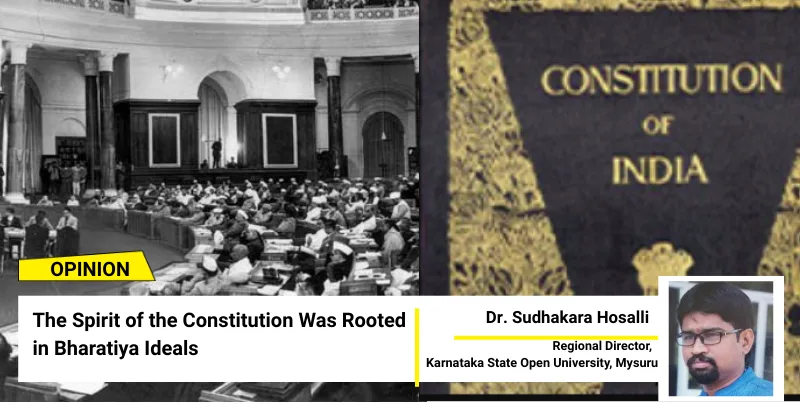
Samvidhan Diwas: The spirit of constitution was rooted in Bharatiya ideals

However, when we examine the debates in the Constituent Assembly, it becomes abundantly clear that the framers never intended to separate the Constitution from India’s civilisational ideals. In fact, there is ample documented evidence to show that the very soul of the Constitution was India itself—its traditions, its values, and its cultural foundations

Dr Sudhakar HosalliDr Sudhakar Hosalli
Nov 26, 2025, 08:00 am IST
in Politics, Bharat, Opinion, Law
Follow on Google News
FacebookTwitterWhatsAppTelegramEmail

Every year, November 26 is observed as Constitution Day. Although the Government of India under Prime Minister Narendra Modi officially initiated this observance only in 2015, this year marks the proud celebration of the 11th Constitution Day across the nation. This occasion calls for a serious and scholarly discussion on the original intentions of the framers of the Constitution. Such a discourse can, in fact, serve as a remedy to many artificially created problems in the country.

In the post-Independence period, the Constituent Assembly carried the enormous responsibility of drafting an independent Constitution, one that recognised individual liberties and citizens’ rights, and one that upheld the dignity of every person. Despite extraordinary pressures and challenges, the framers succeeded in fulfilling this historic task. As the Constitution enters its 76th year, it is ironic that confusion, ambiguity, and negative narratives around it persist in contemporary India.

For 76 years, a narrative has been carefully nurtured and propagated: that the Indian Constitution is something separate from India itself; that India must be imagined without India’s civilisational ethos; and that the Constitution is fundamentally different from the cultural foundations of this land.

Another mistaken belief was also encouraged that once the Constitution came into effect, the idea of “India” would lose its relevance, and that everything must henceforth be viewed solely through legal and constitutional lenses. This has been repeatedly projected as the only “constitutional” approach.

However, when we examine the debates in the Constituent Assembly, it becomes abundantly clear that the framers never intended to separate the Constitution from India’s civilisational ideals. In fact, there is ample documented evidence to show that the very soul of the Constitution was India itself—its traditions, its values, and its cultural foundations.

India is a civilisation of the Vedas, Puranas, the Mahabharata, the Ramayana, and various schools of philosophy, each a repository of knowledge. Many of these civilisational texts are also recognised for their legal and moral value.

On November 18, 1949, during a discussion on what the appropriate name of the country should be, Pandit Bhargava observed:

“People across the world have always referred to us as India, but in our hearts and souls, our nation has always been Bharat.”

He explained that this was precisely why the draft used the expression “India, that is Bharat”—to satisfy both domestic sentiment and international usage. This illustrates how deeply the Constituent Assembly held Bharat in its consciousness.

Answering a member’s query, Dr. B. R. Ambedkar emphatically declared that the Constituent Assembly had rejected all directions from the British Parliament even before beginning its work, and that neither he nor any other member would allow any British-imposed provision to enter the Constitution. This uncompromising stance reflects the peak of national pride and Indian identity.

The Constitution begins with the words, “We, the People of India…”, a powerful testament to Ambedkar’s deep national consciousness. K. V. Kamat had even expressed a desire that the Constitution begin in the name of Bharat Mata, with the words “We, her children…”.

Ambedkar consistently advocated a strong and unified central government, stating:

“I support a strong Centre, ten times stronger than the one created under the Government of India Act, 1935.”

This position strengthened the vision of a united India. Ambedkar emphasised repeatedly that the Constitution-making process was not meant to elevate any individual or political party to power. When defining the nation’s goals, he insisted that neither leaders’ prestige nor party interests should matter—only the nation’s interests must prevail. This principle is reflected throughout the Constitution.

On 23 November 1948, during a debate on amendments proposed by Mohammad Ismail opposing the implementation of a Uniform Civil Code, Ambedkar responded firmly:

“I cannot accept this amendment. It is surprising that despite knowing that we already have a uniform legal framework covering every aspect of human relations, such objections are still raised.”

He also reminded the House that many of the north-western frontier provinces had not been governed by Shariat law until as late as 1935.

Several constitutional provisions are deeply rooted in Indian civilisational practices.

Article 48, concerning agriculture and animal husbandry, reflects long-standing Hindu traditions.

Article 40, on village panchayats, is rooted in India’s ancient grassroots self-governance.

The philosophy underlying panchayati raj and rural organisation unmistakably reflects indigenous cultural practices.

Article 38, mandating social welfare and social justice, echoes the Hindu civilisational ideal of Vasudhaiva Kutumbakam—“the world is one family”.

Article 74, which provides for a Council of Ministers to aid the President, mirrors India’s ancient monarchical advisory traditions.

Thus, many parts of the Constitution reflect Indian nationalism and civilisational values.

Other significant provisions also embody a strong national vision:

Article 239: Administration of Union Territories

Article 239A: Centre’s power to create legislatures and councils of ministers for Union Territory regions

Article 240: President’s authority over Union Territories

Article 247: Parliament’s power to establish additional courts

Article 250: Parliament’s authority to legislate on State subjects during an emergency

Article 253: Centre’s power to make laws for implementing international agreements

Article 257: Centre’s control over states

Article 260: Centre’s jurisdiction in external territories

Article 51A: Fundamental duties, including respect for the Constitution, national symbols, and ideals of the freedom struggle

Taken together, the work of Dr. B. R. Ambedkar’s Drafting Committee and Dr. Rajendra Prasad’s Constituent Assembly clearly reveals one central intention: to translate the culture, traditions, values, conduct, and collective consciousness of this land into a legal framework and offer it to the people of India. This spirit is evident both at the beginning and the end of the Constitution.

Topics: Constitutional valuesParliamentary democracyConstitutional DebatesDr B R AmbedkarConstitution DayIndian ConstitutionFundamental RightsSamvidhan Divas
ShareTweetSendShareSend
✮ Subscribe Organiser YouTube Channel. ✮
✮ Join Organiser's WhatsApp channel for Nationalist views beyond the news. ✮
Previous News

Uttar Pradesh: Yogi Adityanath led-govt takes action against infiltrators in UP, sets up detention centres

Next News

ABVP 71st National Conference to be held in Devbhoomi Uttarakhand; More than 1500 delegates to participate

Related News

RSS struggle to defend the Constitution during the Emergency

Samvidhan Hatya Diwas: Revisiting RSS’s role in defending India’s Constitution & democratic freedoms during 1975-77

For the first time, NCERT adds Emergency to class 9 curriculum, highlights suspension of rights and democratic struggles

NCERT includes Emergency chapter in class 9 textbook, describes 1975-77 period as a major challenge to Indian democracy

A Cow

Know the constitutional position and laws on ‘cow’ protection

Dr. B.R. Ambedkar

Beyond Selective Citations: Re-reading B. R. Ambedkar in his full intellectual integrity

Dr Ambedkar: The architect who prevented India from becoming a communist state

India’s Constitutional Morality and Message of Vasudhaiva Kutumbakam – One Earth, One Dharma, One Family, One Future

Load More

Latest News

(Left) Bharatiya Kisan Sangha National General Secretary Mohini Mohan Mishra ji (Right) Padma Shri awardee Shrirang Devba Lad address the media on the issue of BT cotton

Bharatiya Kisan Sangh demands centre to de-notify BT Cotton varieties BG-I & BG-II amid production slump

BJP councillors of the Tiruvananthapuram Corporation during the re-oath-taking ceremony

Keralam: BJP councillors retake oath after High Court verdict; CPM plea to cancel elections dismissed

Moshiur Khan alias Aman Khan ( Image Courtesy- Janam TV Keralam

Keralam: Another Bangladeshi national arrested from Islamic madrasa in Kollam with forged Indian documents

For 40 years, Bastar’s “Badi Didi” Dr. Budhri Tati walked across 570 villages to educate tribal girls and transform lives

Bastar’s ‘Badi Didi’: Inspiring story of Padma Shri Dr Budhri, who walked across 570 villages to educate tribal girls

The landmark India-UK FTA balances greater market access with domestic industry interests while opening new export opportunities for India's rapidly growing electric vehicle sector

India-UK FTA: How the trade deal opens new global markets for Made-in-India EVs

US Congressman Sanford Bishop(File Photo)

US: “We must stand against Hinduphobia”; Congressman Sanford Bishop hails Georgia’s anti-Hindu hate resolution

Tamil Nadu Higher Education Minister P. Viswanathan (Black T Shirt)

Tamil Nadu: TVK minister faces POCSO complaint over alleged inappropriate conduct with girl athletes in viral videos

Emergency Anniversary: Jaishankar says 1975 tested India's Democracy

Samvidhan Hatya Diwas: EAM Jaishankar recalls 1975 Emergency, lauds those who stood up for constitutional values

Ghar Wapsi in Khandwa: Azad Pathan after embracing Sanatan Dharma at Mahadevgarh temple becomes Ajay Kashyap

RSS struggle to defend the Constitution during the Emergency

Samvidhan Hatya Diwas: Revisiting RSS’s role in defending India’s Constitution & democratic freedoms during 1975-77

Load More
  • Privacy
  • Terms
  • Cookie Policy
  • Refund and Cancellation
  • Delivery and Shipping

© Bharat Prakashan (Delhi) Limited.
Tech-enabled by Ananthapuri Technologies

  • Home
  • Search Organiser
  • Bharat
    • Assam
    • Bihar
    • Chhattisgarh
    • Jharkhand
    • Maharashtra
    • View All States
  • World
    • Asia
    • Africa
    • North America
    • South America
    • Europe
    • Australia
  • Editorial
  • Operation Sindoor
  • Opinion
  • Analysis
  • Defence
  • Culture
  • Sports
  • Business
  • RSS @ 100
  • Entertainment
  • More ..
    • Sci & Tech
    • Vocal4Local
    • Special Report
    • Education
    • Employment
    • Books
    • Interviews
    • Travel
    • Health
    • Politics
    • Law
    • Economy
    • Obituary
  • Subscribe Magazine
  • Read Ecopy
  • Advertise
  • Circulation
  • Careers
  • About Us
  • Contact Us
  • Policies & Terms
    • Privacy Policy
    • Cookie Policy
    • Refund and Cancellation
    • Terms of Use

© Bharat Prakashan (Delhi) Limited.
Tech-enabled by Ananthapuri Technologies