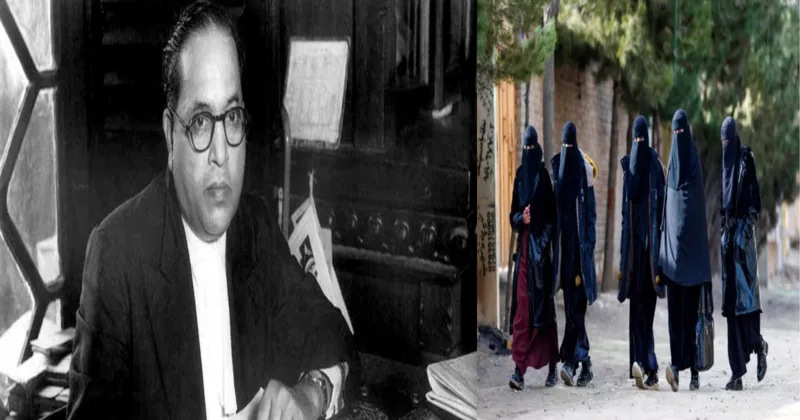
At a time when public discourse bends over backwards to sanitise regressive customs in the name of “cultural sensitivity,” a post by Prof Dilip Mandal on X has revived a forgotten and deeply uncomfortable truth. By recalling Dr B R Ambedkar’s writings on the religious oppression of Muslim women, the post lands like a thunderbolt unapologetic, unsparing, and profoundly unsettling.
Dr. B. R. Ambedkar’s Views on Burka/Hijab/Veil:
"These burka women walking in the streets is one of the most hideous sights one can witness in India."
"Such seclusion cannot but have its deteriorating effects upon the physical constitution of Muslim women."
"They are usually… pic.twitter.com/ixRqz90oLj
— Dilip Mandal (@Profdilipmandal) December 17, 2025
Long before social media debates and television panels, Ambedkar delivered a devastating indictment of the purdah system among Indian Muslims, identifying it as one of the gravest obstacles to women’s emancipation and social integration in India.
Ambedkar’s critique was not ornamental. It was anatomical. He dissected purdah as a systemic form of oppression with religious sanction, and he refused to romanticise it as “choice” or “identity.”
“These burka women walking in the streets is one of the most hideous sights one can witness in India.” This was not a comment on appearance. It was a moral and political judgment on a social order that erased women from public life.
Ambedkar linked purdah directly to physical degeneration. In an era without modern feminist vocabulary, he nonetheless described what today would be called structural violence against women’s bodies:
- Chronic anaemia
- Tuberculosis
- Skeletal deformities
- Pelvic abnormalities leading to death during childbirth
For Ambedkar, these were not accidents of poverty alone. They were products of enforced seclusion, lack of sunlight, restricted movement, and denial of healthcare. The veil, he argued, was not merely cloth it was confinement.
Ambedkar was equally ruthless about the intellectual cost of purdah. He wrote that Muslim women were deprived of “mental and moral nourishment,” trapped in an existence reduced to domestic quarrels and narrow routines. “They have no desire for knowledge, because they are taught not to be interested in anything outside the four walls of the house.”
This was not victim-blaming. Ambedkar located the problem in social conditioning reinforced by religion, producing what he described as a “slavish mentality and an inferiority complex.”
Perhaps Ambedkar’s most explosive argument was his rejection of the claim that purdah preserves morality. On the contrary, he argued, sexual segregation corrodes moral life, not just for women but for men.
By cutting off normal social interaction between the sexes, purdah created what Ambedkar bluntly called “unhealthy tendencies, sexual excesses, and morbid habits.” He dismissed the need for psychoanalysis to understand this outcome it was common sense born of social reality.
Ambedkar made an observation that remains politically radioactive even today, “The Hindus are right when they say that it is not possible to establish social contact between Hindus and Muslims…”
The reason, he argued, was not inherent hostility but the impossibility of normal social interaction when one community’s women are religiously forbidden from public contact. Purdah, in this sense, became a wall not just around women, but between communities.
Ambedkar was careful to note that forms of seclusion existed among Hindus too. But he drew a sharp line of distinction:
- Among Hindus, purdah had social roots and was therefore reformable
- Among Muslims, purdah carried religious sanctity, making reform far more difficult
This sanctification, Ambedkar warned, meant that any serious attempt to abolish purdah would require direct confrontation between religious injunctions and social needs. And here lies his most damning conclusion, “Of any attempt by the Muslims to do away with it, there is no evidence.”
Ambedkar’s words are rarely quoted in full today for a reason. They shatter the convenient narrative that all criticism of Islamic social practices is “bigotry.” Coming from the architect of India’s Constitution, a lifelong fighter against caste oppression, this critique cannot be dismissed as prejudice.
Ambedkar believed that no religion Hinduism included deserved immunity from rational scrutiny. For him, women’s freedom was non-negotiable, even if it meant confronting deeply held beliefs.