FCRA 2026: Transparency vs foreign influence
June 7, 2026
  • Read Ecopy
  • Circulation
  • Advertise
  • Careers
  • About Us
  • Contact Us
Android AppiPhone AppArattai
Organiser
  • ‌
  • Bharat
    • Assam
    • Bihar
    • Chhattisgarh
    • Jharkhand
    • Maharashtra
    • View All States
  • World
    • Asia
    • Europe
    • North America
    • South America
    • Africa
    • Australia
  • Editorial
  • International
  • Opinion
  • RSS @ 100
  • More
    • Op Sindoor
    • Analysis
    • Sports
    • Defence
    • Politics
    • Business
    • Economy
    • Culture
    • Special Report
    • Sci & Tech
    • Entertainment
    • G20
    • Azadi Ka Amrit Mahotsav
    • Vocal4Local
    • Web Stories
    • Education
    • Employment
    • Books
    • Interviews
    • Travel
    • Law
    • Health
    • Obituary
  • Subscribe
    • Subscribe Print Edition
    • Subscribe Ecopy
    • Read Ecopy
  • ‌
  • Bharat
    • Assam
    • Bihar
    • Chhattisgarh
    • Jharkhand
    • Maharashtra
    • View All States
  • World
    • Asia
    • Europe
    • North America
    • South America
    • Africa
    • Australia
  • Editorial
  • International
  • Opinion
  • RSS @ 100
  • More
    • Op Sindoor
    • Analysis
    • Sports
    • Defence
    • Politics
    • Business
    • Economy
    • Culture
    • Special Report
    • Sci & Tech
    • Entertainment
    • G20
    • Azadi Ka Amrit Mahotsav
    • Vocal4Local
    • Web Stories
    • Education
    • Employment
    • Books
    • Interviews
    • Travel
    • Law
    • Health
    • Obituary
  • Subscribe
    • Subscribe Print Edition
    • Subscribe Ecopy
    • Read Ecopy
Organiser
  • Home
  • Bharat
  • World
  • Operation Sindoor
  • Editorial
  • Analysis
  • Opinion
  • Culture
  • Defence
  • International Edition
  • RSS @ 100
  • Magazine
  • Read Ecopy
Home Bharat

FCRA Amendment Bill 2026: Why transparency frightens the ecosystem of foreign influence

The FCRA Amendment Bill 2026 aims to bring transparency and accountability to foreign funding in India, challenging decades of unchecked influence. Political backlash highlights the discomfort of an ecosystem long accustomed to operating in opacity

Adv Karan ThakurAdv Karan Thakur
Apr 11, 2026, 03:30 pm IST
in Bharat, World, International Edition
Follow on Google News
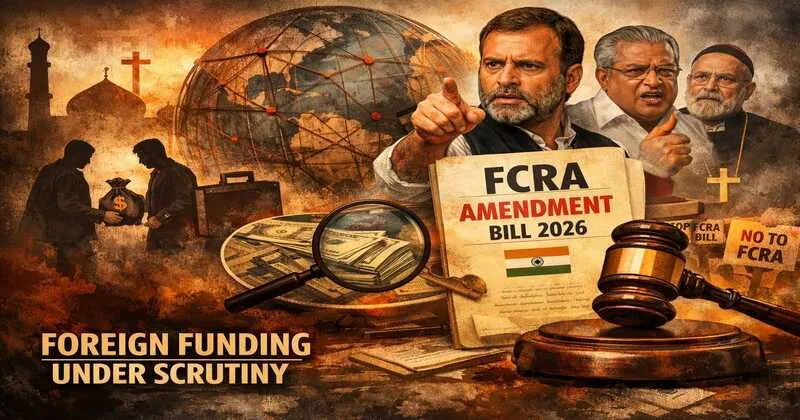
FCRA Amendment Bill 2026 aims to bring transparency and accountability to foreign funding in India, challenging decades of unchecked influence

FCRA Amendment Bill 2026 aims to bring transparency and accountability to foreign funding in India, challenging decades of unchecked influence

FacebookTwitterWhatsAppTelegramEmail

The real discomfort around the FCRA Amendment is not about the law, but about the end of unchecked influence.

When the Government of India introduced amendments to the Foreign Contribution (Regulation) Act, 2010, on March 25, 2026, the objective was unambiguous: to bring transparency, accountability, and national oversight into the inflow and utilisation of foreign funds. Yet, the political tremors that followed were disproportionate, almost as if a long-protected ecosystem had suddenly come under existential scrutiny.

The question that naturally arises is: why does transparency provoke such anxiety?

For decades, foreign contributions have entered India under the garb of charity, development, and humanitarian work. While many institutions have indeed contributed meaningfully to social upliftment, there has also existed a parallel reality, one where foreign funding has been leveraged to influence ideological narratives, facilitate religious conversions, and shape political discourse in subtle but sustained ways. It is precisely this grey zone that the 2026 amendment seeks to illuminate.

Criticism from leaders such as Pinarayi Vijayan, who termed the bill as fear-inducing for minorities, appears less like a principled stand and more like a political reflex. The argument conveniently sidesteps a crucial issue: should foreign funding be allowed to operate without strict scrutiny in a sovereign democracy?

Similarly, Rahul Gandhi’s claim that the government is attempting to monopolise foreign funding is a mischaracterisation. The state is not seeking control over funds; it is demanding accountability. There is a fundamental difference between regulation and appropriation, a distinction that is deliberately blurred in political rhetoric.

Also Read: UP: Around 200-year-old Devanagari manuscript discovered in Ayodhya, to be preserved at International Ram Katha Museum

The amendment addresses long-standing structural deficiencies within the existing legal framework. One of the most significant gaps in the original legislation was the absence of a clear mechanism governing assets created out of foreign contributions. When licences were cancelled, these assets often slipped into ambiguity, leaving room for misuse and diversion.

By introducing a “designated authority” to regulate such assets, the government has taken a step towards safeguarding public interest. Yet, this very provision has been portrayed as state overreach, an argument that does not withstand serious scrutiny.

The resistance from certain church groups and organisations in Kerala further exposes the deeper fault lines. The apprehension that educational and medical institutions may come under state control is not only exaggerated but also legally untenable.

The amendment explicitly preserves the essential religious and charitable character of such institutions. The propagation of fear, therefore, appears less about legal reality and more about preserving operational opacity.

What is unfolding is not merely a legislative debate; it is a confrontation between two competing visions of India.

On one side stands the principle of national sovereignty, which asserts that no external financial influence should operate without transparency and accountability. On the other hand, stands an entrenched ecosystem that has, over the years, benefited from regulatory ambiguities and now resists any attempt at reform.

Union Minister Nityanand Rai’s assertion that misuse of foreign funds will not be tolerated must be seen in this larger context. This is not simply governance; it is a matter of national security. In an era where influence operations are increasingly sophisticated, financial flows become instruments of soft power and ideological penetration.

Significantly, the amendment also tempers the penal provisions. By reducing the maximum punishment from five years to one year, the government has demonstrated restraint and proportionality. Yet, even this calibrated approach has been labelled “draconian” a claim that collapses under objective analysis.

The political reactions surrounding the bill reveal a familiar pattern. The same voices that once endorsed the FCRA framework now resist its strengthening. This inconsistency is not ideological; it is strategic.

As electoral considerations, particularly in states like Kerala, begin to shape narratives, legislative intent is overshadowed by vote-bank calculations. The result is a manufactured controversy, where regulation is framed as repression and accountability as authoritarianism.

At its core, the issue is simple: can a sovereign nation afford to remain indifferent to the sources and uses of foreign funding within its borders?

The answer, unequivocally, is no. Transparency is not a threat; it is a necessity. Accountability is not repression; it is the foundation of democratic integrity. Those who operate within the law have nothing to fear. But for those who have thrived in its shadows, even a ray of transparency can appear blinding. And perhaps, that is what this resistance is truly about.

Topics: National SovereigntyFCRA Amendment 2026foreign funding transparencyIndia foreign contributionsNGO regulation IndiaRahul GandhiPinarayi VijayanNityanand Rai
ShareTweetSendShareSend
✮ Subscribe Organiser YouTube Channel. ✮
✮ Join Organiser's WhatsApp channel for Nationalist views beyond the news. ✮
Previous News

Matrashakti Rising: How rural women are leading Bharat’s war against drugs and liquor addiction

Next News

Kottiyoor Mandir: Kerala’s forest shrine where devotion and nature exist in timeless harmony

Related News

Rahul, Kharge and Jairam vs. India's Great Nicobar Vision (This is an AI generated image)

Great Nicobar Project: Why Congress is opposing Modi government’s strategic mega plan

Kerala HC rejects CMRL appeal, clears way for ED probe against Pinarayi Vijayan’s daughter in money laundering case

Ex-CM Pinarayi Vijayan and his daughter Veena Vijayan (Left to Right)

Keralam: ED may confiscate assets of ex-CM Pinarayi’s daughter Veena Vijayan, examine bank lockers and summon her again

Governor enters the Assembly; State Police Chief seen behind him during the proceedings

Truncated Vande Mataram played in Keralam Assembly; Lok Bhavan and BJP protest, DGP entry sparks row

Kerala former CM Pinarayi Vijayan and his daughter Veena Vijayan

Keralam: Reports claim SFIO found monthly payments from 12 firms to Pinarayi Vijayan’s daughter; CPM defends ED attack

Keralam ED freezes Rs 18.36 crore linked to Pinarayi Vijayan’s daughter; CPM hands over cadres in ED attack case

Keralam: ED freezes Rs 18.36 crore linked to Pinarayi Vijayan’s daughter in CMRL Pay-off case; 4 CPM workers arrested

Load More

Latest News

West Bengal Set for Bullet Train Project, Says Railways Minister

Massive Rail Boost for West Bengal: Bullet train, 60 new metro rakes and Rs 14,205 crore allocation announced

Uttar Pradesh Chief Minister Yogi Adityanath reviewing meeting for upcoming Tourist Circuit

UP Charts New Tourism Vision: From Chhatrapati Shivaji Maharaj Museum to Vindhyachal Circuit

Visuals from the site of protest in Jantar Mantar

From ‘Azadi’ slogans to disrespect of national flag: Inside the Cockroach Janta Party protest at Jantar Mantar

Chairman of the Rastriya Swatantra Party of Nepal Rabi Lamichhane meets PM Modi in New Delhi

From the China Card to Development Diplomacy: Nepal opens a new chapter in its political reset with India

'Stand Up for Abhishek': Expelled TMC MLA Claims Party Was Asked to Applaud Mamata's Nephew After Crushing Election Defeat

West Bengal: Expelled TMC MLA Ritabrata claims party was asked to applaud Mamata’s nephew after crushing defeat

Forced to Remove the “Faith”: How Hindu students are targeted at exam centres

A representative image generated using AI

Gujarat: Parsi woman Married to a Muslim man cremated with Hindu rites after VHP’s intervention

She showed the "Made in Pakistan" label attached to the bedsheet

Made in Pakistan bedsheet sold at Pune religious fair? Viral video triggers investigation

India's first Prime Minister Jawahar Lal Nehru and India's current Prime Minister Narendra Modi

From ‘Ship to Mouth’ under Nehru to free rations for 80 crore under Modi: Inside India’s food security revolution

Picture from the site of protest

22 million followers, a few hundred on ground: Cockroach Janta Party faces its first reality check at Jantar Mantar

Load More
  • Privacy
  • Terms
  • Cookie Policy
  • Refund and Cancellation
  • Delivery and Shipping

© Bharat Prakashan (Delhi) Limited.
Tech-enabled by Ananthapuri Technologies

  • Home
  • Search Organiser
  • Bharat
    • Assam
    • Bihar
    • Chhattisgarh
    • Jharkhand
    • Maharashtra
    • View All States
  • World
    • Asia
    • Africa
    • North America
    • South America
    • Europe
    • Australia
  • Editorial
  • Operation Sindoor
  • Opinion
  • Analysis
  • Defence
  • Culture
  • Sports
  • Business
  • RSS @ 100
  • Entertainment
  • More ..
    • Sci & Tech
    • Vocal4Local
    • Special Report
    • Education
    • Employment
    • Books
    • Interviews
    • Travel
    • Health
    • Politics
    • Law
    • Economy
    • Obituary
  • Subscribe Magazine
  • Read Ecopy
  • Advertise
  • Circulation
  • Careers
  • About Us
  • Contact Us
  • Policies & Terms
    • Privacy Policy
    • Cookie Policy
    • Refund and Cancellation
    • Terms of Use

© Bharat Prakashan (Delhi) Limited.
Tech-enabled by Ananthapuri Technologies