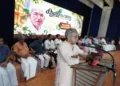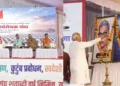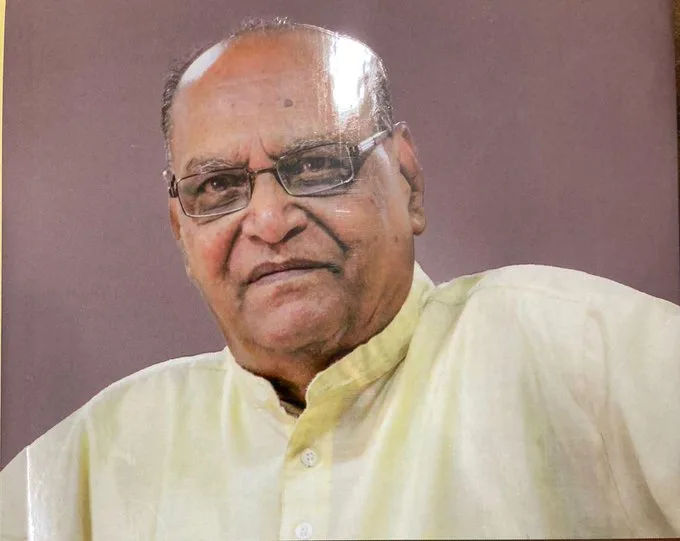
Bengaluru: Veteran scholar, author, and former President of Rashtrotthana Parishat, Dr S.R. Ramaswamy (88), passed away in Bengaluru on April 10, marking the end of an era in intellectual and cultural circles.
Senior functionaries and prominent personalities expressed deep condolences over his demise. Among those who paid tribute were RSS Sarakaryavah Dattatreya Hosabale, RSS Sah Sarakaryavah Mukunda CR, Kshetriya Sanghachalak Dr P. Vaman Shenoy, Kshetriya Karyavah N Thippeswamy, Karnataka Dakshin Prant Sanghachalak G S Umapathi, and Prant Karyavah Dr M. Jayaprakash, along with several other distinguished individuals.
Dr Ramaswamy was widely regarded as a multifaceted scholar, a senior journalist deeply rooted in nationalism, a selfless social worker across multiple domains, and a prolific writer in several languages. Known for his vast intellectual depth, he was a polymath and a polyglot, as well as an unassuming thinker and visionary of a very high order.
For over six decades, Dr Ramaswamy worked tirelessly for the preservation and promotion of India’s civilisational heritage. Throughout this period, he stood as a living embodiment of the values he consistently articulated, dedicating his life to cultural and intellectual pursuits.
Hailing from a family of scholars and creative individuals, Dr Ramaswamy was, in essence, a self-made personality. From an early age, he developed a deep affinity for Indian culture, rooted fundamentally in spirituality.
Inspired by the lives and teachings of Swami Vivekananda and Ramana Maharshi, he immersed himself in various shaastras and arts that reflected this spiritual ethos, shaping his lifelong contributions to society.
Continuing his intellectual journey, Dr S.R. Ramaswamy drew deep inspiration from Padmabhushan D. V. Gundappa (DVG), under whom he served as a personal secretary for over two decades. This association exposed him to Indian philosophy, classical literature, journalism, and public life, with DVG remaining his lifelong guiding influence.
Over the decades, he built meaningful relationships with eminent personalities across age groups, ideologies, and nationalities, earning wide respect and affection. His intellectual journey was enriched by interactions with distinguished scholars such as Masti Venkatesha Iyengar, Rallapalli Ananthakrishna Sharma, and others, while his uncle S. Srikanthashastry inspired his pursuit of multiple foreign languages.
A noted polyglot, Dr Ramaswamy had command over several Indian languages including Telugu, Hindi, Marathi, Gujarati, and Bengali, apart from classical Sanskrit, Pali, and Kannada. He also learnt foreign languages such as German, French, Spanish, and Italian.
He possessed deep knowledge of both Hindustani and Carnatic music and served as a music critic for The Indian Express, while maintaining close associations with leading maestros. His engagement extended to dance, visual arts, and photography, where he contributed through writing, editing, and documentation.
As a journalist, he interacted with leading editors and public figures in India and abroad, while remaining closely connected with several prominent personalities in public life and nationalist thought, including Prof. P. Kodanda Rao, Veerakesari Seetarama Sastry, T.T. Sharma, M.H Mari Gauda, Yadavarao Joshi, Dattopanta Thengadi, H. V. Sheshadri, Deendayal Upadhyaya, Balasaheb Devarasji, Rajjubhaiyahji, Surdarshan ji, N. Krishnappa, Jayadev, Ajit Kumar and many more in the order of RSS were and are very close to him and all of them have been indebted by his learning and erudition.
Dr Ramaswamy was also among the early voices in Karnataka to raise concerns over environmental degradation. His work on ecology, biodiversity, water management, and sustainable development—both as a scholar and activist—was widely regarded as pioneering.
After his long association with DVG, he joined the Kannada weekly Sudhaa as Assistant Editor and later remained closely associated with Rashtroththana Parishat since 1966. He served as Editor-in-Chief of Utthana and Rashtroththana Sahitya for over four decades, while also contributing significantly to the Gokhale Institute of Public Affairs as Honorary Secretary.
A prolific writer and speaker, he authored more than 60 books and over a thousand articles across diverse subjects. His major works include Mahaabhaaratada Belavanige, Manobodha, Sangha-Gitaa, Sukti-Sanchaya, Ananda-Matha, Bhaaratiya-Chitta, Maanasa and Kaala, along with significant works such as Shatamaanada Tiruvinalli Bhaarata, Aarthikateya Eradu Dhruva (also rendered in English as In the Woods of Globalisation), Svadeshi Jaagrti, Svadeshi: Ondu Samvaada, Bhaaratadalli Samaaja-Kaarya, Svaatantryodayada Maili-GallugaLu, Mataantara: Ondu Samvaada, Kaaragil Kampana, Kelavu Itihaasa-ParvagaLu, and NaagaraikaategaLa SamgharSha.
His writings, translations, lectures, and broadcasts through AIR, BBC, and Doordarshan leave behind a lasting intellectual legacy, reflecting a lifetime devoted to scholarship, culture, and national thought.