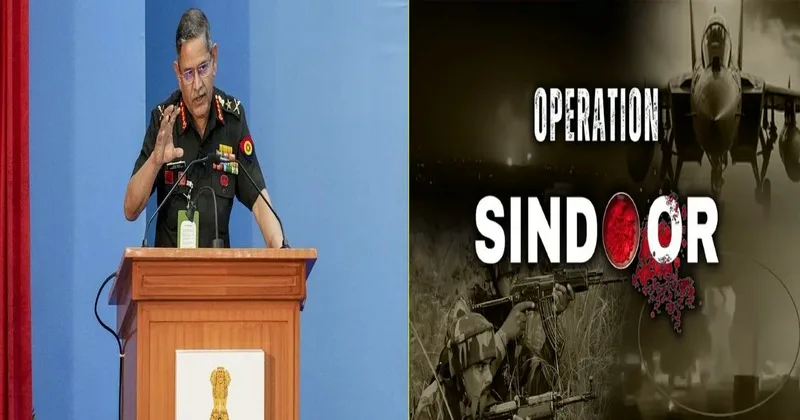
Bengaluru: Chief of Army Staff Upendra Dwivedi on April 9 described Operation Sindoor as a landmark demonstration of India’s growing capability in “domain jointness,” while underlining the urgent need to move towards deeper integration and fusion across military domains.
Speaking at the defence dialogue RAN SAMWAD 2026, General Dwivedi said the operation launched in response to the Pahalgam terror attack that killed 26 Indian tourists serves as a “defining case study” in modern warfare and operational coordination.
“Operation Sindoor was India’s most powerful tool of progression towards domain jointness. But we need to achieve domain integration and fusion,” he said, highlighting the evolution of India’s military doctrine.
The Army Chief revealed that nearly 15 per cent of the operational effort was dedicated to countering disinformation campaigns, reflecting the growing importance of information warfare. However, he cautioned that significant challenges remain, particularly in synchronising operations across strategic, operational and tactical levels.
Evolving nature of warfare
General Dwivedi stressed that modern conflicts are no longer confined to conventional battlefields. “We are living through a dispersed, undeclared, multi-theatre, multi-domain war of our times,” he said, pointing to the rise of hybrid or “grey-zone” warfare that operates below traditional military thresholds.
“These are typically aimed at exploiting adversary vulnerabilities without triggering full-scale conflict,” he explained, adding that non-kinetic operations—such as cyber and information warfare—are increasingly taking precedence.
He elaborated that warfare today involves six interconnected domains—land, air, maritime, cyber, space and cognitive—operating in constant interaction rather than isolation. “The question is not whether domains interact, but how the interface is orchestrated across the battle space,” he noted.
Operation Sindoor: A joint effort
Providing insights into Operation Sindoor, General Dwivedi said the success of the mission lay in seamless coordination across multiple domains. “It was a ground intelligence network coupled with cyber and electronic warfare inputs that enabled joint army-air force targeting, while the navy’s repositioning shaped the strategic calculus,” he said.
“No single domain decided the operation,” he added, emphasising the importance of integrated planning and execution.
He further explained that while domains like cyber, space and cognitive operations benefit from centralised control, land warfare continues to rely on decentralised execution. This creates a complex but adaptive system that must be aligned through clear intent and advanced technological integration.
Structural reforms and future roadmap
The Army Chief outlined several reforms underway to strengthen India’s military capabilities, including the operationalisation of integrated battle groups, Rudra brigades, dedicated drone units, electronic warfare formations and cyber operation nodes.
He also highlighted the importance of the “three Is”—integration, informatisation and intelligentisation—as key pillars of future warfare. “Technology will drive transformation, but the human must remain in the loop exercising judgment,” he asserted.
Calling for a new generation of leadership, General Dwivedi said commanders must evolve into “techno-commanders” capable of operating across domains seamlessly. “We must build a force that does not know where one domain ends and another begins,” he said.
Looking ahead, he identified “six Ds” shaping the future battlefield, including dispersion, democratisation and diffusion. These trends, he noted, will require diversification of assets, delegation of command and distributed response mechanisms.
Concluding his address, the Army Chief called for a decisive shift from “domain silos to domain fusion,” outlining a six-stage progression toward complete integration. He stressed that such transformation is essential for India to remain prepared for the complexities of next-generation warfare.