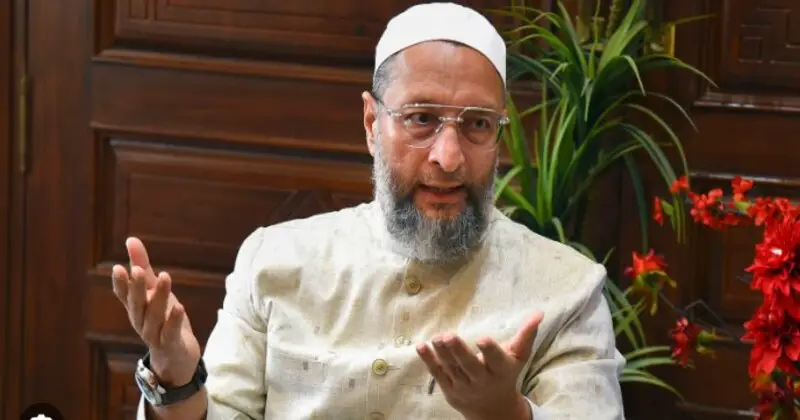
In a politically significant development ahead of the high-stakes West Bengal Assembly elections, the All India Majlis-e-Ittehadul Muslimeen (AIMIM), led by Asaduddin Owaisi, has formally severed ties with the party floated by former Trinamool Congress leader Humayun Kabir.
The decision, announced on Friday through a strongly worded statement, comes in the wake of controversial remarks and disclosures attributed to Kabir, which AIMIM claims raised serious concerns regarding the “integrity of Muslims.”
“Cannot associate with any statements where the integrity of Muslims is brought into question,” the party asserted, confirming that the alliance has been terminated with immediate effect.
While AIMIM has officially cited Kabir’s recent remarks as the trigger, political observers suggest that the split may not be limited to a single controversy. There is growing speculation that the decision could also be influenced by Kabir’s past association with contentious proposals linked to the Babri Masjid demolition discourse in Murshidabad.
Kabir, who was earlier expelled from the All India Trinamool Congress (TMC), had courted controversy over a proposal reportedly invoking the Babri Masjid issue. Subsequently, he went on to form the Aam Janata Unnayan Party.
Although AIMIM has not explicitly linked its decision to the Babri-related episode, the timing and tone of its statement have led to conjecture that the party is attempting to distance itself from any political narrative that could be perceived as aligning “together with” figures associated with such polarising historical issues.
Reiterating its electoral strategy, AIMIM announced that it will now contest the West Bengal elections independently, ruling out any future alliances in the state.
The party emphasised that its primary objective remains providing an “independent political voice” to marginalised communities, particularly Muslims, whom it described as “one of the poorest, neglected and oppressed” in the state despite decades of governance under so-called secular parties.
“Despite years of rule by parties advocating secularism, nothing substantial has changed for Bengal’s Muslims,” the statement noted, indirectly targeting both the TMC and previous regimes.
The political landscape in West Bengal remains highly competitive, with multiple parties vying for influence over key demographic segments, including minority voters.
The elections for the 294-member Assembly are scheduled to be held in two phases on April 23 and April 29, with counting set for May 4. AIMIM’s decision to go solo could potentially reshape electoral equations in select constituencies, particularly in minority-dominated districts.
While AIMIM’s public stance centres on principles and ideological clarity, the abruptness of the split and the reference to “integrity” have left several questions unanswered.
Is the move purely a reaction to recent remarks, or does it reflect a calculated attempt to avoid association with controversial historical narratives like Babri?
Is AIMIM repositioning itself to consolidate a distinct political identity in Bengal’s complex electoral matrix?
As the campaign intensifies, the answers may become clearer but for now, the breakup signals a widening rift that could have implications beyond just one alliance.