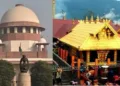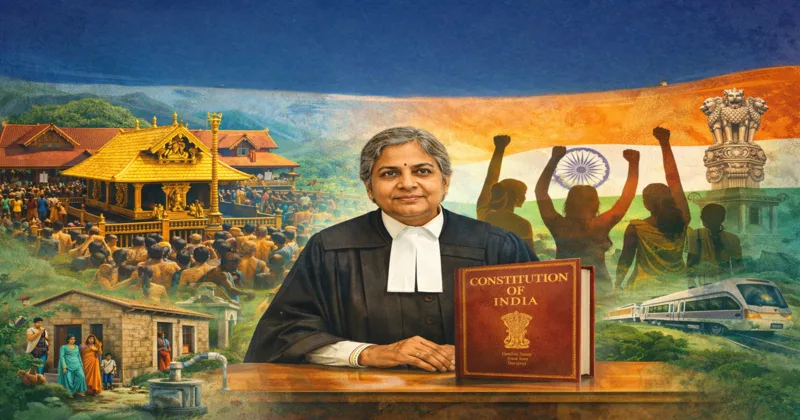
In Indian society, the relationship between religion (Dharma), tradition, and constitutional values is profound and multifaceted. The Sabarimala case stands as a significant example of this complex relationship; on one hand, it raises questions regarding religious faith and tradition, while on the other, it brings to the fore the constitutional interpretation of equality, dignity, and rights. Although this dispute originated over women’s entry into the temple, it carries broader implications, encompassing the interplay among discourses on Indian womanhood, cultural consciousness, and judicial perspectives.
In the context of the Supreme Court’s verdict in this matter, Justice B.V. Nagarathna raised several pertinent questions during the hearings. She questioned whether the prohibition on women’s entry imposed on the grounds of menstruation falls under the category of “untouchability.” Justice Nagarathna observed, “In this case, how an argument regarding ‘Article 17’- that is, the Right against Untouchability, can be advanced is beyond my comprehension. As a woman, I would like to state that it is inconceivable that a woman be deemed ‘untouchable’ for three days every month, only for that ‘untouchability’ to suddenly vanish on the fourth day.”
Justice Nagarathna’s assertion that “discrimination cannot be overlooked” constitutes, in essence, the central pivot of this entire discourse. Articles 14, 15, and 17 of the Constitution address equality, the prohibition of discrimination, and the abolition of untouchability, whereas Article 25 safeguards religious freedom. Thus, the Sabarimala episode evolves into a question of balancing these constitutional values.
In a similar vein, the task of raising several other questions here has been undertaken by Justice B. When Justice V. Nagaratna appeared on the bench, Solicitor General Tushar Mehta, representing the Central Government, argued that characterising the Sabarimala tradition as “untouchability” is historically inappropriate, as untouchability has fundamentally been a caste-based social evil. He described it instead as a religious tradition rooted in Lord Ayyappa’s vow of “Naishtika Brahmacharya” (absolute celibacy) a tradition that, he contended, deserves to be respected. Consequently, the most significant aspect to emerge from this entire discourse was the concept of giving women holistic and comprehensive respect.
The question that now arises is this: Is the status of women within Indian scriptures, intellectual traditions, the Hindu social order, or “Sanatan Dharma” in any way inferior, diminished, or weak? The answer is unequivocally no; on the contrary, when compared to the ancient civilisations of the world, including those that have survived into the modern era, Hindu “Sanatan Dharma” stands out for having accorded women an exceptionally high degree of honour and equal rights. In this context, one may look to the worship of the Goddess (Devi Aradhana), a practice ubiquitous throughout India. A study of the “Durga Saptashati” reveals with absolute clarity that the feminine principle is acknowledged as the universe’s primordial cosmic energy (Shakti). Indeed, the entire “Durga Saptashati” is replete with hymns extolling the greatness of women, celebrating their dignity, and expressing reverence and devotion toward them.
“Ya Devi Sarvabhuteshu Shakti-rupena Samsthita, Namastasyai Namastasyai Namastasyai Namo Namah” (Durga Saptashati, Chapter 5) this is but one example from an entire series of such mantras. “Vidyah samastastava Devi bhedah, striyah samastah sakalah jagatsu, Tvayaikaya puritamambayaitat, ka te stutih stavyapara paroktih” It is stated thus: “O Goddess! All the forms of knowledge in the world are but your various manifestations. Similarly, all the women of the universe are embodiments of your very self. O Amba (Mother)! It is you alone who has pervaded this entire cosmos. Who, then, could possibly offer you adequate praise? You transcend even the very words used to extol you.” In essence, everything that exists throughout the universe is permeated by the feminine principle- Shakti. This constitutes the fundamental core of Indian philosophy, which reveals to us that the woman is the foundational energy of creation.
Devi Bhagwat Purana expresses this sentiment, “Tvameva Srishti-Tvameva Palanam, Tvameva Sanharkarini.” That is, the creation, maintenance and destruction of the universe; all three are under the power of women. (Skandha 1, Chapter 8). This high position of women is also mentioned in Vedic literature. In the Rig Veda (Mandal 10, Sukta 125), through the Vak Sukta, woman presents herself as the ruling power of the universe.
“Aham Rashtri Sangamani Vasunaam…” is a very important mantra of ‘Vak Sukta’ of Rig Veda (10.125.3), which states the supremacy of Gyan Shakti (Goddess Speech). It means, “I (Vak Shakti) am the mistress of the nation, the gatherer of all wealth Vasunaam Sangamani and the possessor of superior knowledge (Chikitushi). In this way it describes itself as the supreme consciousness or speech as the origin of the wealth and knowledge of the nation.
It has even been said in Manu Smriti that “Yatra Naryastu Pujyante Ramante Tatra Devata.” (Chapter 3, Verse 56). Where women are revered, there the deities reside. Indeed, it must be said that this verse reflects the fundamental structure of Indian society. The modern scholar Patrick Olivelle (in Manu’s Code of Law, p. 78) also regards this as evidence of the respect accorded to women.
Admittedly, confusion is often deliberately sown regarding a specific “Chaupai” (couplet) from the “Ramcharitmanas”. However, it is inappropriate to interpret its meaning without first understanding the language and context employed by Goswami Tulsidas. In the aforementioned couplet, the word “Tadana” signifies “care” or “protection” in the Awadhi dialect. Acharya Ramchandra Shukla in ‘Hindi Sahitya ka Itihas’ [History of Hindi Literature], p. 214) clarifies this very fact. Now, the question arises; if Indian tradition accords such a high status to women, why do traditions like Sabarimala exist? The answer lies in social and biological realities. Menstruation is a natural physiological process that entails physical discomfort, fatigue, and inconvenience for women.
In this context, one may refer to a 2022 report by the World Health Organisation (WHO), which states that approximately 70 per cent of women experience some form of physical distress during this period. In ancient times- owing to a lack of adequate sanitary facilities, certain traditions evolved with the specific objective of providing women with necessary rest. It is crucial to clarify here that “setting aside for the purpose of rest” and “deeming someone untouchable” are two distinct concepts. The underlying ethos within Indian society was one of protection and concern for health, not of discrimination.
Furthermore, it must be understood that within the Indian tradition, purity of both body and mind is an absolute prerequisite for seeking the “darshan” (sacred sight) of a deity or approaching the sanctum. Even if, for the sake of argument, we were to set aside the discourse concerning women in this context, would a man be granted permission to enter a temple if urine were involuntarily trickling or dripping from his genitals? Would he- or his family members, or the temple authorities- permit his entry into the temple premises, knowing full well that he lacks control over his bodily excretory functions? Would entry be granted? In scientific terms, after all, it is merely water!
Similarly, consider the acts of defecation, the continuous expulsion of saliva from the body, or a runny nose; while these are, strictly speaking, merely physiological processes, would one be permitted entry into a temple while experiencing them? Indeed, in all Hindu households, there exists a common tradition- one about which no one explicitly needs to speak- whereby, after bathing and prior to performing “puja” (worship), family members do not sit just anywhere or wander about aimlessly. Even if someone wishes to embrace them without having bathed, they must wait until the “puja” has been concluded. Furthermore, the Sabarimala issue is inextricably linked to the faith of millions of people.
Therefore, the fundamental point to grasp here is that Indian philosophy teaches us that a woman is, in her very essence, “Shakti” (Divine Power). She is the “Mother,” the “Sustainer,” and the “Cornerstone of Creation.” “Stree Samasta Sakala Jagatsu”- “Women embody the entirety of the universe”, this is the very essence of the Indian worldview. Consequently, when adjudicating matters such as the Sabarimala issue, it is imperative to proceed by harmonising three distinct elements: the sanctity of the Constitution, the profundity of the scriptures, and the realities of society. This very balance constitutes the hallmark of “Indianness” (Bhartiyata), and it also represents the true resolution to this ongoing discourse. We remain hopeful that Justice B.V. Nagarathna, too, will undoubtedly interpret this matter within this very context.