Delhi Budget 2026–27: A thinking government with visible intent
July 21, 2026
  • Read Ecopy
  • Circulation
  • Advertise
  • Careers
  • About Us
  • Contact Us
Android AppiPhone AppArattai
Organiser
  • ‌
  • Bharat
    • Assam
    • Bihar
    • Chhattisgarh
    • Jharkhand
    • Maharashtra
    • View All States
  • World
    • Asia
    • Europe
    • North America
    • South America
    • Africa
    • Australia
  • Editorial
  • International
  • Opinion
  • RSS @ 100
  • More
    • Op Sindoor
    • Analysis
    • Sports
    • Defence
    • Politics
    • Business
    • Economy
    • Culture
    • Special Report
    • Sci & Tech
    • Entertainment
    • G20
    • Azadi Ka Amrit Mahotsav
    • Vocal4Local
    • Web Stories
    • Education
    • Employment
    • Books
    • Interviews
    • Travel
    • Law
    • Health
    • Obituary
  • Subscribe
    • Subscribe Print Edition
    • Subscribe Ecopy
    • Read Ecopy
  • ‌
  • Bharat
    • Assam
    • Bihar
    • Chhattisgarh
    • Jharkhand
    • Maharashtra
    • View All States
  • World
    • Asia
    • Europe
    • North America
    • South America
    • Africa
    • Australia
  • Editorial
  • International
  • Opinion
  • RSS @ 100
  • More
    • Op Sindoor
    • Analysis
    • Sports
    • Defence
    • Politics
    • Business
    • Economy
    • Culture
    • Special Report
    • Sci & Tech
    • Entertainment
    • G20
    • Azadi Ka Amrit Mahotsav
    • Vocal4Local
    • Web Stories
    • Education
    • Employment
    • Books
    • Interviews
    • Travel
    • Law
    • Health
    • Obituary
  • Subscribe
    • Subscribe Print Edition
    • Subscribe Ecopy
    • Read Ecopy
Organiser
  • Home
  • Bharat
  • World
  • Operation Sindoor
  • Editorial
  • Analysis
  • Opinion
  • Culture
  • Defence
  • International Edition
  • RSS @ 100
  • Magazine
  • Read Ecopy
Home Bharat

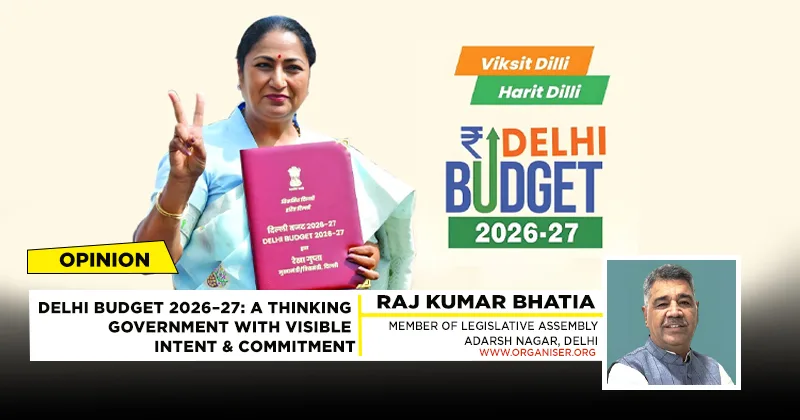
Delhi Budget 2026–27: A thinking government with visible intent and commitment

Under the leadership of Delhi Chief Minister Rekha Gupta, the budget emphasises a life-cycle approach to development—addressing the needs of citizens from infancy to old age—while prioritising inclusivity, sustainability and dignity

Raj Kumar BhatiaRaj Kumar Bhatia
Apr 7, 2026, 09:00 pm IST
in Bharat, Opinion, Delhi, Economy
Follow on Google News
FacebookTwitterWhatsAppTelegramEmail

When a bird takes flight, it does not just look at the sky.
It looks for a safe nest for its young.

That is the difference between ordinary governance and a thinking government.

The Delhi Budget 2026–27 is not just Rs 1,03,700 crore. It is not just a document. It is intent, empathy and vision. It reflects what Hon’ble Prime Minister Narendra Modi has consistently emphasised: “Governance must transform lives, not just create schemes.”

That philosophy is visible in every layer of this budget and is being implemented on the ground by Hon’ble Chief Minister Rekha Gupta, who believes that “Development is meaningful only when every citizen feels secure and empowered.”

This is a budget that begins with life itself.
Fifty-six tests for newborns under the ANMOL scheme are not merely a policy decision; they are reassurance for every mother.

This is a budget that empowers a school-going teenage girl. An allocation of Rs 90 crore to provide bicycles to more than one lakh girls is not about mobility alone; it is about freedom, confidence and dignity. Women’s safety has been strengthened through investment in surveillance systems, better lighting and safer public transport. This is not infrastructure alone; this is trust built into the system.

Also Read: India-flagged LPG carrier ‘Green Asha’ crosses Strait of Hormuz; Another step in strengthening energy security

Beyond these immediate interventions, the budget adopts a broader, life-cycle approach to governance, addressing the needs of citizens at different stages of life. It seeks to connect policy not only with infrastructure, but with lived experience.

Healthcare remains a central pillar. With more than Rs 12,000 crore allocated to health and the development of 750 Ayushman centres, there is a clear effort to expand access to quality care. At the same time, the increase in undergraduate medical seats from around 600 to over 800 reflects a long-term investment in healthcare capacity.

Education is being aligned more closely with opportunity. The introduction of a Talent Hunt Scheme and the expansion of skill development initiatives signal a move towards identifying and nurturing potential, enabling young citizens to become self-reliant.

Infrastructure development remains a key focus, guided by the Four S framework articulated by Prime Minister Narendra Modi, which emphasises scope, scale, speed and skill. Allocations of Rs 5,900 crore for public works and Rs 7,900 crore for urban development reflect this direction.

Visible improvements are planned in everyday infrastructure, including end-to-end recarpeting of 750 kilometres of roads. Targeted investments in Trans Yamuna development and Delhi Gram Vikas Board initiatives indicate an effort to ensure more balanced regional growth.

Basic services are also being strengthened. With Rs 9,000 crore allocated to the Delhi Jal Board, the expansion of water supply and sewerage infrastructure aims to address long-standing urban challenges.

Transport planning reflects a forward-looking approach, with metro expansion, increased deployment of electric buses and a broader push towards sustainable mobility. Environmental priorities are further reinforced through green budget expansion and the scaling up of waste processing to 15,000 metric tonnes per day.

An important dimension of the budget is its emphasis on dignity across generations. The introduction of initiatives such as Vayo Anand Yojana creates meaningful spaces for senior citizens to engage, participate and live with joy. It recognises that development is not only about growth, but also about respect and care for those who have built the foundations of society.*

*Similarly, initiatives such as Mahila Haat ie Rani Haat provide platforms for women artisans to connect directly with markets. These are not merely economic measures; they are pathways to self-reliance, entrepreneurship and dignity, where skill is transformed into sustainable livelihood and independence.

An important dimension of the budget is also its emphasis on compassion as a governing principle. Investments in veterinary hospitals and animal care gau shalas facilities reflect a wider understanding of responsibility within an urban ecosystem.

As Prime Minister Narendra Modi has observed, “Good governance must become a people’s movement.” This budget attempts to reflect that idea by reaching multiple sections of society and integrating welfare with development.

Hon’ble Chief Minister Rekha Gupta has also emphasised that “We are not planning for the next year; we are planning for the next generation.” This long-term orientation is visible in its focus on sustainability, capacity building and institutional strengthening.

What ultimately defines this budget is its attempt to balance scale with sensitivity. It recognises the concerns of households, the aspirations of young people and the dignity of senior citizens, while building systems that are efficient, inclusive and forward-looking.

It may therefore be seen not merely as a financial budget, but as a statement of direction—one that seeks to build a Delhi that is not only more developed, but also more inclusive, secure and humane.


 

Topics: Prime Minister Narendra ModiDelhi CM Rekha GuptaDelhi-Budget 2026-2027
ShareTweetSendShareSend
✮ Subscribe Organiser YouTube Channel. ✮
✮ Join Organiser's WhatsApp channel for Nationalist views beyond the news. ✮
Previous News

Kovil/ Tirupati Vs Tituttani: A tale of two Kovil towns

Next News

The Kharge Episode: If this is ‘illiteracy’ then what is wrong with it?

Related News

PM Modi Applauds Sant Niranjan Dass' Social Welfare Work During Punjab Visit

PM Modi meets Sant Niranjan Dass, lauds his contribution to spiritual awareness and social welfare

'Putin Listens to PM Modi': Polish Deputy FM Highlights India's Global Influence

PM Modi played role in stopping Russian President from using nuclear weapons in Ukraine: Polish Dy Foreign Minister

Rupee-Rupiah trade, digital payments and strategic cooperation mark a new chapter in the India-Indonesia economic partnership.

India, Indonesia advance de-dollarisation with Rupee-Rupiah local currency settlement framework

Home Minister Amit Shah laying foundation stone for 125-foot Dr Syama Prasad Mookerjee statue in Kolkata

Dr Syama Prasad Mookerjee: Not just a statue but the foundation of Sonar Bangla

PM Modi's Gifts to Albanese Blend India's Ancient Craft, Modern Music and Premium Coffee

From Dhokra Sculpture to Colonial Cousins Vinyl: PM Modi’s gifts to Australian PM Albanese showcases cultural heritage

India Declares One-Day National Mourning for Qatar's Father Amir Sheikh Hamad bin Khalifa Al Thani

India declares one-day national mourning on demise of former Qatar Amir Sheikh Hamad bin Khalifa Al Thani

Load More

Latest News

Punjab Pharma Officer Exam Cheating Racket Exposed: 35 detained, candidates allegedly paid up to Rs 13 lakh

(Left) Congress leader Mohammed Nalapad (Right) Karnataka Minister Priyank Kharge

RSS Defamation Case in Karnataka: Court orders personal appearance Of Priyank Kharge, Mohammed Nalapad

BMS hosts 15th BRICS Trade Union Forum (TUF) Summit 2026 in Hyderabad; Calls for worker-centric global order

BRICS TUF Summit 2026: Shifting the labour discourse

Courtesy: T.C. Rajesh’s FB post

Keralam: CPM’s Deshabhimani daily drops ‘Vijayan, the thief’ article from Sunday supplement; text Surfaces on FB

Self-immolation by Lobsang Palden in front of UN Headquarters in New York, (inset) the activist shortly before immolating himself

China and Tibet: Immolation of ‘Imposed Unity’

Authorities attacked during anti-encroachment drive in Shivajinagar

Anti-Encrochment Drive in Karnataka: Officials attacked in Shivajinagar; BJP slams govt’s appeasement politics

The Shadow of politics & radical ideologies behind NEET protests

AgriBio 2.0 aims to build a self-reliant, climate-resilient agricultural future through biotechnology

NITI Aayog’s AgriBio 2.0: How biotechnology and climate-resilient crops will transform Indian agriculture

(L) Jalaudheen Ustad with Dr. Arif Hussein Theruvath (R)

Keralam: Islamic scholar inaugurates Ex-Muslim event anonymously over security fears

Delhi's CJP protest allegedly shifted from student issues to political confrontation, overshadowing educational concerns

Delhi’s CJP Protest: How opposition collectives hijacked the movement and compromised students’ interests

Load More
  • Privacy
  • Terms
  • Cookie Policy
  • Refund and Cancellation
  • Delivery and Shipping

© Bharat Prakashan (Delhi) Limited.
Tech-enabled by Ananthapuri Technologies

  • Home
  • Search Organiser
  • Bharat
    • Assam
    • Bihar
    • Chhattisgarh
    • Jharkhand
    • Maharashtra
    • View All States
  • World
    • Asia
    • Africa
    • North America
    • South America
    • Europe
    • Australia
  • Editorial
  • Operation Sindoor
  • Opinion
  • Analysis
  • Defence
  • Culture
  • Sports
  • Business
  • RSS @ 100
  • Entertainment
  • More ..
    • Sci & Tech
    • Vocal4Local
    • Special Report
    • Education
    • Employment
    • Books
    • Interviews
    • Travel
    • Health
    • Politics
    • Law
    • Economy
    • Obituary
  • Subscribe Magazine
  • Read Ecopy
  • Advertise
  • Circulation
  • Careers
  • About Us
  • Contact Us
  • Policies & Terms
    • Privacy Policy
    • Cookie Policy
    • Refund and Cancellation
    • Terms of Use

© Bharat Prakashan (Delhi) Limited.
Tech-enabled by Ananthapuri Technologies