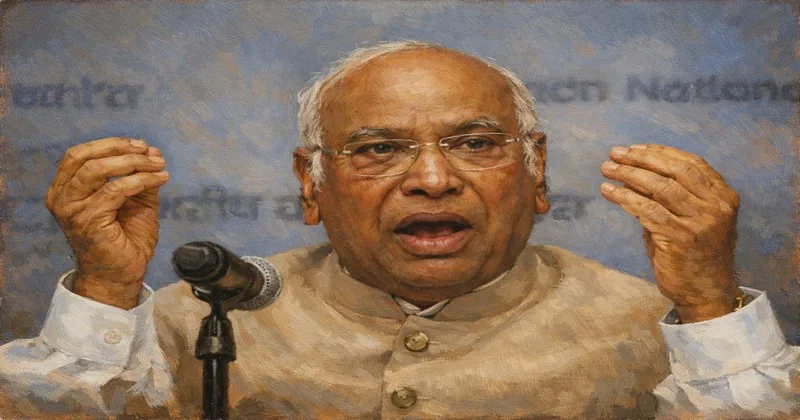
While addressing an election rally in Kerala, Congress National President Mallikarjun Kharge remarked regarding the people of Gujarat that they are “uneducated”; consequently, he argued, PM Modi can easily mislead them. In contrast, he asserted that the people of Kerala are more discerning and educated and therefore, no one can confuse them. Undoubtedly, by making this statement, Kharge has insulted not only the people of Gujarat but also the citizens residing in all those states across India where the Bharatiya Janata Party(BJP) is currently in power.
Given the current political landscape of the country, the Bharatiya Janata Party and the National Democratic Alliance(NDA) which it leads, enjoy a vast presence within Indian politics. The BJP holds power-either directly or through alliances in 21 states and Union Territories across the nation. Viewed from a certain perspective, the BJP exerts direct influence over most parts of North India(the Hindi heartland), West India and Northeast India; meanwhile, in key states such as Andhra Pradesh, Bihar, Maharashtra and those in the Northeast, it maintains strong ties with major regional allies. It is also a matter of fact that the states governed by the BJP and its allies collectively represent over 60 per cent of India’s total population. Furthermore, approximately 58 to 62 per cent of the country’s total geographical area falls within those states where BJP or NDA governments are currently in power.
In the wake of this statement by Kharge, Gujarat Chief Minister Bhupendra Patel has issued the following response: “The remarks made by Congress National President Mallikarjun Kharge ji regarding the people of Gujarat are highly objectionable and unfortunate. Such comments constitute not only an insult to the 60 million people of Gujarat but also inflict damage upon the dignity of this sacred land, the very birthplace of Mahatma Gandhi and Sardar Patel”. Gujarat has consistently played a leading role in nation-building, development and fostering unity, and it will continue to do so in the future. Statements of this nature merely serve to expose the narrow-mindedness of the Congress party. This remark clearly illustrates the extent of the discomfort and insecurity the Congress party feels in the face of the BJP’s politics of development spearheaded by Prime Minister Narendra Modi, and the widespread public support it continues to garner.
Much like Chief Minister Bhupendra Patel, other voices of dissent have also emerged, outright rejecting the statement made by Congress National President Mallikarjun Kharge and labeling it as both inappropriate and an insult to the common citizens of the country. At times, it seems as though the Congress despite having been out of power at the Centre for over eleven years, simply refuses to learn its lesson. Had the party truly understood the pulse of the nation’s people, its National President, Mallikarjun Kharge, would certainly not have issued such parochial and spite-driven statements. Furthermore, there is a second perspective to consider regarding this statement: even if the people of Gujarat ‘were’ uneducated, what exactly would be wrong with that? After all, they possess a profound understanding of the fundamental truths of life!
Even if Kharge chooses to draw a comparison between Kerala and Gujarat, one must examine where both states stand today. In reality, within India’s developmental landscape, Kerala and Gujarat represent two distinct models of development. While Kerala is renowned for its achievements in social development, education, healthcare, and human development indices, Gujarat stands at the forefront in the realms of economic growth, industrialization, and investment. A comparative analysis reveals that Gujarat holds the lead in several critical sectors.
Let us begin this analysis with a look at population demographics: Gujarat has a population of approximately 73 to 75 million(7.3 to 7.5 crores)- more than double that of Kerala, which stands at roughly 35 million(3.5 crores). Generally, it is expected that a state with a larger population would face greater pressure on its resources and experience higher rates of issues such as unemployment and crime; however, the reality on the ground appears to be quite the opposite. Despite its massive population, Gujarat has successfully managed to mitigate these challenges through robust job creation, industrial expansion, and the generation of economic opportunities. In stark contrast, Kerala- despite having a significantly smaller population- continues to grapple with a high rate of unemployment.
Here, the unemployment rate for the years 2025-26 stands at approximately 7-8 per cent. In contrast, the unemployment rate in Gujarat is merely 2-3 per cent; one of the lowest in the country. This leads to the conclusion that a high literacy rate alone is insufficient; rather, the economic structure and the capacity for job creation are of greater significance; areas in which Gujarat holds the lead. Kerala boasts a literacy rate of approximately 96 per cent, whereas Gujarat’s falls between 80 and 85 percent; yet, despite this achievement, a critical question remains: are these educational attainments translating into economic opportunities? The prevalence of unemployment among highly educated youth suggests that Kerala’s social progress has not yet fully integrated with its economic structure. Conversely, Gujarat has established a balance by expanding economic opportunities, despite its relatively lower performance in the realm of education.
From an economic perspective, Gujarat’s performance has been remarkably impressive. In 2025-26, Gujarat’s Gross State Domestic Product(GSDP) reached approximately ₹29-30 lakh crore, whereas Kerala’s GSDP stood at around ₹14-15 lakh crore. In terms of foreign investment(FDI), Gujarat has consistently maintained its position among the top-ranking states. By 2025, the state had successfully attracted billions of dollars in investment. Gujarat’s greatest strength lies in its industrial base. Sectors such as petrochemicals, pharmaceuticals, automobiles, textiles, and port-based industries have transformed it into India’s industrial hub. It must be acknowledged that for any state to achieve overall success; specifically long-term economic stability and growth- a robust industrial foundation is paramount; in this regard, Gujarat holds a decisive lead.
In terms of per capita income, both states appear to be on a relatively equal footing; however, when it comes to growth rates and industrial contribution, Gujarat takes the lead. Industries contribute over 50 percent to Gujarat’s economy, whereas the service sector dominates in Kerala. While the majority of people in Kerala earn their livelihood by working outside the state, Gujaratis not only generate wealth for themselves but also provide employment opportunities to a large number of others. This is precisely why Gujarat currently accounts for approximately 25–27 percent of India’s total exports. Thus, in terms of economic expansion and production capacity, Gujarat is clearly far ahead of Kerala.
Another significant aspect is the crime rate. Kerala has recorded a higher crime rate per 100,000 population, whereas in Gujarat, the rate is comparatively lower. Gujarat’s relatively low crime rate today demonstrates that economic opportunities and employment contribute significantly to social stability. Furthermore, Gujarat has made remarkable strides in the development of roads, power infrastructure, ports, and industrial corridors. The state has consistently ranked at the top in terms of “Ease of Doing Business,” a factor that has successfully attracted investment. While Kerala possesses a robust infrastructure for health and education, it faces a relative deficit in physical infrastructure and industrial facilities. This underscores the fact that physical infrastructure is absolutely essential for economic growth, an area in which Gujarat holds the advantage.
Today, Gujarat exhibits a revenue surplus and controlled debt levels. In contrast, Kerala is grappling with a high revenue deficit and rising debt. It is particularly significant that, despite facing greater population density and resource constraints, Gujarat has outperformed in areas such as employment, crime control and economic growth. Given this reality, it is astonishing that the National President of the Congres party that has governed the country for a prolonged period dismisses Gujarat’s success-going so far as to label its people as uneducated! This statement undoubtedly reflects the narrow mindset of the Congress party; a mindset that cannot be criticized enough.