When a bird takes flight, it does not just look at the sky.
It looks for a safe nest for its young.
That is the difference between ordinary governance and a thinking government.
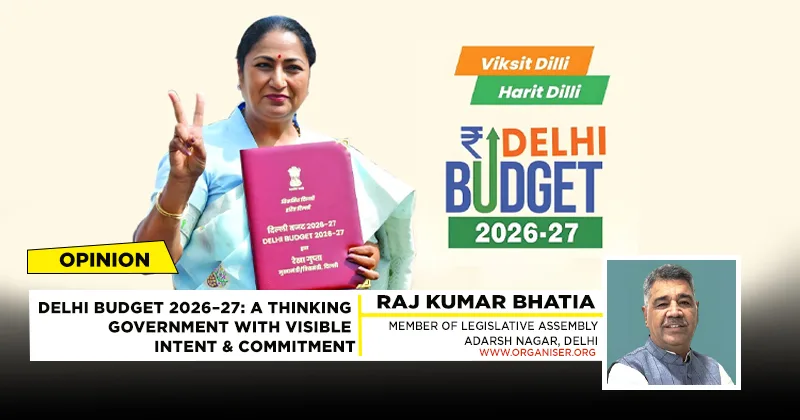
The Delhi Budget 2026–27 is not just Rs 1,03,700 crore. It is not just a document. It is intent, empathy and vision. It reflects what Hon’ble Prime Minister Narendra Modi has consistently emphasised: “Governance must transform lives, not just create schemes.”
That philosophy is visible in every layer of this budget and is being implemented on the ground by Hon’ble Chief Minister Rekha Gupta, who believes that “Development is meaningful only when every citizen feels secure and empowered.”
This is a budget that begins with life itself.
Fifty-six tests for newborns under the ANMOL scheme are not merely a policy decision; they are reassurance for every mother.
This is a budget that empowers a school-going teenage girl. An allocation of Rs 90 crore to provide bicycles to more than one lakh girls is not about mobility alone; it is about freedom, confidence and dignity. Women’s safety has been strengthened through investment in surveillance systems, better lighting and safer public transport. This is not infrastructure alone; this is trust built into the system.
Beyond these immediate interventions, the budget adopts a broader, life-cycle approach to governance, addressing the needs of citizens at different stages of life. It seeks to connect policy not only with infrastructure, but with lived experience.
Healthcare remains a central pillar. With more than Rs 12,000 crore allocated to health and the development of 750 Ayushman centres, there is a clear effort to expand access to quality care. At the same time, the increase in undergraduate medical seats from around 600 to over 800 reflects a long-term investment in healthcare capacity.
Education is being aligned more closely with opportunity. The introduction of a Talent Hunt Scheme and the expansion of skill development initiatives signal a move towards identifying and nurturing potential, enabling young citizens to become self-reliant.
Infrastructure development remains a key focus, guided by the Four S framework articulated by Prime Minister Narendra Modi, which emphasises scope, scale, speed and skill. Allocations of Rs 5,900 crore for public works and Rs 7,900 crore for urban development reflect this direction.
Visible improvements are planned in everyday infrastructure, including end-to-end recarpeting of 750 kilometres of roads. Targeted investments in Trans Yamuna development and Delhi Gram Vikas Board initiatives indicate an effort to ensure more balanced regional growth.
Basic services are also being strengthened. With Rs 9,000 crore allocated to the Delhi Jal Board, the expansion of water supply and sewerage infrastructure aims to address long-standing urban challenges.
Transport planning reflects a forward-looking approach, with metro expansion, increased deployment of electric buses and a broader push towards sustainable mobility. Environmental priorities are further reinforced through green budget expansion and the scaling up of waste processing to 15,000 metric tonnes per day.
An important dimension of the budget is its emphasis on dignity across generations. The introduction of initiatives such as Vayo Anand Yojana creates meaningful spaces for senior citizens to engage, participate and live with joy. It recognises that development is not only about growth, but also about respect and care for those who have built the foundations of society.*
*Similarly, initiatives such as Mahila Haat ie Rani Haat provide platforms for women artisans to connect directly with markets. These are not merely economic measures; they are pathways to self-reliance, entrepreneurship and dignity, where skill is transformed into sustainable livelihood and independence.
An important dimension of the budget is also its emphasis on compassion as a governing principle. Investments in veterinary hospitals and animal care gau shalas facilities reflect a wider understanding of responsibility within an urban ecosystem.
As Prime Minister Narendra Modi has observed, “Good governance must become a people’s movement.” This budget attempts to reflect that idea by reaching multiple sections of society and integrating welfare with development.
Hon’ble Chief Minister Rekha Gupta has also emphasised that “We are not planning for the next year; we are planning for the next generation.” This long-term orientation is visible in its focus on sustainability, capacity building and institutional strengthening.
What ultimately defines this budget is its attempt to balance scale with sensitivity. It recognises the concerns of households, the aspirations of young people and the dignity of senior citizens, while building systems that are efficient, inclusive and forward-looking.
It may therefore be seen not merely as a financial budget, but as a statement of direction—one that seeks to build a Delhi that is not only more developed, but also more inclusive, secure and humane.