
“If it (the problem of Maoism) is not properly evaluated, it would be unfair to future generations of Bharat. Some people describe it as merely a law-and-order or development issue. I do not agree with this. Naxalism began in the 1980s in parts of Maharashtra, Odisha, Andhra Pradesh, and Bastar. At that time, around 100 districts in the country were less developed than Bastar. Yet, Maoism did not emerge there. Therefore, the problem is neither about law and order nor development alone. It is fundamentally linked to ideology. If it is not ideological, then why is it called “Maoism”? Their belief is that solutions emerge from the barrel of a gun. Our view is that solutions come through democracy” – Shri Amit Shah, Union Home Minister, while addressing the Organiser confluence titled ‘Chhattisgarh@25: Shifting the Lens, at Raipur, Chhattisgarh, on February 8, 2026
By the target of March 31, 2026, the violent Red Corridor, once infested by Maoist terrorists, has shrunk to a few red spots. This is a remarkable national achievement and should be celebrated. Maoist terrorists strategically occupied forest territories and claimed to defend the rights of the Scheduled Tribes. Past efforts to eradicate this menace existed, but they were piecemeal or temporary. Now, the Maoist war against Bharat is nearing its end. We must analyse the reasons behind this anti-Maoist drive’s substantial success and plan the way forward.
The violent communist ideology, fundamentally opposed to Constitutional democracy, began spreading soon after the Independence of Bharat. In several parts of present-day Telangana, violent uprisings started in the 1940s under the banner of a farmers’ movement, coinciding with the cusp of Independence. The Naxalbari movement subsequently emerged in West Bengal in the 1960s. During the 1980s, the People’s War Group (PWG) revived in Andhra and Telangana, later spreading to Maharashtra, Madhya Pradesh, and Chhattisgarh. United Bihar saw caste wars—another manifestation of Maoist ideology. Since 2004, the unified Communist Party of India (Maoist) has continued this violence. Each of these movements drew inspiration from Maoist thought, viewing armed struggle as the only route to power and explicitly rejecting the democratic process. Although their leadership was not from Scheduled Tribes, they appropriated tribal identity to attract sympathy, while urban supporters offered protection via legal, academic, and civil society activism. The central driving force was not socio-economic grievances, but a commitment to violent revolution intended to overthrow the state.
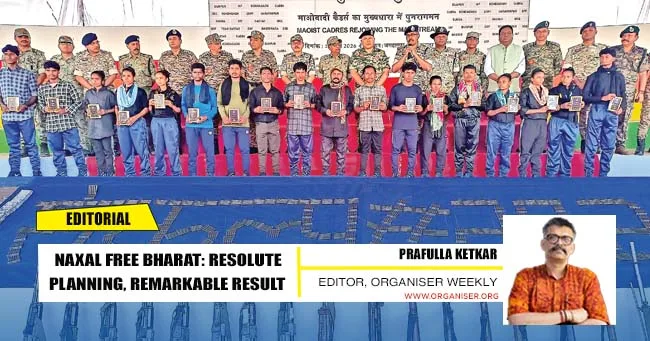
A precise understanding of the ideological roots of Maoism—specifically, the political and social beliefs that distinguish Maoism from general law-and-order concerns— shaped the present Government’s success. Previously, the Home Ministry’s Left-Wing-Extremism (LWE) division addressed the problem with an imprecise understanding, treating terrorism as mere ideological extremism and viewing the security threat primarily as a law-and-order issue. This ideological confusion led to Maoists being shielded by human rights activism and subsequent pressure for dialogue after every operation, which enabled Maoists to regroup. Currently, the approach is clear: dialogue is not extended to armed groups, while surrendered individuals are given opportunities for rehabilitation. This strategy has enabled suffocated and disgruntled members to choose the rehabilitation package, resulting in over 4,800 surrenders in the last three years.
Coordination between the Naxal-affected States and various security agencies was another key feature of this entire operation. Financial resources were choked. 406 new CAPF camps were established and security forces and local recruits worked together to eliminate the armed Maoists in perfect synchronisation. Over 700 dreaded terrorists were eliminated. Locals were taken into confidence, assured of security, and provided with dignity and development through clear policy implementation. Regular inter-State communication and coordination through the Union Home Ministry denied Maoists their old escape strategy of crossing State borders. The combined strategy included strikes, arrests, and surrenders, all supported by training and technology. This brought the Maoists to the brink of defeat. The Naxal Free Bharat slogan, with a target of March 31, 2026, gave the security forces a clear direction and objective.
Bharat has won the ground battle. Yet, as the discussion in Parliament showed, the war against violent shades of Communism is far from over. Sympathisers still want to compare terrorists with freedom fighters and push for a dialogue. The veil of NGO, media, legal, literary, and academic activism still exists. As Union Home Minister Amit Shah rightly exposed, all variants of Communism are inspired by foreign ideology. These are opposed to constitutional democracy. Their concern for human rights is meant only for armed terrorists. The intellectual and ideological battle against them should continue with the same zeal and policy. The forests are now free from this inhuman ideology. It is our collective responsibility to strengthen civilisational bonds with the Scheduled Tribe brothers and sisters. We must foil urban attempts to divide society and create civil unrest. This will require a similar national resolve and resolute planning to eradicate inhuman and anti-democratic communism in all its forms from this sacred land..