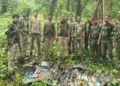
Jagdalpur: In a major breakthrough in the fight against Red Terrorism, security forces on July 18 unearthed a massive Maoist dump deep inside the forests of Kader village in the Sonpur area of Narayanpur district, Chhattisgarh just a day after a similar recovery in the region. The operation, carried out by the 133rd Battalion of the Border Security Force (BSF) based on precise intelligence inputs, led to the seizure of a substantial cache of weapons, explosives, digital storage devices and advanced communication equipment, dealing a significant blow to Maoist networks operating in the area.
Officials described the operation as a major success, as the seized materials indicate the presence of a well-organized Maoist network that had been operating in the region and preparing for long-term activities.
Huge recovery of digital devices raises intelligence hopes
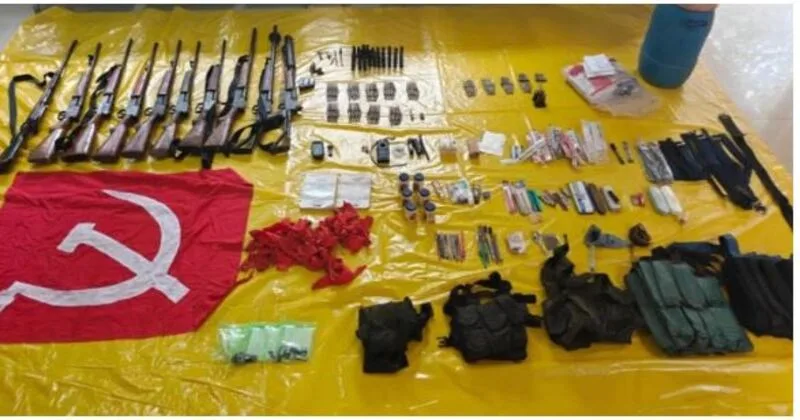
One of the most striking aspects of the operation is the recovery of a substantial number of digital storage devices, which are expected to provide critical insights into Maoist operations. Security forces recovered a total of 78 memory cards of varying capacities, including 27 units of 4GB, 37 units of 8GB, six units of 16GB and eight units of 32GB. Along with these, six pen drives ranging from 16GB to as much as 1TB capacity were also seized.
Authorities believe that these devices may contain sensitive data related to Maoist communications, operational strategies and past activities. Officials have stated that a detailed technical analysis of these devices is underway and there is a strong possibility that crucial information about Maoist networks and their linkages could be uncovered.
Advanced communication equipment found in the dump
In addition to digital storage devices, the forces recovered sophisticated communication and electronic equipment from the site. These include a GPS device, RF detector, antennas, helical antennas and an ID operating mechanism. The presence of such equipment highlights the use of modern technology by Maoist groups to coordinate their movements and maintain communication in remote forest areas while evading detection.
Experts believe that these equipments may also provide valuable intelligence inputs once examined thoroughly.
Arms and explosives cache neutralized
During the operation, a significant quantity of weapons and explosives was recovered, which posed a serious threat if they had been used. The seized weapons included one .303 rifle, six .315 rifles and one 12-bore gun, as well as two under-barrel grenade launchers (BGLs). Additionally, various weapon accessories such as magazines, magazine pouches and rifle slings were found in the cache.
A notable part of the operation was the discovery of 44 BGL shells, consisting of 24 large shells and 20 small shells. Due to the potential risk they posed, the Bomb Disposal Squad (BDS) safely neutralized and destroyed all the shells on-site following standard safety protocols, effectively eliminating any possible threat.
Large stockpile of ammunition recovered
Security personnel also recovered a large quantity of ammunition from the dump, indicating preparedness for sustained armed activities. The seized ammunition includes 33 cartridges of 12 bore, 91 HD cartridges, 46 rimmed cartridges of 7.62 mm (.303), and additional rounds of 7.62 mm ammunition. Other technical components such as filler materials, knocking handling assemblies and specialized tools were also found, further suggesting the operational readiness of Maoist cadres in the area.
Naxal literature and medical supplies point to long-term presence
Apart from arms and ammunition, the dump contained Maoist literature, banners, uniforms and photographs, pointing to ideological propagation and organized presence in the region. The recovery of medical supplies such as infusion sets, disposable syringes, surgical dressing pads, pain relief ointments and crepe bandages indicates that Maoist cadres were equipped to manage injuries and sustain themselves in remote forest areas over extended periods. Daily-use items, including a plastic drum and other logistical supplies, were also part of the recovered cache, suggesting that the location may have served as a support base.
Operation based on credible intelligence input
According to Narayanpur Superintendent of Police Sandeep Kumar Patel, the operation was initiated after the BSF’s 133rd Battalion received credible intelligence on July 17 about a large quantity of Maoist materials hidden in the Kader forest area. Acting swiftly on the information, security forces launched a search operation in the area.
Upon reaching the suspected location, the Bomb Disposal Squad conducted a thorough inspection while adhering to all safety norms. The area was then excavated, leading to the recovery of the concealed dump buried underground.
Continuous search operations in naxal-affected areas
Despite significant progress in reducing Maoist influence in several parts of the region, security forces have not scaled down their operations. Officials believe that Maoists may have hidden weapons, explosives, and other materials in remote and inaccessible forest areas over time. To counter this threat, security forces continue to carry out intensive search operations across interior regions. The Narayanpur recovery is being seen as a direct outcome of this sustained operation and vigilance.
Focus on old hideouts and hidden dumps
Security agencies have now intensified their focus on identifying and dismantling old Maoist hideouts and hidden dumps. Officials have stated that search operations will continue even in areas that have been declared free from Maoist influence, in order to ensure that no hidden stockpiles remain. The goal is to recover all concealed arms and materials, thereby eliminating any possibility of resurgence and ensuring long-term stability in the region.
Towards lasting peace and security
Police officials confirmed that necessary legal action is being taken regarding the recovered materials. The operation is expected to significantly weaken Maoist infrastructure and disrupt their operational capabilities.
This major recovery not only highlights the effectiveness of intelligence-based operations but also reinforces the commitment of security forces to ensure lasting peace and security in the region. Authorities remain determined to dismantle Maoist networks and prevent any future threats, making this operation a crucial step toward strengthening stability in Narayanpur and surrounding areas.
It is noteworthy that security forces had achieved another significant success just a day earlier, on July 17, further underscoring the momentum of anti-Naxal operations in Narayanpur district. During a joint search operation conducted by the Narayanpur Police and the 58th Battalion of the Border Security Force (BSF), a concealed Maoist arms dump was recovered from the dense forests of Kachchapal under the Kohkameta police station limits.
The recovered cache included a .303 rifle, a .315 rifle, a locally fabricated barrel launcher, along with live cartridges of multiple calibers. Security personnel also seized an empty magazine, cartridge fillers and tracer rods. All recovered materials were secured as per protocol, and necessary legal proceedings have been initiated at the Kohkameta police station.
Officials emphasized that these back-to-back recoveries highlight the effectiveness of sustained, intelligence-based and coordinated operations in Maoist-affected regions. They also pointed out that such actions are crucial in disrupting insurgent logistics and preventing future threats.
In recent years, Maoist influence in the Abujhmad region and interior pockets of Narayanpur has shown a steady decline, driven by the continuous presence of security forces, establishment of forward camps, expansion of road connectivity and regular search operations. The ongoing recovery of hidden arms and explosives indicates that former Maoist hideouts and stockpiles are being systematically neutralized, significantly weakening their operational capabilities and support systems.