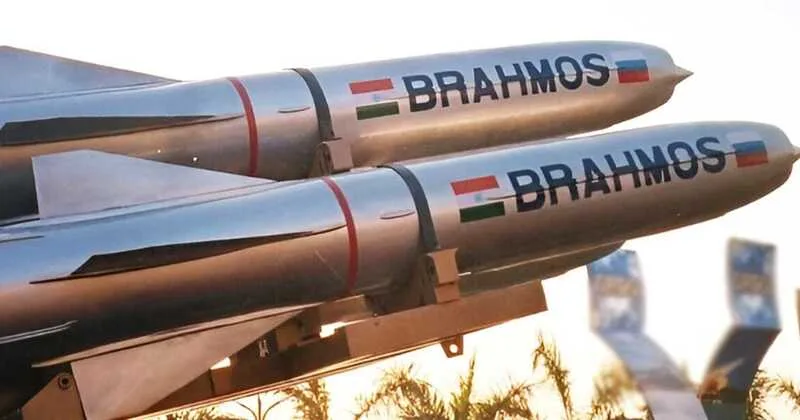
New Delhi: India’s rapid development of the extended-range BrahMos supersonic cruise missile is reshaping the maritime balance in the Arabian Sea. With trials progressing smoothly and induction targeted for the Indian Navy by 2027–2028, the 800 km variant promises a game-changing standoff capability that directly challenges Pakistan’s strategy of dispersing naval assets away from vulnerable forward bases.
Currently, the BrahMos equips dozens of Indian warships, including advanced destroyers and frigates, in both anti-ship and land-attack roles. Its speed of Mach 2.8–3, combined with a sea-skimming flight profile and complex terminal manoeuvres, already makes it one of the most difficult threats for any regional navy to counter. The upcoming 800 km version, enabled by a modified ramjet engine and increased fuel capacity, nearly doubles the missile’s effective range while retaining its hallmark precision and survivability. Notably, existing naval launchers can be upgraded through relatively simple software and fire-control adjustments, allowing a swift transition without major hardware overhauls.
Shrinking Pakistan’s strategic depth
For Pakistan, this development significantly erodes critical sanctuary options. Bases such as Ormara, developed to provide depth and reduce exposure to strikes from the Indian mainland or forward coastal positions, were intended to offer safer berthing for submarines and surface combatants during periods of heightened tension. Located roughly 600–700 km from key Indian naval operating areas along the Gujarat and Maharashtra coasts, these bases are already within the extended reach of current BrahMos deployments.
With the induction of the 800 km naval variant, Indian warships will be able to launch precision strikes from even deeper within the Arabian Sea, well beyond the horizon and outside the effective engagement envelope of many Pakistani coastal defences. A single Indian destroyer or frigate group, positioned conservatively, could hold major Pakistani ports, including Gwadar, Karachi, Ormara, and Pasni, under credible conventional threat, while minimising exposure to counterattack.
A force multiplier for sea control
The extended range of the BrahMos makes it a powerful tool for both sea control and sea denial. Indian naval task forces would gain the ability to conduct precision land-attack missions against port infrastructure, logistics hubs, and command nodes from safe standoff distances. At the same time, the missile retains its anti-ship capability, allowing seamless targeting of hostile naval assets attempting to sortie into open waters.
This dual-role flexibility is further enhanced by India’s expanding maritime domain awareness network, which includes satellites, maritime patrol aircraft, and drones. Together, these assets enable accurate targeting and create a persistent “no-go” zone, significantly compressing the operational space available to the Pakistan Navy.
Pakistan, for its part, has invested in expanding its western naval bases and acquiring new submarines, frigates, and coastal defence systems to counter India’s growing maritime superiority. However, the speed and precision of an 800 km BrahMos strike, especially when executed in coordinated salvos alongside other Indian military assets, pose a formidable challenge to even layered defensive systems.
The operational and psychological pressure is further heightened by the missile’s characteristics. Its low radar cross-section during the cruise phase and high terminal velocity drastically reduce defenders’ reaction time. Moreover, the difficulty of distinguishing between conventional and potentially dual-capable payloads in real time increases the risk of escalation, forcing more cautious deployment of naval assets.
Defence observers suggest that the extended-range BrahMos aligns with India’s broader doctrinal shift toward rapid, precise deep-strike capabilities while minimising platform exposure. For Pakistan’s naval planners, the margin for safe dispersion is narrowing rapidly. Reliance on geographic depth, such as positioning assets in Ormara, will offer diminishing returns once Indian naval platforms can reliably strike targets across 800 kilometres at supersonic speeds. In effect, the extended-range BrahMos not only enhances India’s offensive reach but also redefines the strategic calculus in the Arabian Sea, tilting the balance decisively in favour of greater Indian naval dominance.