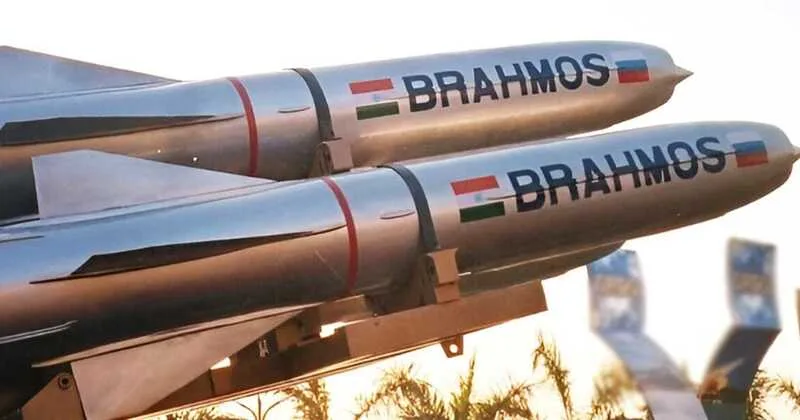
BrahMos 800 km boost expands India’s naval strike reach
August 30, 2026
  • Read Ecopy
  • Circulation
  • Advertise
  • Careers
  • About Us
  • Contact Us
Android AppiPhone AppArattai
Organiser
  • ‌
  • Bharat
    • Assam
    • Bihar
    • Chhattisgarh
    • Jharkhand
    • Maharashtra
    • View All States
  • World
    • Asia
    • Europe
    • North America
    • South America
    • Africa
    • Australia
  • Editorial
  • International
  • Opinion
  • RSS @ 100
  • More
    • Op Sindoor
    • Analysis
    • Sports
    • Defence
    • Politics
    • Business
    • Economy
    • Culture
    • Special Report
    • Sci & Tech
    • Entertainment
    • G20
    • Azadi Ka Amrit Mahotsav
    • Vocal4Local
    • Web Stories
    • Education
    • Employment
    • Books
    • Interviews
    • Travel
    • Law
    • Health
    • Obituary
  • Subscribe
    • Subscribe Print Edition
    • Subscribe Ecopy
    • Read Ecopy
  • ‌
  • Bharat
    • Assam
    • Bihar
    • Chhattisgarh
    • Jharkhand
    • Maharashtra
    • View All States
  • World
    • Asia
    • Europe
    • North America
    • South America
    • Africa
    • Australia
  • Editorial
  • International
  • Opinion
  • RSS @ 100
  • More
    • Op Sindoor
    • Analysis
    • Sports
    • Defence
    • Politics
    • Business
    • Economy
    • Culture
    • Special Report
    • Sci & Tech
    • Entertainment
    • G20
    • Azadi Ka Amrit Mahotsav
    • Vocal4Local
    • Web Stories
    • Education
    • Employment
    • Books
    • Interviews
    • Travel
    • Law
    • Health
    • Obituary
  • Subscribe
    • Subscribe Print Edition
    • Subscribe Ecopy
    • Read Ecopy
Organiser
  • Home
  • Bharat
  • World
  • Operation Sindoor
  • Editorial
  • Analysis
  • Opinion
  • Culture
  • Defence
  • International Edition
  • RSS @ 100
  • Magazine
  • Read Ecopy
Home Bharat

BrahMos 800 km boost expands India’s naval strike reach, squeezes Pakistan’s maritime space in Arabian sea

India’s 800 km BrahMos upgrade is set to redraw the Arabian Sea’s strategic map, giving the Navy deep-strike reach from safe standoff distances. Pakistan’s coastal bases, from Karachi to Gwadar and Ormara, face a shrinking sanctuary as India’s supersonic edge tightens control at sea

Dr Vishnu AravindDr Vishnu Aravind
Apr 6, 2026, 01:20 pm IST
inBharat, World, Defence, International Edition
Follow on Google News
India’s 800 km BrahMos ushers in a new era of naval dominance, pushing Pakistan’s key ports within precise, high-speed strike range.

India’s 800 km BrahMos ushers in a new era of naval dominance, pushing Pakistan’s key ports within precise, high-speed strike range.

Facebook
Twitter
WhatsAppTelegramEmail

New Delhi: India’s rapid development of the extended-range BrahMos supersonic cruise missile is reshaping the maritime balance in the Arabian Sea. With trials progressing smoothly and induction targeted for the Indian Navy by 2027–2028, the 800 km variant promises a game-changing standoff capability that directly challenges Pakistan’s strategy of dispersing naval assets away from vulnerable forward bases.

Currently, the BrahMos equips dozens of Indian warships, including advanced destroyers and frigates, in both anti-ship and land-attack roles. Its speed of Mach 2.8–3, combined with a sea-skimming flight profile and complex terminal manoeuvres, already makes it one of the most difficult threats for any regional navy to counter. The upcoming 800 km version, enabled by a modified ramjet engine and increased fuel capacity, nearly doubles the missile’s effective range while retaining its hallmark precision and survivability. Notably, existing naval launchers can be upgraded through relatively simple software and fire-control adjustments, allowing a swift transition without major hardware overhauls.

Shrinking Pakistan’s strategic depth

For Pakistan, this development significantly erodes critical sanctuary options. Bases such as Ormara, developed to provide depth and reduce exposure to strikes from the Indian mainland or forward coastal positions, were intended to offer safer berthing for submarines and surface combatants during periods of heightened tension. Located roughly 600–700 km from key Indian naval operating areas along the Gujarat and Maharashtra coasts, these bases are already within the extended reach of current BrahMos deployments.

Also Read: India advances indigenous project Kusha to match Russian S-400 missile system, strengthen air defence at half the cost

With the induction of the 800 km naval variant, Indian warships will be able to launch precision strikes from even deeper within the Arabian Sea, well beyond the horizon and outside the effective engagement envelope of many Pakistani coastal defences. A single Indian destroyer or frigate group, positioned conservatively, could hold major Pakistani ports, including Gwadar, Karachi, Ormara, and Pasni, under credible conventional threat, while minimising exposure to counterattack.

A force multiplier for sea control

The extended range of the BrahMos makes it a powerful tool for both sea control and sea denial. Indian naval task forces would gain the ability to conduct precision land-attack missions against port infrastructure, logistics hubs, and command nodes from safe standoff distances. At the same time, the missile retains its anti-ship capability, allowing seamless targeting of hostile naval assets attempting to sortie into open waters.

This dual-role flexibility is further enhanced by India’s expanding maritime domain awareness network, which includes satellites, maritime patrol aircraft, and drones. Together, these assets enable accurate targeting and create a persistent “no-go” zone, significantly compressing the operational space available to the Pakistan Navy.

Pakistan, for its part, has invested in expanding its western naval bases and acquiring new submarines, frigates, and coastal defence systems to counter India’s growing maritime superiority. However, the speed and precision of an 800 km BrahMos strike, especially when executed in coordinated salvos alongside other Indian military assets, pose a formidable challenge to even layered defensive systems.

The operational and psychological pressure is further heightened by the missile’s characteristics. Its low radar cross-section during the cruise phase and high terminal velocity drastically reduce defenders’ reaction time. Moreover, the difficulty of distinguishing between conventional and potentially dual-capable payloads in real time increases the risk of escalation, forcing more cautious deployment of naval assets.

Defence observers suggest that the extended-range BrahMos aligns with India’s broader doctrinal shift toward rapid, precise deep-strike capabilities while minimising platform exposure. For Pakistan’s naval planners, the margin for safe dispersion is narrowing rapidly. Reliance on geographic depth, such as positioning assets in Ormara, will offer diminishing returns once Indian naval platforms can reliably strike targets across 800 kilometres at supersonic speeds. In effect, the extended-range BrahMos not only enhances India’s offensive reach but also redefines the strategic calculus in the Arabian Sea, tilting the balance decisively in favour of greater Indian naval dominance.


Topics: Pakistanindian NavyBrahmos
Dr Vishnu Aravind
Dr Vishnu Aravind
Dr Vishnu Aravind is a researcher, political commentator and writer based in New Delhi, with a PhD from Jawaharlal Nehru University (JNU). His areas of interest include international politics, Indian foreign policy, electoral politics, election analysis, political developments, and cultural affairs. [Read more]
Share
Tweet
SendShareSend
✮ Subscribe Organiser YouTube Channel. ✮
✮ Join Organiser's WhatsApp channel for Nationalist views beyond the news. ✮
Previous News

Gwalior Love Jihad Case: Sameer Khan arrested for posing as Ravi Thakur, exploiting widow and leaking private photos

Next News

Indian scientific perspective holds the key to solve modern technological challenges: J Nandakumar

Related News

The demolition of Shri Guru Singh Sabha Gurdwara has intensified fears over the disappearance of Pakistan’s Sikh religious heritage

Pakistan demolishes 200-year-old Sikh Gurdwara in Quetta; Historic minority heritage land sold for commercial project!

Multi-Purpose Vessel (MPV), ‘Samarthak

Indian Navy receives first Multi-Purpose Vessel ‘Samarthak’ from L&T, with over 75 percent indigenous content

Nipun, the second indigenously designed and constructed Diving Support Vessel (DSV)

Indian Navy to commission Nipun: Indigenous vessel marks milestone in strengthening Indian Ocean maritime security

Leftists Vs Rabindranath & Rakshabandhan: Red sickle strike of fraternity

US religious freedom panel, headed by a Pakistani, peddles lies about RSS ahead of Sarsanghachalak’s US visit

Maulana Abul Ala Maudidi (1903-1979)

85 Years of Jamaat-e-Islami in the Subcontinent: Maududi and His Organization

Load More

Latest News

Dutch TikTokker Angelo Bryson, known as Superhuman Unchained, at a pro-Palestine protest.

Dutch TikTokker recently converted to Islam livestreams stabbing three in Amsterdam; Watch video

From Kanchipuram to Kalamkari, India’s traditional textiles reflect its rich regional cultures and centuries-old craftsmanship

From Kanchipuram to Kalamkari: Exploring India’s rich traditional textiles and regional clothing heritage

Punjabi Influencer Abducted, Burnt Alive Near Morinda

Punjab Law and order crisis: Influencer Manjeet Kaur abducted, burnt alive after attack near Morinda

‘Dimagi Naxals’ romanticising Mao, Stalin and Pol Pot

The Swadeshi movement turned Indian enterprise into a powerful force for economic self-reliance, national pride and the struggle for Swaraj

Building Economic Swaraj: How Indian enterprises fought foreign rule and reclaimed national pride

Prime Minsiter Narendra Modi and Uzbekistan President Shavkat Mirziyoyev

India-Uzbekistan Herald New Chapter: Uranium deal, 30-day visa-free entry to Indians & $5bn trade propel bilateral ties

The new FCRA rules seek to curb unchecked foreign funding, strengthen financial accountability, and protect Bharat’s national security

Stopping Unchecked Foreign Money: How new FCRA rules protect Bharat’s security and financial sovereignty

Keralam CM VD Satheeshan, DCC member Chembil Anil (Left to Right)

Keralam Congress infighting surfaces in CM VD Satheeshan’s vehicle blockade; DCC member Chembil Anil arrested, remanded

Indian Logistics Data Bank tracks ten crore containers, transforming freight visibility and strengthening the nation’s logistics network

From Lothal Dockyard to Ten Crore Containers: India’s Logistics Data Bank transforms EXIM freight tracking

Former Union Minister Dharmendra Pradhan and BJD President Naveen Patnaik

Odisha: Dharmendra Pradhan hits back at Naveen Patnaik over MMDR bill; Slams for concealing facts & misleading people

Load More
  • Privacy
  • Terms
  • Cookie Policy
  • Refund and Cancellation
  • Delivery and Shipping

© Bharat Prakashan (Delhi) Limited.
Tech-enabled by Ananthapuri Technologies

  • Home
  • Search Organiser
  • Bharat
    • Assam
    • Bihar
    • Chhattisgarh
    • Jharkhand
    • Maharashtra
    • View All States
  • World
    • Asia
    • Africa
    • North America
    • South America
    • Europe
    • Australia
  • Editorial
  • Operation Sindoor
  • Opinion
  • Analysis
  • Defence
  • Culture
  • Sports
  • Business
  • RSS @ 100
  • Entertainment
  • More ..
    • Sci & Tech
    • Vocal4Local
    • Special Report
    • Education
    • Employment
    • Books
    • Interviews
    • Travel
    • Health
    • Politics
    • Law
    • Economy
    • Obituary
  • Subscribe Magazine
  • Read Ecopy
  • Advertise
  • Circulation
  • Careers
  • About Us
  • Contact Us
  • Policies & Terms
    • Privacy Policy
    • Cookie Policy
    • Refund and Cancellation
    • Terms of Use

© Bharat Prakashan (Delhi) Limited.
Tech-enabled by Ananthapuri Technologies