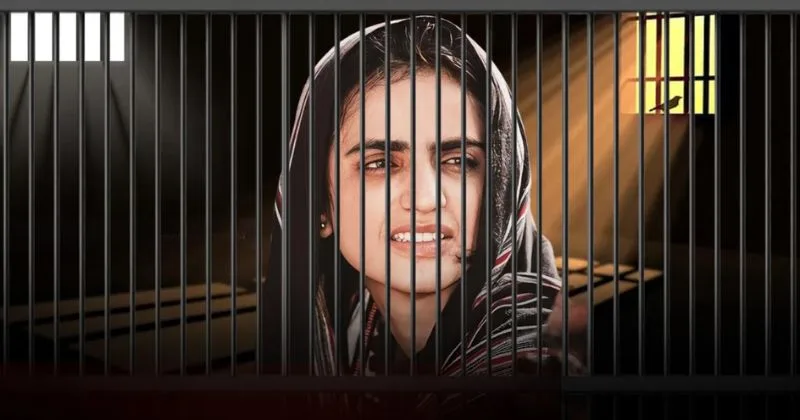
The top leader of the Baloch Yakjehti Committee (BYC), Dr Mahrang Baloch, has written about her detention, political struggle and the situation in Balochistan in an article published in The Guardian on April 1, according to a report of The Balochistan Post. The Guardian has given it a catchy, apt, and to-the-point headline: A dispatch from solitary confinement in a Pakistani women’s prison.
In her article, Dr Baloch, who is currently held in Quetta’s Central Huda Jail, said she has completed one year in solitary confinement in Block 9. Incidentally, the Baloch human rights activist was arrested on March 22 last year. She stated that her detention has failed to halt her political struggle, adding: “My peaceful struggle continues.” She has also written that the images and memories of her past actions, her activism, and the support from various Baloch people come back to her with greater clarity as she looks back on her struggles.
Dr Baloch, who heads the BYC, wrote that she and two of her colleagues, Beebo Baloch and Beebarg Zehri, are being held separately from other female prisoners on account of being political detainees. She has written that being classified as “political detainees’’ means their interactions with other prison inmates are not possible. This is because the government fears that we will convince other prisoners to our cause. She described solitary confinement as more distressing than physical hardship, particularly as, according to her, her family has faced pressure due to her activities.
In the article, she has said that books and regular exercise helped her immensely, but that was still October last year. She developed medical problems around that time and had to be hospitalised in February this year, and was diagnosed with having a slipped disc and radiculopathy.
She stated that her cousin, Salal Baloch, and Saifullah Baloch were subjected to enforced disappearance. She further wrote that her brother had been placed on the “Fourth Schedule”, resulting in increased surveillance, travel restrictions and financial constraints. She also said that her sister faced legal cases and alleged harassment after speaking at press conferences. Besides undergoing the physical and medical discomforts due to being jailed, it was mentally a source of great pain to know that her activism had created many difficulties for her family and friends.
Dr Baloch noted that access to phone calls in prison is restricted, while court hearings are held inside the prison, limiting public access. She wrote that her arrest and detention are a consequence of her advocacy for the rights of the Baloch people and have strengthened her resolve.
She also raised concerns regarding what she described as state repression, enforced disappearances, and the targeting of Baloch women. According to her, the BYC documented more than 1,200 cases of enforced disappearances in 2025.
Dr Baloch stated that the BYC operates within the framework of Pakistan’s constitution and advocates peaceful resistance against human rights violations. She said the organisation condemns violence and rejected what she described as attempts to link the movement with armed groups.
Concluding her article, she wrote: “Memories become sharper in captivity, but the clearest among them is my homeland, Balochistan. We will continue our peaceful resistance.”