On the occasion of the completion of 100 years since the founding of the Rashtriya Swayamsevak Sangh (RSS), numerous programmes have been initiated to build wide contact with society. One significant endeavour among these programmes is to reach various sections of society through five themes aimed at social transformation. This campaign, named Sajjan Shakti Jagaran (Awakening Power of the Virtuous), is built around five themes of Social Transformations (Panch-Parivartan) namely Family Awakening (Kutumb Prabodhan), Environmental Protection (Paryavaran Sanrakshan), Social Harmony (Samajik Samarasata), Civic Duty (Lok Kartavya) and Swadeshi (Indigenous) Way of Life (Swadeshi Jeevanshaili)
In the context of the Swadeshi Way of Life, the commonly emphasised aspects include: using goods manufactured by indigenous producers instead of products from multinational companies; practising communication in one’s mother tongue; wearing traditional Bharatiya attire on festivals and occasions; adopting traditional Bharatiya food; devotional worship (Bhajan) of one’s chosen deity (Ishta-devata); incorporating the influence of Bharatiya character in home decor; and undertaking pilgrimages (Teerth Yatra) and visits to historical sites with family.
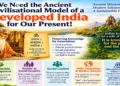
However, the Swadeshi Way of Life carries a deeper and broader meaning. One must first understand the word Self (Swa) inherent in the word “Swadeshi.” ‘Swa’ has three foundational dimensions that have given Bharat a distinct identity and personality. When these three dimensions find natural expression in our personal, familial, professional, social, and national life, only then can that way of living be truly called the Swadeshi Way of Life in the fullest sense.
The First Dimension: Spirituality (Adhyatma)
Bharat’s first and most fundamental ‘Swa’ is its spirituality. Because the Bharatiya worldview is rooted in spirituality, it is integral (Ekatma) and holistic (Sarvangeen). Bharat perceives the entire creation as interconnected, and it is from this that the idea of “the world is one family” (Vasudhaiva Kutumbakam) emanates.
According to the Bharatiya view, one singular consciousness (Chaitanya) has expressed itself in myriad forms. Diversity is not difference; it is multiple expressions of a singular whole. It follows that each soul is potentially divine. The goal is to manifest the divinity within by controlling nature, both internal and external. One can do this by work (Karmayoga), worship (Bhaktiyoga), knowledge (Jnanayoga) or meditation (Rajayoga).
This is the path to Moksha, or becoming one with the all-encompassing Chaitanya by the complete transcendence of the individual ego and the merging of the self into the universal consciousness that permeates the entire cosmos. Each individual’s path towards Moksha can be different, shaped by their nature, inclinations, and the impressions formed through life, making it a deeply personal journey that can be called one’s personal mode of worship or religion (Upasana). Because of this belief, there has always been a tradition of Spiritual Democracy in Bharat. Religion helps to elevate spiritually, enabling one to perform Dharma, not a synonym for Dharma.
The Second Dimension: Society-Based Nation
In Western nations, the concept of nationhood has been State-based (State-Nation). Contrary to this, in Bharat, society is the living expression of the nation, not the State. This is precisely why the Preamble of the Bharatiya Constitution begins with, “We, the People of Bharat…”
The bedrock of governance and mutual co-existence is society first, and not the state. Therefore, the concept of the ‘Welfare State’ is not Bharatiya. In his famous essay ‘Swadeshi Samaj‘, Rabindranath Thakur writes that in traditional Bharat, subjects like justice, internal and external security, and foreign affairs alone fell under the State’s jurisdiction. Education, health, industry, trade, mercantile commerce, arts, music, theatre, travel, pilgrimages and their management, all such life-sustaining systems were operated by society itself. The funds for these did not come from the State; society itself bore those responsibilities.
In Rabindranath Thakur’s words: The society that remains least dependent on the State for its needs, is a Swadeshi Samaj.
The Third Dimension: The Vision of Life’s Wholeness
In Bharatiya philosophy, pursuing both material prosperity and spiritual elevation together is considered the fullness of life. Pursuing only material pleasure or only renunciation alone is considered incompleteness. This very thought is expressed in Vaisheshika Sutra: “Yato Abhyudaya Nihshreyasa Siddhih Sa Dharmah (1.1.2)” — That which brings about both material prosperity and spiritual well-being is Dharma.
Another key aspect of understanding this “Swa” is that everybody, performing various duties for the society is important and equal. Practicing this equality is the idea of Samarasata (Harmony). Bharatiya spiritual thought holds that one singular consciousness pervades the entire creation. Therefore any brother or sister who is engaged in any kind of work in society, the same consciousness that exists in me, exists in them too. No work is insignificant, every kind of work has its place in the world. Thus, the idea of ‘high’ and ‘low’ caste goes against the grain of ‘Swa’.
Our foundational essence is, “Hindavah Sodarah Sarve” — All Hindus are brothers, children of Bharat Mata, and are equal. Therefore, the Swadeshi Way of Life means practising inclusion and harmony in society — bringing together people from all castes, all classes, and all kinds of professions.
As a natural extension of wholeness and harmony, our tradition says, “Mata Bhumih Putro’ham Prithivyah” (12, Prithvi Sukta, Atharvaveda). This earth is my mother, and I am her son. But in blindly imitating the western model of development, we have created a grave crisis of environmental imbalance. Nature (Srishti) is our mother. Therefore, its use should be for fulfilling needs, not for exploitation. As is our custom, these ideas are best understood through allegorical stories.
Once, an election was announced. Four candidates entered the field, Water Pollution, Air Pollution, Land Pollution, and Food Pollution. All four demanded ‘Human Being’ as their election symbol. The election officer said: “This symbol can go to only one. Whoever gives the most compelling reason as to why they deserve it will get it.” They all said the same thing: “It is the human being who gave birth to us, who nurtured and raised us. Today we have grown so strong, all of this is the human being’s gift.”
This story compels us to think. The ‘human being’ who has given birth to these problems is the so-called developed, prosperous human being, whose roughly five hundred years of development model has today placed water, air, land, and food in crisis.
In contrast, Bharat’s national life has endured for at least twenty thousand years or more, while maintaining balance with nature. Therefore, the Swadeshi Way of Life is the key to protecting the environment and preserving its balance. This requires daily practice — simple actions such as not wasting water unnecessarily, avoiding single-use plastic, planting more trees, and nurturing and protecting them may go a long way.
The Bharatiya Way Of Thought
Western thought emphasises individualism. In contrast, Bharatiya thought holds that the smallest unit of society is not the individual but the family. For the formation of a family, the individual’s ‘I’ must dissolve into ‘We’. This journey begins with the family and expands gradually to encompass extended kin, village or town, state, nation, all of humanity, and ultimately the entire creation. To become one with the supreme consciousness that resides within this expanded ‘We’, that is the ultimate purpose of human life, which we call Moksha.
This very progression is described in Bharatiya philosophy as the four steps: Individual (Vyashti), society (Samashti), Creation (Srishti), and the Supreme (Parameshti). These are the ascending rungs of this long spiritual journey. The starting point of this journey is the family, this is why, among the four stages of life (Ashrams), the householder stage (Grihastha-ashram) is accorded special importance.
The world may be in despair but it is possible for the entirety of humanity, amidst diverse forms of worship, languages, racial diversity, and limited resources, to live a prosperous, harmonious, and peaceful life. The wisdom for this lies with Bharat’s spirituality-based view of life. Therefore, for the welfare of humanity, it is essential that Bharat stands as a prosperous, capable, and self-confident nation and maintains its essential identity.
If the society that lives Bharat’s thought does not exist, this knowledge will remain confined only to books and scholarly discussions. The society that will bring this thought into conduct and practice will be shaped by the family system. Passing on this intellectual and cultural heritage to the children, through conversation and dialogue, is the primary responsibility of the family. The role of the school and society comes after. Generally, approximately 2.1 ie, three children per family is essential to sustain the continuity of the family. If all members of the family sit together weekly, converse and connect, then social, intellectual, and cultural continuity will naturally be maintained.
On this basis, Bharat will remain capable, active, and empowered to play its global role. This is the manifestation of Bharat’s ‘Swa’, an inseparable part of the Swadeshi Way of Life. The State can be supportive, but the primary responsibility is of society. To shape such a society, the role of the family is the most fundamental and decisive.