A university is not merely a collection of brick-and-mortar classrooms; it is an intellectual beating heart of a civilisation. When the State apparatus attempts to dictate what can and cannot be discussed within the walls of a university, it stifles the event. Moreover, it sounds death knell for intellectual inquiry.
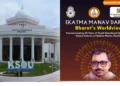
The recent event surrounding the international academic conference at the Karnataka State Open University (KSOU) in Mysuru stands as a textbook example of blatant State overreach. It serves as a grim reminder of how fragile our academic freedoms are when confronted by petty, partisan politics.
Anatomy of Academic Sabotage
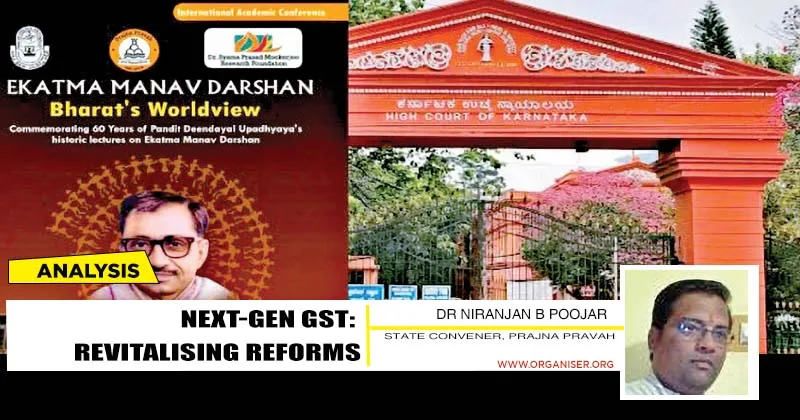
The three-day International Academic Conference on “Ekatma Manav Darshan – Bharat’s Worldview,” organised jointly by Prajna Pravah Karnataka and Dr Syama Prasad Mookerjee Research Foundation, was conceived as a rigorous, purely academic exercise. The numbers speak for themselves: over 650 participants officially registered, and more than 178 scholarly research papers were submitted by academics across the country.
Standard protocols were meticulously followed. The State Higher Education Department had initially issued the necessary approvals, including the sanctioning of ‘On Other Duty’ (OOD) leaves for participating faculty members. Yet, the moment a Congress MLA raised objections during the Zero Hour, the entire machinery of the Karnataka State Government was mobilised to crush a purely intellectual gathering.
Intimidatory Tactics
What followed was an unprecedented and shameful display of administrative strong-arming. The Personal Assistant to the Higher Education Minister reportedly called Vice-Chancellors across the State, issuing severe threats and warnings against participating in the conference. Institutional heads were intimidated into preventing their faculties from attending.
When these intimidation tactics failed to break the resolve of the organisers, the State descended to the lowest denominator of vindictive politics: at the end of the month, the Government arbitrarily froze the bank accounts of KSOU. To hold the livelihoods and salaries of university staff hostage merely to satisfy a political vendetta is a dark day for democratic governance.
Judiciary Steps In: A Stinging Rebuke
Fortunately, the constitutional safeguards of our democracy held firm. The Honourable High Court of Karnataka had to intervene, delivering a severe and much-needed reprimand to the State Government for its unwarranted interference.
Asking a fundamental and piercing question “Are universities your party offices? Who are you to interfere in academic matters?,” the judiciary laid bare the vindictive politics at play. It is a supreme irony, and a matter of profound intellectual bankruptcy, that the very political actors who routinely pontificate on freedom of expression and constitutional values were caught actively strangling academic autonomy, ultimately standing with their heads bowed before the court.
Hypocrisy of Intellectual Apartheid
The fierce opposition to this conference exposes a glaring hypocrisy within certain political and academic circles. Our university spaces have long been open to debating a wide spectrum of ideologies. We routinely and openly discuss the dialectical materialism of Karl Marx, the social justice frameworks of B.R. Ambedkar, the non-violence of Mahatma Gandhi, and the democratic socialism of Jawaharlal Nehru. These leaders and thinkers are subjected to rigorous academic scrutiny and debate.
Why, then, is there such visceral intolerance toward the ideas of Pandit Deendayal Upadhyaya?
Ekatma Manav Darshan is not a mere political manifesto; it is a profound articulation of the Bharatiya civilisational worldview. It is a philosophy that intricately weaves together our culture, our traditional way of life, our rural ecosystems (Lok Parampara), environmental consciousness, and the sanctity of the family unit. It is, in essence, a holistic discourse on Bharat. To banish indigenous philosophical frameworks from university campuses while championing imported ideologies is not progressivism; it is intellectual colonisation.
Courage of Institutional Leadership
Despite the full, oppressive weight of the State Government bearing down upon it, the conference was an overwhelming success, witnessing the participation of over 800 individuals, a staggering number by any national academic standard. Furthermore, the active participation of the Honourable Governor of Karnataka, Honourable Shri Thawar Chand Gehlot, and Union Minister for Education, Shri Dharmendra Pradhan, underscored the undeniable academic legitimacy of the event.
However, the true heroes of this episode are the administrators of KSOU. The Vice-Chancellor and the university leadership demonstrated exemplary courage. KSOU is a self-financed, autonomous body, with its leadership appointed by the Governor. By standing their ground and defending their institutional autonomy despite severe personal and professional risks, they have set a benchmark for academic leadership in Bharat.
Protect Sanctity of Academia
If Vice-Chancellors and academicians do not fiercely guard their autonomy, universities will be reduced to mere echo chambers of the ruling political dispensation, thereby losing all credibility in the eyes of society.
The intellectual class of Karnataka and indeed, of the entire nation must unite and stand firmly with the KSOU. We must send an unequivocal message that academic platforms are for open debate, dissent, and dialogue, not for state-sponsored censorship. The legacy of Bharat is one of Shastrartha (philosophical debate); it is a land that celebrates the clash of ideas, not their suppression.
Let the incident at Mysuru be a turning point. It is time we draw a line in the sand: the State must step back, and the universities must be allowed to breathe.