Bhārat is one of the world’s oldest continuous cultures. It is evident from historical records that trade links existed between Bhārat and the Roman Empire, Southeast Asia and Central Asia. From maritime spice routes to land-based Silk Roads, our Civilisation was a thriving hub of Paṇyavyāpāra or the commercial transaction of goods. Many researches have indicated that around one-fourth of global industrial manufacturing occurred in Bhārat. Textiles produced here such as muslin, silk and brocades were in vogue, especially in the West. The Romans were principal importers of linen. It is therefore not surprising that the yarn used to weave the Shroud of Turin has rediscovered its Bharatiya ancestry.
Chronicling the relic
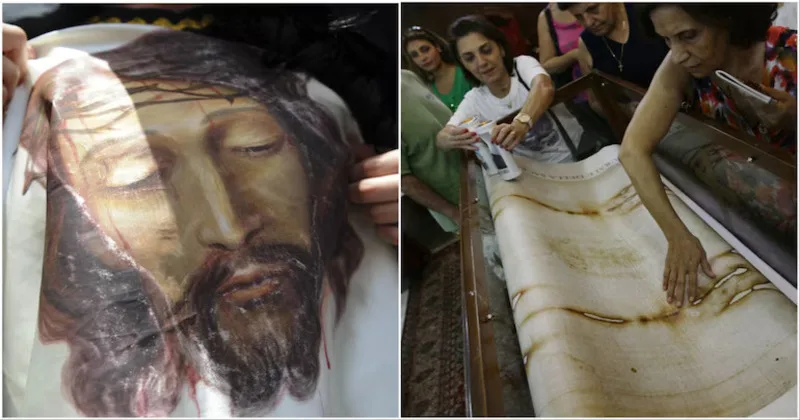
The burial shroud of Jesus of Nazareth is revered by Christians, particularly Catholics across the world. The shroud is a 4.4 meters long and 1.1 meters wide linen cloth bearing a blurred, negative imprint of a crucified man carrying thorn wounds. This image is consistent with four prominent canonical Gospels detailing a central event in Jerusalem at Golgotha(Calvary), i.e. the crucifixion of Jesus. There are several claims that the Shroud of Turin was preserved in Turkey and Greece for approximately twelve centuries after it originated in Judea region of ancient Israel in the 30s CE. However, the documented history commences in 1353, when the shroud was exhibited in a church in Lirey, France.
It was later removed due to the Hundred Years’ War between France and England. It was gradually passed to the dukes of Savoy belonging to Western Europe in the early 1450s. Around 1502, the shroud was installed in the city of Chambéry but after a massive fire broke out at the city castle’s chapel, it was relocated. The Savoys moved it to Turin, Italy in 1578. Since then, the Shroud has been guarded in the Cathedral of St. John the Baptist. The Roman Catholic Church acquired legal custody of it in 1983.
Deciphering the DNA
It was in the year 1988 that the Vatican assented to carbon-14 dating of the Shroud of Turin in order to determine the estimated age of the fabric. It was concluded that the material belonged to the medieval age(between 1260 and 1390 CE) leading to more speculations around the authenticity. The recent DNA and metagenomic study led by researchers at the University of Padova found a wide diversity of DNA, including plant DNA linked to the Indian subcontinent. Vigna unguiculata which is commonly known as cowpea is native to the Indian subcontinent. In addition, Bhārat, being a mercantilely advanced civilisation, was the chief exporter of textiles. Therefore, fabric’s ancestry only reaffirms the ingenuity of our trade and craftsmanship.
In an earlier article published in Nature Scientific Reports in 2015, Dr. Barcaccia and his colleagues had also observed that people from diverse ethnicities had come in contact with the Turin Shroud, including Indians. There is a strong possibility that these were the manufacturers and transporters of the linen.
Reconfirming Bhārat’s economic competence
While there has been an increasing social media buzz around the latest findings, it is important to separate facts from opinions. The findings prove and strengthen the historical evidences that up until the colonisation of Bhārat, our economy was steadily flourishing. There was significant trade surplus and inward flow of gold and silver owing to a robust internal trade network. Northern route(Uttarapatha) and Southern route(Dakshinapatha) connected internal trade hubs. The persisting Sindhu-Saraswati Civilisation was known for its luxuriant designs and fine weave. Bhārat accounted for a considerable percentage of the world’s GDP.
The global footprint of Bhārat on world economy has been reiterated by this discovery. In Sanātana Dharma, cloth is a metaphor for the earthly vessel of the human body. Strikingly, the findings imply not just a material transaction, but quite possibly a philosophical one. Bhārat’s role in shaping ubiquitous trade culture is evident from this accomplishment of our ancestors. We were not an isolated society but an active participant in global economy and discourse.