
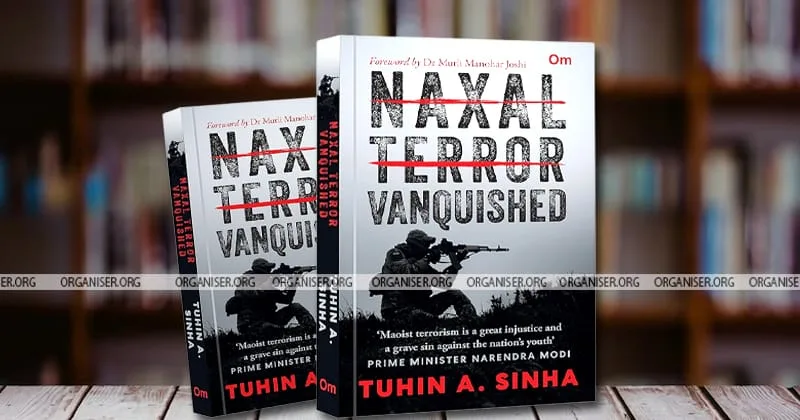
Tuhin A. Sinha’s Naxal Terror Vanquished is a politically charged, deeply assertive and ideologically grounded account of one of India’s longest-running internal conflicts the Naxal-Maoist insurgency. Positioned not merely as a historical narrative but as a strategic and political argument, the book seeks to document what it presents as the decisive dismantling of Left-Wing Extremism(LWE) under the leadership of Prime Minister Narendra Modi and Home Minister Amit Shah. In doing so, Sinha offers a work that is as much about contemporary Indian statecraft as it is about insurgency.
At its core, the book advances a clear thesis: that India’s success against Naxalism stems from a fundamental shift in doctrine from indecisive, reactive governance in the past to a robust, multi-dimensional counter insurgency strategy under the current regime. The narrative is structured across thematic sections that move from historical origins to policy execution, blending security analysis with political commentary.
One of the book’s strengths lies in its historical grounding. Sinha traces the origins of Naxalism to the 1967 uprising in Naxalbari, where agrarian distress, land inequality and ideological radicalism coalesced into a violent movement. By mapping its evolution from a localized peasant revolt into a sprawling insurgency across what came to be known as the “Red Corridor”, the author underscores the structural vulnerabilities that allowed Naxalism to thrive state neglect, tribal marginalization, and lack of development.
However, Sinha is careful to distinguish his narrative from what he perceives as earlier academic or policy approaches that overly emphasize “root causes”. While he acknowledges socio-economic deprivation, he strongly critiques what he portrays as a tendency within previous governments particularly the UPA era to treat Naxalism primarily as a developmental issue rather than a security threat. This critique forms a central ideological pillar of the book. According to Sinha, such an approach resulted in policy paralysis, emboldening insurgents and allowing them to expand their influence across dozens of districts.
In contrast, the book presents the Modi government’s approach as a paradigm shift. The concept of “zero tolerance towards terror”, repeatedly emphasized in the opening chapters, is portrayed as the cornerstone of a new national security doctrine. Sinha elaborates on how this doctrine combines military assertiveness, intelligence coordination, legal reform and welfare outreach. Operations such as the surgical strikes following the Uri attack and the Balakot airstrike are cited not merely as isolated actions but as symbols of a broader strategic transformation one that rejects what the author terms “strategic restraint” in favor of proactive deterrence.
A particularly compelling aspect of the book is its detailed exploration of how counter insurgency efforts were integrated with development initiatives. Sinha argues that the state’s success in weakening Naxalism was not solely due to military operations but also due to the expansion of infrastructure and welfare schemes in previously inaccessible regions. Programmes providing roads, electricity, sanitation, banking access and education are presented as tools that undercut the Maoists’ recruitment base. By restoring the state’s presence in remote tribal areas, the government is depicted as reclaiming both territory and legitimacy.
Yet, the book’s most controversial sections are arguably those dealing with “urban Naxals” and ideological ecosystems. Sinha devotes considerable attention to what he describes as a network of intellectuals, activists and institutions that allegedly provided moral and logistical support to Maoist insurgents. University campuses and civil society organizations are portrayed as spaces where “Marxist anarchy” was incubated. While this argument aligns with a broader political discourse in contemporary India, it is likely to be contested by readers who see it as overly sweeping or lacking nuance.
Stylistically, Naxal Terror Vanquished is assertive and rhetorical rather than detached or academic. Sinha writes with a clear sense of purpose, often framing events in terms of moral clarity and national resolve. The language is accessible and persuasive, making the book suitable for a general readership interested in national security and contemporary politics. However, this accessibility comes at the cost of analytical balance. The narrative frequently privileges one perspective, with limited engagement with counterarguments or alternative interpretations of events.
Another notable feature of the book is its strong emphasis on leadership. Prime Minister Narendra Modi and Home Minister Amit Shah are central figures throughout the narrative, portrayed as architects of a decisive and transformative strategy. The book credits their leadership with introducing coherence and determination into India’s counterinsurgency efforts. While this focus reinforces the book’s central argument, it also raises questions about the extent to which complex, multi-agency processes can be attributed primarily to individual leadership.
The book’s treatment of violence is both stark and strategic. Sinha recounts numerous instances of Maoist brutality massacres, ambushes and targeted killings to underscore the human cost of the insurgency. These accounts serve to reinforce his argument that Naxalism must be understood not merely as a socio-economic movement but as a violent challenge to the Indian state. At the same time, the emphasis on Maoist violence is not always matched by a similarly detailed examination of state excesses or controversies in counterinsurgency operations, which could have provided a more balanced perspective.
From a policy standpoint, Naxal Terror Vanquished offers valuable insights into the mechanics of modern counterinsurgency. The integration of security operations with development, the use of financial intelligence to disrupt funding networks, and the strengthening of legal frameworks such as amendments to the Unlawful Activities (Prevention) Act are presented as key components of success. The discussion of narcotics networks and their link to terror financing adds another layer of complexity, highlighting the interconnected nature of security challenges.
However, the book’s overarching narrative of near-total victory over Naxalism may invite scrutiny. While there is evidence of a significant decline in violence and territorial control by Maoists in recent years, the extent to which the insurgency has been fully “vanquished” remains a matter of debate. Insurgencies are often resilient, adapting to changing conditions rather than disappearing entirely. A more cautious assessment might have strengthened the book’s credibility.
In conclusion, Naxal Terror Vanquished is a bold and unapologetic work that seeks to redefine the narrative around India’s fight against Naxalism. It is as much a political statement as it is a historical account, reflecting a particular ideological viewpoint that emphasizes strong leadership, national security, and state authority. While the book’s arguments are compelling and its storytelling engaging, readers would benefit from approaching it with a critical lens, mindful of its perspective and omissions.
For those interested in understanding the evolution of India’s counterinsurgency strategy and the political thinking that underpins it, Sinha’s book offers a valuable, if partisan, contribution. It succeeds in capturing the scale and complexity of the challenge, even as it sparks important debates about how such conflicts should be interpreted and ultimately resolved.