CBSE mandates three-language rule for Class 10 boards by 2031
June 9, 2026
  • Read Ecopy
  • Circulation
  • Advertise
  • Careers
  • About Us
  • Contact Us
Android AppiPhone AppArattai
Organiser
  • ‌
  • Bharat
    • Assam
    • Bihar
    • Chhattisgarh
    • Jharkhand
    • Maharashtra
    • View All States
  • World
    • Asia
    • Europe
    • North America
    • South America
    • Africa
    • Australia
  • Editorial
  • International
  • Opinion
  • RSS @ 100
  • More
    • Op Sindoor
    • Analysis
    • Sports
    • Defence
    • Politics
    • Business
    • Economy
    • Culture
    • Special Report
    • Sci & Tech
    • Entertainment
    • G20
    • Azadi Ka Amrit Mahotsav
    • Vocal4Local
    • Web Stories
    • Education
    • Employment
    • Books
    • Interviews
    • Travel
    • Law
    • Health
    • Obituary
  • Subscribe
    • Subscribe Print Edition
    • Subscribe Ecopy
    • Read Ecopy
  • ‌
  • Bharat
    • Assam
    • Bihar
    • Chhattisgarh
    • Jharkhand
    • Maharashtra
    • View All States
  • World
    • Asia
    • Europe
    • North America
    • South America
    • Africa
    • Australia
  • Editorial
  • International
  • Opinion
  • RSS @ 100
  • More
    • Op Sindoor
    • Analysis
    • Sports
    • Defence
    • Politics
    • Business
    • Economy
    • Culture
    • Special Report
    • Sci & Tech
    • Entertainment
    • G20
    • Azadi Ka Amrit Mahotsav
    • Vocal4Local
    • Web Stories
    • Education
    • Employment
    • Books
    • Interviews
    • Travel
    • Law
    • Health
    • Obituary
  • Subscribe
    • Subscribe Print Edition
    • Subscribe Ecopy
    • Read Ecopy
Organiser
  • Home
  • Bharat
  • World
  • Operation Sindoor
  • Editorial
  • Analysis
  • Opinion
  • Culture
  • Defence
  • International Edition
  • RSS @ 100
  • Magazine
  • Read Ecopy
Home Bharat

CBSE mandates three-language rule for Class 10 boards by 2031; Board will now cover all 22 languages

CBSE has introduced a major curriculum overhaul for 2026-27, including a third language from Class 6, which will become compulsory in Class 10 board exams by 2031. The reforms also emphasise skill-based learning, AI education, and flexible assessment systems

WEBDESKWEBDESK
Apr 4, 2026, 07:30 am IST
in Bharat, Education
Follow on Google News
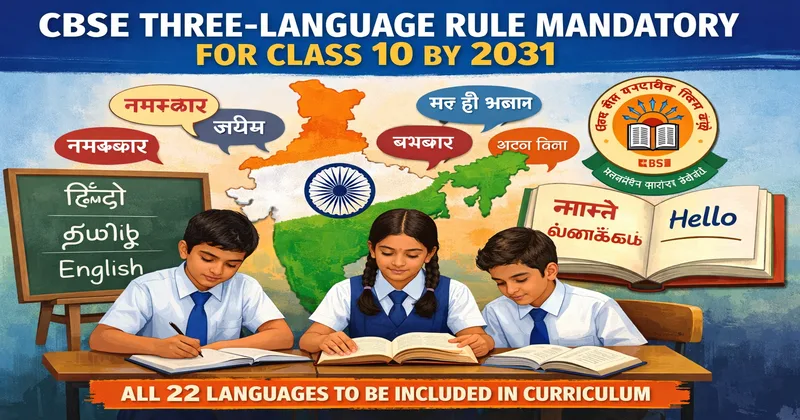
Representative Image (This is an AI Generated image)

Representative Image (This is an AI Generated image)

FacebookTwitterWhatsAppTelegramEmail

To align the school education with national policy goals, the Central Board of Secondary Education (CBSE) has unveiled a revised curriculum for the academic session 2026  to 2027, introducing sweeping changes across Classes 9 to 12. Among the most notable reforms is the gradual implementation of a compulsory third language, which will eventually become part of the Class 10 board examination system by 2031. As per the National Education Policy 2020 (NEP 2020), the three-language formula is to be adopted to promote multilingualism and cultural integration among students.

Under the new curriculum framework, CBSE has made it mandatory for students in Class 6 to study a third language in addition to the existing two-language system. This will be the beginning of a phased transition toward a full-fledged three-language model in secondary education. Currently, students typically study two languages, usually English and one Indian language. With the addition of a third language (referred to as R3), students will now be exposed to a broader linguistic base early in their academic journey.

According to CBSE officials, textbooks and learning materials for the third language are being developed in collaboration with the National Council of Educational Research and Training (NCERT). These resources will be made available on the CBSE Academic Portal in the coming weeks. While the third language has been introduced at the middle school level, it will not immediately impact the board examinations. Instead, the policy will take full effect when the current batch of Class 6 students reach Class 10 in 2031.

Also Read China sees wave of unrest as residents clash with police over projects and governance, security tightened in Beijing

One of the key concerns revolves around the interpretation of the three-language formula, particularly the requirement that students learn at least two Indian languages. In practice, many students already study English as one of their primary languages. However, under NEP 2020, English is often categorised as a foreign language. This raises questions about whether students will be required to study two additional Indian languages alongside English. This might potentially increase the academic pressure.

Recognising the unique challenges faced by CBSE-affiliated schools abroad, the board has provided certain relaxations. Schools located outside India will not be strictly required to offer two Indian languages. Instead, these institutions will have the flexibility to include one Indian language as a compulsory subject, while allowing students to choose other languages based on regional or international relevance.

Integration of Skill-Based and Holistic Learning

In addition to language reforms, CBSE has introduced several changes to promote holistic and skill-based education. Art education, vocational studies, and physical education are set to become mandatory components of the curriculum for Classes 9 and 10. For the time being, art and physical education will be assessed internally by schools and will not be part of the board examination. However, vocational education will be introduced as a compulsory subject starting from the 2027-28 academic session.

Another major highlight of the new curriculum is the inclusion of computational thinking and artificial intelligence (AI) as compulsory subjects for Classes 9 and 10. Initially, these subjects will be introduced as modules with internal assessments. However, CBSE plans to elevate them to full-fledged board examination subjects by 2029.

CBSE has also introduced a two-tier system for Mathematics and Science at the Class 9 level. Students will have the option to choose between standard and advanced levels, depending on their aptitude and interest. Those opting for the advanced level will be required to take an additional one-hour exam worth 25 marks that covers content beyond the common syllabus. The results of this advanced assessment will appear on the student’s marksheet only if they successfully clear it.

According to Praggya Singh, Director (Academics) at the Central Board of Secondary Education, textbooks are being developed jointly with the National Council of Educational Research and Training (NCERT), ensuring standardised, high-quality learning material for students. The Board has also provided flexibility for CBSE-affiliated schools operating outside India. Unlike schools within the country, which are required to offer two Indian languages, international schools will only need to provide one Indian language as a compulsory subject, making the policy more adaptable to global contexts.

Further, the revised curriculum reinforces guidelines issued in a CBSE circular last year, mandating that schools must include at least one Indian language as an option for the medium of instruction from the preparatory stage through Class 12.

Also, to promote linguistic diversity, CBSE has expanded its language offerings. From the current academic session, students in Class 9 will have the option to study languages such as Dogri, Maithili, Konkani, and Santhali. With this addition, the Board will now cover all 22 languages listed in the Eighth Schedule of the Indian Constitution.

The reforms direct towards a gradual but comprehensive transformation of CBSE’s assessment framework. By introducing internal assessments, modular subjects, and advanced-level options, the board is moving away from a one-size-fits-all approach toward a more flexible and student-centric model.
Topics: Three-language ruleCBSECentral Board of Secondary Education
ShareTweetSendShareSend
✮ Subscribe Organiser YouTube Channel. ✮
✮ Join Organiser's WhatsApp channel for Nationalist views beyond the news. ✮
Previous News

Assam Election | Forget my arrest; Rahul Gandhi won’t be able to harm a hair on my head in next seven lives: Himanta

Next News

Happiness Index Under Fire: Questions raised over India’s low ranking

Related News

Congress Era of paper leaks (This is an AI generated image)

Congress era and the recurring challenge of paper leaks: A look back at 2004-2014; Were resignations asked then?

ABVP’s National Executive Council Meeting began in Bhubaneswar with Prof. Raghuraj Kishore Tiwari, Dr Virendra Singh Solanki and Shri Ashish Chauhan inaugurating the event

ABVP National Executive Council Meet: “Three-language policy to strengthen Indian languages,” says Dr Virendra Singh

CBSE introduces three language reform (This is an AI generated image)

Sanskrit favoured with three language formula in CBSE schools

The three language formula as a bridge to India’s linguistic unity

CBSE Revises Class 12 Assessment Amid West Asia Tensions

CBSE rolls out alternative evaluation plan for Class 12 students in West Asia

Representative Image

CBSE makes career counsellors mandatory in schools: Why India needs trained guidance experts

Load More

Latest News

New York anti-Hindu Bill fails to advance: How the bill fueled bias & espoused caste discrimination

Beyond Alignment: How India is Carving Its Own Strategic Space Amid Global Power Play

Beyond Alignment: How India is Carving Its Own Strategic Space Amid Global Power Play

Chinese President Xi Jinping, Russian President Vladimir Putin and Prime Minister Narendra Modi

China’s New Tone Towards India: Tactical shift or strategic necessity? What Beijing’s push for RIC ties really signals

Keralam’s 2026 Fiscal Health White Paper has unveiled a mounting debt burden of Rs 5.07 lakh crore, exposing deep structural challenges in the state’s economy

Keralam’s Financial Reality Check: White Paper exposes Rs 5.07 lakh crore debt crisis

Tamil Nadu: TVK government arrests YouTuber Maridhas; BJP alleges crackdown on dissent

‘Every grave or dargah is not automatically Waqf property’: Madras High Court’s landmark verdict

US Court strikes down Trump’s $100,000 H-1B fee as executive overreach; Lawmakers & Republicans welcome the verdict

Union Defence Minister Rajnath Singh

Uttar Pradesh: Defence land goes green; Rajnath Singh clears 250 MW solar project in Sitapur

Afghanistan Foreign Minister Amir Khan Muttaqi and External Affairs Minister Dr. S. Jaishankar(File Photo)

India extends gratis long-term business visas to Afghan traders; Slams Pakistan for “trade & transit terrorism”

How Modi's Zero-tolerance doctrine reshaped India's anti-terror policy (This is an AI generated image)

Twelve Years of Modi Government and the rise of India’s zero-tolerance doctrine against terrorism

Load More
  • Privacy
  • Terms
  • Cookie Policy
  • Refund and Cancellation
  • Delivery and Shipping

© Bharat Prakashan (Delhi) Limited.
Tech-enabled by Ananthapuri Technologies

  • Home
  • Search Organiser
  • Bharat
    • Assam
    • Bihar
    • Chhattisgarh
    • Jharkhand
    • Maharashtra
    • View All States
  • World
    • Asia
    • Africa
    • North America
    • South America
    • Europe
    • Australia
  • Editorial
  • Operation Sindoor
  • Opinion
  • Analysis
  • Defence
  • Culture
  • Sports
  • Business
  • RSS @ 100
  • Entertainment
  • More ..
    • Sci & Tech
    • Vocal4Local
    • Special Report
    • Education
    • Employment
    • Books
    • Interviews
    • Travel
    • Health
    • Politics
    • Law
    • Economy
    • Obituary
  • Subscribe Magazine
  • Read Ecopy
  • Advertise
  • Circulation
  • Careers
  • About Us
  • Contact Us
  • Policies & Terms
    • Privacy Policy
    • Cookie Policy
    • Refund and Cancellation
    • Terms of Use

© Bharat Prakashan (Delhi) Limited.
Tech-enabled by Ananthapuri Technologies